
Disregard Everything I Say
Month
Dosage (oral)
Threshold: 100mg
Light: 100 - 300mg
Common: 300 - 600mg
Strong: 600 - 900mg
Heavy: 900mg +
Duration (oral)
Total duration: 5 - 6 hours
Onset: 1 - 2 hours
Peak: 2 - 3 hours
Come down: 1 - 2 hours
After effects: 2 - 3 hours
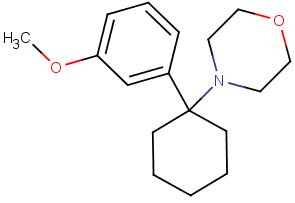
3-MeO-PCMo (4-[1-(3-methoxyphenyl)cyclohexyl]morpholine) is a new morpholine analogue of 3-MeO-PCP. It is a dissociative NMDA receptor antagonist and anesthetic drug of the arylcyclohexylamine chemical class with a potency of less than 1/10th of that of 3-MeO-PCP.
This compound induces a state referred to as “dissociative anesthesia” when ingested and is therefore used as a recreational drug. 3-MeO-PCMo has recently become freely available through online research chemical vendors[1] where it is being sold as a designer drug.
Although very little is known about this compound, similar morpholine analogues of phencyclidine have been researched before.[2][3]
In terms of its chemistry, 3-MeO-PCMo, or 4-[1-(3-methoxyphenyl)cyclohexyl]morpholine, is classified as an arylcyclohexylamine
drug. Ayrlcyclohexylamine drugs are named for their structures which
include a cyclohexane ring bound to an aromatic ring along with an amine
group at the same location. The aryl substituent of 3-MeO-PCMo is a
phenyl ring with a methoxy (CH3-O-) substituent at R3, which is bound to a six-membered cyclohexyl ring. Bound at the same location on the cyclohexyl ring R1 is an amine group which is incorporated into a morpholine ring as R4. Morpholine is a six-membered heterocyclic ring with an oxygen subsitutent at R1. 3-MeO-PCMo is a morpholine analogue to 3-MeO-PCP, which lacks an oxygen moiety in its six-membered amine ring (a piperidine ring instead of a morpholine ring).
In terms of its pharmacology, due to the lack of research regarding the substance, all discussion regarding the pharmacology of it is purely based on its structure and subjective effect similarities to other arylcyclohexylamine dissociatives such as 3-MeO-PCP, PCP and MXE. With this in mind, 3-Meo-PCMo is thought to act as an NMDA receptor antagonist. NMDA receptors allow for electrical signals to pass between neurons in the brain and spinal column; for the signals to pass, the receptor must be open. NMDA receptor antagonists close the NMDA receptors by blocking them. This disconnection of neurons leads to loss of feeling, difficulty moving, and eventually the famous “hole.”
The effects listed below are based upon the subjective effects index and personal experiences of PsychonautWiki contributors. The listed effects will rarely (if ever) occur all at once, but heavier dosages will increase the chances and are more likely to induce a full range of effects.
Physical effects:
The subjective physical effects of 3-MeO-PCMo can be broken down into several components which progressively intensify proportional to dosage. These are described below and generally include:
Cognitive effects:
The general head space of 3-MeO-PCMo is often described as simplistic and shallow in comparison to that of MXE and ketamine. The specific cognitive effects can be broken down into several separate subcomponents which are listed and described below:
Visual effects:
Suppressions:
This substance does not enhance visual stimuli; instead, it tends to degrade and decrease visual aptitude in a variety of ways which generally include:
Distortions:
The visual geometry found within 3-MeO-PCMo can be described as very dark and bland when compared to that of ketamine or DXM. It often consists of many tiny interlocking and woven lines. It does not extend beyond level 4 geometry and can be comprehensively described through its variations as simplistic in complexity, algorithmic in style, synthetic in feel, unstructured in organization, dimly lit in lighting, multicoloured in scheme, glossy in shading, soft in edges, small in size, slow in speed, smooth in motion, equal in rounded and angular corners, immersive in depth and consistent in intensity.
Auditory effects:
Physical health effects, potential addiction and tolerance:
The toxicity and long-term health effects of recreational 3-MeO-PCMo
use have not been studied in any scientific context and the exact toxic
dose is unknown. This is because 3-MeO-PCMo is a research chemical with
very little history of human usage. Anecdotal evidence from people who
have tried 3-MeO-PCMo within the psychonaut community suggests that
there are no negative health effects attributed to simply trying this
drug at low to moderate doses or using it very sparingly (but nothing
can be completely guaranteed).
There is a tolerance build up with 3-MeO-PCMo which results in the need to consume increasingly large doses in order to achieve the same level of effects. This should reset to baseline after 1 - 2 weeks. There may be some addictive potential, but this is still unknown.
In terms of its long-term health effects when used repeatedly and with excess for extended periods of time, 3-MeO-PCMo seems to exhibit almost identical bladder and urinary tract problems to those found within ketamine, MXE and other arylcyclohexylamines, but to an even more extreme extent. This is because 3-MeO-PCMo is 50% less potent than that of ketamine which means significantly more of the drug must be consumed in order to achieve the same effects. Symptoms of 3-MeO-PCMo-induced cystitis can become extremely serious and can be described as:
All of these, however, can easily be avoided by simply not using
3-MeO-PCMo on a daily or even weekly basis and manually limiting one’s
usage of the substance.
Legal issues:
3-MeO-PCMo is currently a legal grey area drug worldwide and is freely available through the use of online research chemical vendors. However, this does not guarantee anyone to be immune from legal prosecution should they be found in possession of this substance as the legality is likely to vary from country to country.
Within the U.K. specifically, as 3-MeO-PCMo is the morpholine analogue of 3-MeO-PCP,
it is therefore an arylcyclohexylamine (ACH) that is not controlled in
the U.K. because a morpholine substituion on the amine is not proscribed
by the country’s generic ACH laws.
Conclusion:
3-MeO-PCMo is by far the closest experience to that of MXE or ketamine currently available in the U.K. legal research chemical market. Its absurd lack of potency, however, makes it unusable for regular usage due to its proportionally adverse effects on the bladder.
This substance breakdown was written through collaboration between PsychonautWiki contributors Kaylee, Josikins and Oscarette. The full article is available here.
Dosage (oral)
Threshold: 50 - 75mg
Light: 75 - 110mg
Common: 110 - 150mg
Strong: 150 - 200mg
Heavy: > 200mg +
Duration (oral)
Total duration: 5 - 7 hours
Onset: 10 - 30 minutes
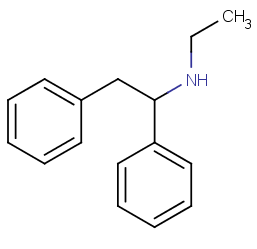
Ephenidine (N-Ethyl-1,2diphenylethylamine) is a dissociative NMDA receptor antagonist and anesthetic drug of the phenethylamine chemical class. It has similar effects to that of the arylcyclohexylamine and morphinan classes of dissociatives.
This compound induces a state referred to as “dissociative anesthesia”
and is used as a recreational drug. Very little is known about this
substance, but it has recently become freely available through online research chemical
vendors where it is being sold as a designer drug. Due to the lack of
research regarding the substance, all discussion regarding the
pharmacology of it is purely based on its structure and subjective effect similarities to other piperidine dissociatives such as diphenidine and methoxphenidine.
In terms of its chemistry, ephenidine is a molecule of the diarylethylamine class. It contains a substituted phenethylamine skeleton with an additional phenyl ring bound to Rα. An ethyl chain is bound to the terminal amine RN of the phenethylamine. Ephenidine is structurally analogous to diphenidine and MXP, but is not a piperidine dissociative. Ephenidine shares a diphenylethylamine skeleton with diphenidine and MXP, but lacks a piperidine substitution.
In terms of its pharmacology, no formal studies have been carried out. However, ephenidine is thought to act as an NMDA receptor antagonist due to its structural similarities to diphenidine. NMDA receptors allow for electrical signals to pass between neurons in the brain and spinal column; for the signals to pass, the receptor must be open. NMDA receptor antagonists close the NMDA receptors by blocking them. This disconnection of neurons leads to loss of feeling, difficulty moving, and eventually the famous “hole.” This compound induces considerable stimulation at higher doses which suggests that it might function as a serotonin, dopamine and noradrenaline reuptake inhibitor in a similar manner to other dissociatives.
The effects listed below are based upon the subjective effects index and personal experiences of PsychonautWiki contributors. The listed effects will rarely (if ever) occur all at once, but heavier dosages will increase the chances and are more likely to induce a full range of effects.
Physical effects:
The subjective physical effects of ephenidine can be broken down into
several components which progressively intensify proportional to
dosage. These are described below and generally include:
Cognitive effects:
The general head space of ephenidine is often described as particularly euphoric and clear-headed in comparison to that of DXM and ketamine. The specific cognitive effects can be broken down into several separate subcomponents which are listed and described below:
Visual effects:
Suppressions:
This substance does not enhance visual stimuli; instead, it tends to degrade and decrease visual aptitude in a variety of ways which generally include:
Distortions:
Ephenidine exhibits a full array of dissociative distortions and alterations in visual perception which generally includes:
Geometry:
The visual geometry found within ephenidine can be described as very distinct and psychedelic when compared to that of ketamine, MXE, methoxphenidine and diphenidine. It is considerably less detailed than that of DXM. It does not extend beyond level 5 and can be comprehensively described through its variations
as simplistic in complexity, algorithmic in style, synthetic in feel,
unstructured in organization, dimly lit in lighting, multicoloured in
scheme, glossy in shading, soft in edges, small in size, slow in speed,
smooth in motion, equal in rounded and angular corners, immersive in
depth and consistent in intensity.
Hallucinatory states:
At high doses, ephenidine can produce a full range of high level hallucinatory states in a fashion that is less consistent and reproducible than that of many other commonly used psychedelics. These effects include:
Auditory effects:
The auditory effects are common in their occurrence and exhibit a range of effects which commonly includes:
Physical health effects, potential addiction and tolerance:
The toxicity and long-term health effects of recreational ephenidine use have not been studied in any scientific context and the exact toxic dosage is unknown. This is because ephenidine is a research chemical with very little history of human usage. Anecdotal evidence from people who have tried ephenidine within the psychonaut community suggests that there are no negative health effects attributed to simply trying this drug at low to moderate doses or using it very sparingly (but nothing can be completely guaranteed).
There is a very strong tolerance build up with ephenidine which results in the need to consume increasingly large doses in order to achieve the same level of effects. This should reset to baseline after 1 - 2 weeks. There may be some addictive potential, but this is still unknown.
Legal issues:
Ephenidine is currently a legal grey area drug worldwide and is
freely available through the use of online research chemical vendors.
However, this does not guarantee anyone to be immune from legal
prosecution should they be found in possession of this substance as the
legality is likely to vary from country to country.
Conclusion:
In conclusion, ephenedine is a deeply profound dissociative which presents a full range of effects at high enough doses. Although it is not an MXE replacement, it is perhaps the best novel dissociative to recently arrive on the legal research chemical scene and is superior to that of diphenidine or MXP in my opinion.
This substance breakdown was written through collaboration between PsychonautWiki contributors Kaylee, PJosepherum, Josikins and Oscarette. The full article is available here.