Disregard Everything I Say
Month
Dosage (oral)
Threshold : 3 - 5 mg
Light : 10 - 20 mg
Common : 15 - 30 mg
Strong : 10 - 50 mg
Heavy : 25 - 60mg
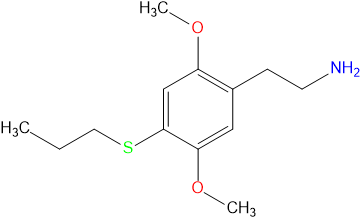
In terms of its chemistry, 2C-T-7 is a substituted phenethylamine with methoxy groups attached to carbons R2 and R5as well as a sulfide chain attached to carbon R4.
In terms of its pharmacology, 2C-T-7 has efficacy at the 5-HT2A receptor as a partial agonist. This is a mechanism of action shared by all of the hallucinogenic tryptamines and phenethylamines. Along side of this, as the 2,5-desmethoxy derivative of 2C-T-7 has been shown to be a moderate monoamine oxidase A inhibitor, this substance may likewise have MAOI effects.
2C-T-7 is a highly dose sensitive psychedelic known for its strong visuals and intense body load. Many reports also indicate that the effects of this chemical may be overly intense for those who are not already experienced with psychedelics. The experience contains a complex and wide array of effects which based on the predefined potential subjective effects index found here, I will now begin to breakdown and describe.
Physical effects:
The physical effects of 2C-T-7 can be broken down into six components all of which progressively intensify proportional to dosage. These are described below and generally include:
Cognitive effects:
The head space of 2C-T-7 is described by many as one which is both insightful and relatively normal in its thought processes even at moderate to high dosages.
The total sum of these cognitive components regardless of the setting generally includes:
Visual effects:
Enhancements
2C-T-7 presents a full and complete array of possible visual enhancements which generally includes:
Distortions
2C-T-7 presents a full and complete array of possible visual distortions which generally includes:
Geometry
The visual geometry that is present throughout this trip can be described as more similar in appearance to that of 4-AcO-DMT or Ayahuasca than that of LSD, 2C-B or 2C-I. They can be comprehensively described as structured in their organization, organic in geometric style, intricate in complexity, large in size, fast and smooth in motion, colourful in scheme, glossy in colour, sharp in their edges and equally rounded and angular in their corners. They give off a contradictory natural and synthetic feel with slightly more mystical and shamanic undertones to them in comparison to other phenethylamines. At higher dosages they are equally likely to result in states of Level 7A visual geometry and Level 7B. There seems to be visual geometry that is extremely similar to 2C-E and 2C-P and can be described as equal in intensity or complexity and equal in proportion to the accompanying cognitive and physical effects.
Hallucinatory states
2C-T-7 produces a full range of high level hallucinatory states in a fashion that is more consistent and reproducible than that of many other commonly used psychedelics. This holds particularly true in comparison to other substances within the phenethylamine family. These effects include:
Auditory effects
The auditory effects of 2C-T-7 are more common in their occurrence than many more commonly used psychedelics and exhibit a full range of effects which commonly includes:
Health effects, addiction potential and tolerance:
The toxicity and long term health effects of recreational 2C-T-7 use does not seem to have been studied in any scientific context and the exact toxic dosage is unknown. This is because 2C-T-7 is a research chemical with very little history of human usage. Anecdotal evidence from people who have tried 2C-T-7 within the psychedelic community suggests that there are no negative health effects attributed to simply trying this drug at low to moderate doses or using it very sparingly (but nothing can be completely guaranteed).
2C-T-7 does not seem to be physically addictive and many users experience a self regulating quality. There seems to be a tolerance build up when used consecutively multiple days in a row which requires one to double their dosage each time to achieve the same effects.
There is no current data for the LD50 of 2C-T-7, but it is thought to be high. Erowid does however have some annecdotal information on fatal dosages occurring at 35mg+ of insufflated dosages.
If 2C-T-7 does have MAOI effects, this could indicate that 2C-T-7 is more likely to induce serotonin syndrome, especially at high dosages, than other serotonergic hallucinogens. This may make it dangerous to combine with certain substances such as MDMA, AMT, Ayahuasca or any substance which releases neurotransmitters such as serotonin or those with similar pharmocological effects.
Legal issues:
Conclusion:
2C-T-7 shows incredible depth on both an insightful and a recreational level with a full spectrum of deep psychedelic effects. It is completely worthy of its position within the magical half dozen and an extremely versatile compound. I would recommend this experience to anybody willing to try it in a safe and sensible manner.
This substance breakdown was written in collaboration with PsychonautWiki admin PJosepherum. For a more detailed breakdown please click the here.
Dosage:
Threshold : 0.2 mg
Light : 0.2 - 0.75 mg
Common : 0.75 - 1.75 mg
Strong : 1.75 - 2.5 mg
Heavy : 2.5 - 3.5 mg+
Duration:
Total duration : 7 - 17 hours
Onset / Initial effects : 30 - 90 mins
Coming up : 60 - 90 mins
Peak : 3 - 8 hrs
Coming down : 3 - 8 hrs
After effects : 4 - 8 hrs
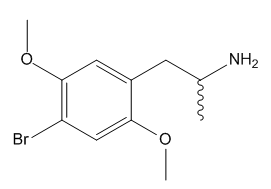
Dimethoxybromoamphetamine (DOB), also known as Brolamfetamine and Bromo-DMA, is a psychedelic substituted alpha-methylated phenethylamine, a class of compounds commonly known as amphetamines. The phenethylamine equivalent of this substance (lacking the alpha-methyl group) is 2C-B.
This substance has no history of human usage prior to the 1991 publication of its synthesis and pharmacology in the book PiHKAL (Phenethylamines i Have Known And Loved) by Alexander Shulgin. In modern times it is used as a recreational drug and an entheogen, rarely sold on the streets and almost exclusively obtained as a grey area research chemical through the use of online vendors. It was first synthesized by Alexander Shulgin and described in his 1991 book.
In terms of its pharmacology, this substance acts as a selective 5-HT2A, 5-HT2B, and 5-HT2C receptor partial agonist. Its psychedelic effects are thought to be mediated via its actions on the 5-HT2A receptor.
The DOB experience contains a complex and wide array of effects which based on the predefined potential subjective effects index found here, I will now begin to breakdown and describe.
Physical effects:
The physical effects of DOB can be broken down into six components all of which progressively intensify proportional to dosage. These are described below and generally include:
Cognitive effects:
The head space of DOB is described by many as one of mental stimulation and a powerful enhancement of a person’s current mental state. Many user report that it may not be as deep as other traditional psychedelics such as LSD or Psilocin and that it is comparatively empty in terms of its insightfulness.
The total sum of these cognitive components regardless of the setting generally includes:
Visual effects:
Enhancements
DOB presents a full and complete array of possible visual enhancements which generally includes:
Distortions
DOB presents a full and complete array of possible visual distortions which generally includes:
Geometry
The visual geometry that is present throughout this trip can be described as more similar in appearance to that of LSD, 25I-NBOME or 2C-B than that of Ayahuasca, Psilocin or 2C-E. They can be comprehensively described as unstructured in their organization, algorithmic in geometric style, intricate in complexity, small in size, fast and smooth in motion, colourful in scheme, glossy in colour, sharp in their edges and equally rounded and angular in their corners. They give off a synthetic feel to them that at higher dosages are significantly more likely to result in states of Level 7A visual geometry over Level 7B.
Hallucinatory states
DOB is capable of producing a full range of low and high level hallucinatory states in a fashion that is significantly less consistent and reproducible than that of many other commonly used psychedelics. These effects include:
Auditory effects:
The auditory effects of DOB are common in their occurrence and exhibit a full range of effects which commonly includes:
Health effects, addiction potential and tolerance:
The toxicity and long term health effects of recreational DOB use do not seem to have been studied in any scientific context and the exact toxic dosage is unknown. This is because DOB is a research chemical with very little history of human usage. Anecdotal evidence from people who have tried DOC within the psychedelic community suggests that there are no negative health effects attributed to simply trying this drug at low to moderate doses or using it very sparingly but nothing can be completely guaranteed.
DOB is not physically addictive and many users experience a frequency self-regulating quality to the drug. Tolerance for DOC seems to be very mild and does not build up without repeated use over a short period of time.
Legal Issues:
Conclusion:
Although DOB could be considered as bland and generic in comparison to DOC and other more traditional psychedelics, it is still a worthwhile experience and perfect for recreational events. This substance can be generally described as a less insightful version of LSD with a longer duration, generic visual and an emptier headspace.
Click here for a more comprehensive breakdown.
Dosage:
Threshold : 100 µg
Light : 100 - 300 µg
Common : 350 - 700 µg
Strong : 700 - 1500 µg
Duration:
Total duration : 8 - 10 hrs
Onset / Initial effects : 15 - 60 mins
Coming up : 60 - 120 mins
Peak : 3 - 4 hrs
Coming down : 1 - 2 hrs
After effects : 5 - 24 hrs
25B-NBOMe can be fatal at heavy doses.[1] It is strongly discouraged to take large amounts of this substance or to snort it.
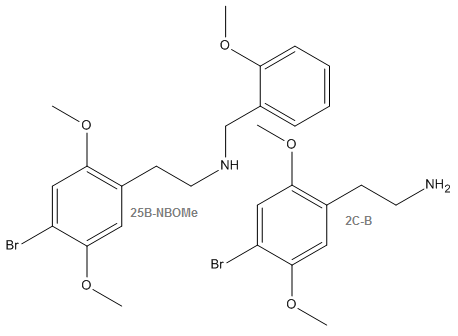
25B-NBOMe or 2C-B-NBOMe is a serotonergic N-benzyl derivative of the substituted phenethylamine psychedelic known as 2C-B.
It has nearly no history of human use prior to 2010 when it first became popular due its ease of purchase from online research chemical vendors.
25B-NBOMe has efficacy at the 5-HT2A receptor where it acts as a potent partial agonist. It was discovered in 2003 by Ralf Heim at the Free University of Berlin, it differs from 2C-B structurally through a substitution on the amine (NH2) with a 2-methoxybenzyl (BOMe) group as shown in the image above. This change in structure results in roughly a sixteen fold increase in potency when compared to 2C-B, allowing even the most extreme of dosages to fit in liquid form onto tabs and blotter paper (which people often mistake for LSD).
There are, however, methods of differentiating between LSD and adulterants like 25B-NBOMe with and without test kits.
For example, one of the key differences between 25B-NBOMe and LSD is that this substance is only active when taken through a sublingual or insufflated route. This means that in order to get the full effects, 25B-NBOMe blotter paper must be lightly chewed on within the mouth for 10 - 20 minutes and never immediately swallowed.
Insufflation, however, is not recommended due to the amount of people who have suffered through dangerous and often fatal overdoses due to this route of administration.
The 25B-NBOMe experience contains a complex and wide array of effects which based on the predefined potential subjective effects index found here, I will now begin to breakdown and describe.
Physical effects:
The physical effects of 25B-NBOMe can be broken down into six components all of which progressively intensify proportional to dosage. These are described below and generally include:
Cognitive effects:
The head space of 25B-NBOMe is described by many as remarkably light and underwhelming in comparison to the classical psychedelics. It is not uncommon for people to report feeling that their thought stream has maintained general normality in its specific style throughout low to moderate dosages. At high dosages however, mild to overwhelming cognitive alterations become present.
The most prominent of these cognitive effects generally include:
Visual effects:
Enhancements
25B-NBOMe presents a full and complete array of possible visual enhancements which generally includes:
Distortions
The visual distortions and alterations which are experienced are detailed below:
Geometry
The visual geometry that is present throughout this trip is often described as similar in appearance to that of LSD. They can be comprehensively described as algorithmic in geometric style, intricate in complexity, fine and zoomed out in detail, fast and smooth in motion, structured in shape, colourful in scheme, glossy in colour, sharp around the edges and mostly rounded across their corners. In comparison to other more commonly used psychedelics they can be described as significantly more intricate than the visual geometry found within 2C-I and most of the 2C-x family in general as well as completely on par with LSD, Psilocin and DMT at appropriately high dosages.
In terms of their behaviour, 25B-NBOMe’s geometry leads onto Level 7A visual geometry with Level 7B remaining so far unconfirmed within this substance. They also seem to consistently build up in visual intensity when the tripper stares at a central point. This eventually envelops the visual field and creates the sensation that the tripper has broken through into a continuously shifting geometric landscape or structure with a vast sense of immersive physical size attributed to it.
Hallucinatory states
25B-NBOMe is capable of producing a full range of hallucinatory states within the level 1 - 3 range extremely consistently. However, level 4 hallucinatory breakthroughs are reported but very uncommon and inconsistent in comparison to other more commonly used psychedelics such as psilocin, 2C-E and DMT.
These effects include:
Auditory effects:
The auditory effects of 25B-NBOMe are common in their occurrence and exhibit a full range of effects which commonly includes:
Health effects, addiction potential and tolerance:
25B-NBOMe is a very new substance and little is known about its pharmacological or behavioural risks. The LD50 is not known. Some deaths have been attributed to 25B-NBOMe overdose caused by improper handling and uneducated use of this substance. Its recent widespread use suggests that death is primarily caused from overdoses and not from ordinary doses, particularly from insufflation.
The fact that 25B-NBOMe is active in the microgram range is likely a contributing factor since this makes measuring doses significantly more difficult.
In terms of its addictive potential, 25B-NBOMe has not been studied formally but due to its immediate tolerance build up which lasts up to 2 - 3 weeks after the experience, it is essentially impossible to use this substance compulsively.
Legal issues:
Conclusion:
As for the substance itself, 25B-NBOMe and the NBOMe series as a whole are an extremely interesting set of psychedelics but do not quite compare in terms of hallucinatory and cognitive depth if you have access to classical psychedelics such as genuine LSD, DMT and psilocin.
Please let me know if you agree or disagree with any particular points contained within this article by using the comment system below.
Click here for a more comprehensive article.
It may seem that I have been inactive recently due to a general lack of new original posts but I and others have been working extremely hard on overhauling and expanding upon the content within both DEIS and PsychonautWiki. This post is essentially a list of specific updates to inform my readers on the progress, changes and future of this website which can be found below:
As for the future, we are currently in the process of working on a full release for PsychonautWiki and have ten or so individual psychedelic substance breakdowns to post over up the upcoming weeks.
Thanks for reading and have a nice day <3