
Disregard Everything I Say
Month
Today marks three years since the start of DEIS. We would like to thank each and every one of you for the balls you have tripped, your support and your contributions. Much love to all of you!!! ♡ ♡ ♡ (• ε •)
Sorry for the lack of new content around here recently, you can be expecting many posts and updates very soon. In the mean time, for frequent updates, an active community and a far superior website, please visit our ongoing project www.PsychonautWiki.org


Dosage (oral):
Threshold : 20 - 30mg
Light : 60 - 100mg
Common : 100 - 175mg
Strong : 175 - 300+mg
Duration (oral):
Onset : 20 - 70 minutes
Peak : 3 - 5 hours
Coming down : 3 - 4 hours
After effects : 24 hours
MDAI (5,6-Methylenedioxy-2-aminoindane) is a drug developed in the 1990s by a team led by David E. Nichols at Purdue University. It acts as a non-neurotoxic and highly selective serotonin releasing agent (SSRA) which produces entactogen effects in humans similar to that of MDMA.
In terms of its chemistry, the chemical structure of MDAI is indirectly derived from that of the illicit drug MDA, but the alpha-methyl group of the alkylamino amphetamine side chain has been bound back to the benzene nucleus to form an indane ring system. This changes its pharmacological properties substantially.
In terms of its pharmacology, MDAI has been shown to inhibit the reuptake of serotonin, dopamine, and norepinephrine. This demonstrates that MDAI has selective affinity for the serotonin receptor. Studies show that the brains of animals treated with MDAI have greater extracellular concentrations of monoamine neural transmitters, most significantly serotonin. This result indicates that MDAI is a potent releaser of serotonin while effectively inhibiting the reuptake of serotonin. For comparison, MDAI is similar in potency with releasing serotonin to MDA but significantly less potent than MDMA.
The effects listed below are based upon the subjective effects index and personal experiences of PsychonautWiki contributors. The listed effects may rarely if ever occur all at once but heavier dosages will increase the chances and are more likely to induce a full range of effects.
Physical Effects:
The physical effects of MDAI can be broken down into seven components all of which progressively intensify proportional to dosage. These are described below and generally include:
Cognitive Effects:
The cognitive effects of MDAI can be broken down into four components all of which progressively intensify proportional to dosage. The general head space of MDAI is described by many as one of euphoria and feelings of love or empathy. It contains a number of typical entactogenic cognitive effects.
The most prominent of these cognitive effects generally include:
Visual effects:
The visual effects of MDAI only occur at higher dosages and are subtly psychedelic. These generally include:
Physical Health Effects, Potential Addiction and Tolerance:
MDAI and other similar drugs have been widely used in scientific research, as they are able to replicate many of the effects of MDMA but without causing the neurotoxicity which may be associated with MDMA and some related drugs. No tests have been performed on cardiovascular toxicity.
There is currently no scientific data on the lethal dosage of MDAI within human beings but it is thought to be high in comparison to its active dosage. Due to its action as a serotonin reuptake inhibitor, overdoses of this substance would likely result in acute or even fatal serotonin syndrome.
The tolerance to MDAI builds up with repeated usage in much the same way that MDMA does. There does not seem to be any addictive potential but long term usage could potentially lead onto it.
Legal issues:
MDAI is currently a legal grey area world wide and freely available through the use of online research chemical vendors. This does not mean that you are guaranteed to be immune from legal prosecution should you be found in possession of this substance as it is likely to vary from country to country.
Conclusion:
In conclusion, MDAI is an extremely interesting alternative to MDMA due to its lack of neurotoxic effects and minimal dopamine reuptake inhibition. I would suggest this compound to anybody who wishes to experience the profound therapeutic entactogenic effects of MDMA without the stimulation or neurotoxicity. I would recommend the use of 5-HTP serotonin supplements the day after heavy MDAI usage to further mitigate its unlikely adverse effects .
This substance breakdown was written through collaboration between PsychonautWiki administrators Josikins and Oscarette. The full article is available here.
Dosage (oral):
Threshold : 5 - 10mg
Light : 10 - 20mg
Common : 20 - 30mg
Strong : 30 - 40mg
Heavy : 40mg+
Duration (oral):
Total Duration : 4 - 6 hours
Onset : 20 - 60 minutes
Peak : 1 - 2 hours
Coming down : 2 - 4 hours
After effects : 1 - 5 hours
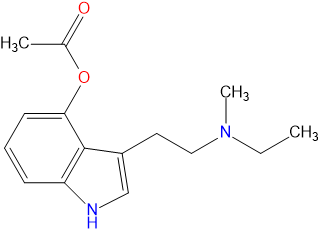
4-Acetoxy-MET (4-Acetoxy-N-methyl-N-ethyltryptamine, metacetin or 4-AcO-MET) is a psychedelic tryptamine thought to be a serotonergic psychedelic similar to 4-AcO-DMT, LSD and DMT. Its molecular structure and pharmacological effects resemble those of the tryptamine psilocin which is the primary psychoactive chemical in magic mushrooms.
In terms of its chemistry, 4-AcO-MET is the acetate ester of 4-HO-MET. It is a substituted tryptamine with an acetoxy group at the 4 position of the cyclohexane ring, an ethyl chain and a methyl chain on the nitrogen position.
It is hypothesized that this compound is quickly hydrolyzed into the free phenolic 4-HO-MET, although human studies concerning the metabolic fate of this drug are lacking. This would explain a somewhat similar experience in their subjective effects. This is similar to how 4-AcO-DMT is thought to be deacetylated to 4-HO-DMT during first pass metabolism and subsequent passes through the liver.
In terms of its pharmacology, 4-AcO-MET’s psychedelic effects are believed to come from its efficacy at the 5-HT2A receptor as a partial agonist. However, the role of these interactions and how they result in the psychedelic experience continues to remain elusive.
4-AcO-MET is commonly sold as a research chemical through the use of online vendors. In terms of its effects, it can be vaguely described as somewhat more synthetic in feel to that of other tryptamines but with a shorter duration.
The effects listed below are based upon the subjective effects index and personal experiences of PsychonautWiki contributors. The listed effects will rarely if ever occur all at once but heavier dosages will increase the chances and are more likely to induce a full range of effects.
Physical Effects:
The physical effects of 4-AcO-MET can be broken down into three components all of which progressively intensify proportional to dosage. These are described below and generally include:
Cognitive Effects:
The cognitive effects of 4-AcO-MET are described by many as somewhat relaxing, yet face-paced in style with similarities to psychedelics such as LSD or 2C-B which tend to be cognitively energetic and stimulating. The drug contains a large number of typical and unique psychedelic cognitive effects.
The most prominent of these typical effects generally include:
Visual effects:
Enhancements
4-AcO-MET presents a full and complete array of possible visual enhancements which generally includes:
Distortions
As for visual distortions and alterations, the effects experienced are detailed below:
Geometry
The visual geometry that is present throughout this trip can be described as somewhat similar in appearance to that of Psilocin, 4-AcO-DMT and 4-HO-MiPT but with far stronger synthetic digital undertones reminiscent of LSD or 2C-B. 4-AcO-MET can be comprehensively described through its variations as intricate in complexity, abstract in form, equally synthetic and organic in style, structured in organization, extremely brightly lit and multicoloured in scheme, glossy in shading, sharp in edges, large in size, fast in speed, smooth in motion, angular in corners, unimmersive in depth and consistent in intensity. The visuals have a contradictory “natural” and “synthetic” feel to them which is reminiscent of both LSD and and Psilocybin. Higher dosages are significantly more likely to result in states of Level 8A visual geometry over Level 8B.
Hallucinatory States
4-AcO-MET and its various other forms produce a full range of high level hallucinatory states in a fashion that is more consistent and reproducible than that of many other commonly used psychedelics. These effects generally include:
Auditory Effects:
The auditory effects of 4-AcO-MET are common in their occurrence and exhibit a full range of effects which commonly include:
Physical Health Effects, Potential Addiction and Tolerance:
The toxicity and long term health effects of recreational 4-AcO-MET use do not seem to have been studied in any scientific context and the exact toxic dosage is unknown. This is because 4-AcO-MET is a research chemical with very little history of human usage. Anecdotal evidence from people who have tried 4-AcO-MET within the psychonaut community suggests that there are no negative health effects attributed to simply trying this drug at low to moderate doses or using it very sparingly (but nothing can be completely guaranteed).
There is no current data for the LD50 of 4-AcO-MET, but it is thought to be high.
4-AcO-MET does not seem to be physically addictive and many users experience a self-regulating quality. There seems to be a tolerance build up when used consecutively multiple days in a row which requires one to double their dosage each time to achieve the same effects.
Legal issues:
USA: 4-Acetoxy-MET is unscheduled in the United States, but the possession and sale of 4-Acetoxy-MET could possibly be prosecuted under the Federal Analog Act if intent to consume can be proven because of its structural similarities to psilocin.
Conclusion:
4-AcO-MET induced a trip which was distinctively different from that of other more commonly used research chemicals that I have tried. The colourful, digital and synthetic geometry was in sharp contrast to that of 4-AcO-DMT, psilocybin and ayahuasca. This combined with its shorter duration and equally insightful headspace made for a therapeutic and recreational experience somewhat halfway between that of mushrooms and LSD.
This substance breakdown was written through collaboration between PsychonautWiki contributors Josikins and Oscarette. The full article is available here.