
Disregard Everything I Say
Month
Dosage
Threshold : 0 - 50 mg
Light : 50 - 100 mg
Common : 100 - 150 mg
Strong : 150 - 200 mg
Heavy : 200 mg+
Duration
Total duration : 6 - 8 hrs
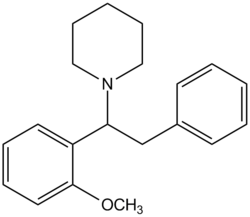
Methoxphenidine (MXP) or 1-[1-(2-methoxyphenyl)-2-phenylethyl]piperidine is a hallucinogenic dissociative compound of the piperdine chemical class. It has similar effects to that of the arylcyclohexylamine and morphinan classes of dissociatives.
It induces a state referred to as “dissociative anesthesia” and is used as a recreational drug. Very little is known about this substance but it has recently become freely available through online research chemical vendors where it is being sold as a designer drug and marketed as a replacement for MXE despite many users reporting it as qualitatively different in its effects and closer to that of DXM. It has yet to be studied within humans in any formal context.
In terms of its chemistry, MXP is classed as a piperdine drug. The piperdine molecule in MXP is attached to a benzene group via two carbon atoms on one side and a methoxybenzene molecule attached to one carbon on the other side. It is usually produced in its freebase form, which is insoluble in water. When consumed orally, the molecule is converted to the hydrochloride salt in the stomach. The HCl salt is reported to raise blood pressure, and peak effects are felt around 2 hours in, whereas the citrate salt has been observed to peak at around 30 minutes with less blood pressure concern. This is the same principal as DXM which is more potent in its citrate salt.
As for its pharmacology, MXP has antagonistic action on NMDA receptors, which leads to anaesthetic and dissociative effects. Although it has not been formally studied, the feelings of physical and emotional euphoria which many users report suggests that it may also have action as a dopamine reuptake inhibitor.
The MXP experience contains a complex and wide array of effects which based on the predefined potential subjective effects index found here, I will now begin to breakdown and describe.
Physical effects:
The subjective physical effects of MXP are most similar to that of DXM than any other commonly used dissociative. They can be broken down into seven components all of which progressively intensify proportional to dosage. These are described below and generally include:
Cognitive effects:
The head space of MXP is often described as particularly clear headed even at heavy dosages. It is far more controllable, less disorientating and confusing at dosages of equal subjective intensity to that of MXE, DXM and Ketamine. The cognitive effects of MXP can be broken down into 6 separate subcomponents which are listed and described below:
Visual effects:
The visual effects of MXP are unique in comparison to other dissociatives as they do not include open eye visual suppression, geometry or distortions but still remain very powerful at appropriate dosages. The present effects progressively intensify according to dosage and commonly include:
Auditory effects:
The auditory effects of MXP are common in their occurrence but unlike other more commonly used dissociatives, they are unlikely to suppress or distort auditory input and exhibit a small range of effects which exclusively includes:
Afterglow:
The afterglow is a feeling that occurs within the 24 hours after the trip itself. It is long lasting and as equally enjoyable as the trip itself to many people. It can be be described in terms of its physical sensation as one of euphoria, rejuvenation, relaxation and a light bounciness. In terms of its mental thought processes however, it can be described as a complete loss of anxiety, feelings of contentedness and an extremely high appreciation for music which dissipates within a day or so after the experience.
Health effects, addiction potential and tolerance:
The toxicity and long term health effects of recreational MXP use does not seem to have been studied in any scientific context and the exact toxic dosage is unknown. This is because MXP is a research chemical with very little history of human usage. Anecdotal evidence from people who have tried MXP within the community suggests that there are no negative health effects attributed to simply trying this drug at low to moderate doses or using it very sparingly (but nothing can be completely guaranteed).
There is a very strong tolerance build up with MXP which results in the need to consume increasingly large doses in order to achieve the same level of effects. This should reset to baseline after 1 - 2 weeks. There may well be some addictive potential but this is still unknown.
Tolerance may be mitigated via preparing the citrate salt by mixing the chemical with citric acid or lemon juice, which will aid in absorption and increase effects.
Legal Issues:
MXP is currently a legal grey area world wide and freely available through the use of online research chemical vendors. This does not mean that you are guaranteed to be immune from legal prosecution should you be found in possession of this substance as it is likely to vary from country to country.
Conclusion:
This new dissociative is an extremely novel, capable and interesting compound. The potential negative effects are currently unknown so tread carefully and start with light dosages if you are so inclined.
This subjective effect breakdown was made in collaboration with PsychonautWiki user, PJosepherum.
Click here for a more comprehensive breakdown.
Dosage (oral)
Threshold : 2-5mg
Light : 5-15mg
Common : 10-25mg
Strong : 20-30mg
Heavy : 30+mg
Duration (oral)
Total duration : 5 - 8 hours
Onset : 20 - 90 minutes
Come up : 20 - 30 minutes
Peak : 3 - 7 hours
Come down : 1 - 2 hours
After effects : 2 - 4 hours
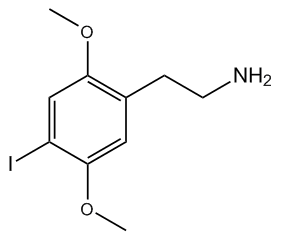
2C-I or 2,5-dimethoxy-4-iodophenethylamine is a psychedelic phenethylamine of the 2C-x family. It was first synthesized by Alexander Shulgin. It was described in Shulgin’s 1991 book PiHKAL: A Chemical Love Story. The drug is used recreationally for its psychedelic and entactogenic effects and is sometimes confused for the analog 25I-NBOMe. 2C-I is commonly sold in its hydrochloride salt form, which is a fluffy, sparkling, white powder, which can sometimes be pressed into tablet form. 2C-I has been explored as a potential stimulant nootropic in doses between 1-8mg.
In terms of its chemistry, 2C-I is a substituted phenethylamine with methoxy groups attached carbons R2 and R5 as well as an iodine molecule attached to carbon R4. It is thought to have efficacy at the 5-HT2A receptor as a partial agonist.
The 2C-I experience contains a complex and wide array of effects which based on the predefined potential subjective effects index found here, I will now begin to breakdown and describe.
Physical effects:
The physical effects of 2C-I can be broken down into five components all of which progressively intensify proportional to dosage. These are described below and generally include:
Cognitive effects:
The head space of 2C-I is described by many as one which is relatively normal in its thought processes even at moderate to high dosages. It is often said to lack insight when compared to that of 2C-E, 2C-B and LSD.
The total sum of these cognitive components regardless of the setting generally includes:
Visual effects:
Enhancements
2C-I presents a full and complete array of possible visual enhancements which generally includes:
Distortions
2C-I presents a full and complete array of possible visual distortions which generally includes:
Geometry
The visual geometry that is present throughout this trip can be described as more similar in appearance to that of LSD or 2C-B than that of 2C-E, psilocin, or ayahuasca although it is much more bland and less detailed. They can be comprehensively described as unstructured in their organization, algorithmic in geometric style, intricate in complexity, large in size, fast and smooth in motion, colourful in scheme, glossy in colour, both soft and sharp in their edges as well as equally rounded and angular in their corners. They seem high in algorithmic visuals such as fractals and at higher dosages are significantly more likely to result in states of Level 7A visual geometry over Level 7B.
Hallucinatory states
Like LSD, while 2C-I is capable of producing a full range of low and high level hallucinatory states, this is extremely rare and inconsistent at higher levels but common at lower and generally includes the following effects:
Auditory effects:
The auditory effects of 2C-I are common in their occurrence and exhibit a full range of effects which commonly include:
Health effects, addiction potential and tolerance:
The toxicity and long term health effects of recreational 2C-I use does not seem to have been studied in any scientific context and the exact toxic dosage is unknown. This is because 2C-I is a research chemical with very little history of human usage. Anecdotal evidence from people who have tried 2C-I within the psychedelic community suggests that there are no negative health effects attributed to simply trying this drug at low to moderate doses or using it very sparingly (but nothing can be completely guaranteed).
There is a short period of tolerance after 2C-I use. Using 2C-I two days in a row is likely to lead to a diminished experience the second day. However, this effect is nearly non-existent when spaced 5-7 days apart.
Legal issues:
Conclusion:
2C-I is a worthwhile experience but is not as deep as other drugs of the same family. It is a substance which works better for some than others. For example, while many find it to be extremely uncomfortable others find it perfect for recreational use in public and social environments.
This subjective effect breakdown was made in collaboration with PsychonautWiki admin, Oscarette.
Click here for a more comprehensive breakdown.