
Disregard Everything I Say
Month
Dosage (insufflated)
Threshold : 10 - 15 mg
Light : 15 - 30 mg
Common : 30 - 75 mg
Strong : 60 - 125 mg
The K Hole : 100 - 250 mg
Duration (insufflated)
Onset : 5 - 15 minutes
Duration : 45 - 60 minutes
Normal After Effects : 1 - 3 hours
Dosage (oral)
Threshold : 40 - 50 mg
Light : 50 - 100 mg
Common : 75 - 300 mg
Strong : 200 - 450 mg
The K Hole : 500 + mg
Onset : 5 - 20 minutes (depending on stomach contents)
Duration : 90 minutes
Normal After Effects : 4 - 8 hours
Click here for a more comprehensive breakdown.
Ketamine is a hallucinogenic dissociative drug of the arylcyclohexylamine class of chemicals. It is used in human and veterinary medicine, primarily for the induction and maintenance of general anesthesia (usually in combination with a sedative). Other uses include sedation and anestheticin intensive care (particularly in emergency medicine) and treatment of bronchospasm (a sudden constriction of the muscles in the walls of the lungs bronchioles).
This substance was originally developed as a medicine in 1965 as a derivative of phencyclidine (PCP), which was synthesized in 1926. It became popular among recreational users in the 1970s but remains a ‘core’ medicine in the World Health Organization’s “Essential Drugs List”, a list of minimum medical needs for a basic healthcare system.
Like other drugs of its class such as Methoxetamine and phencyclidine (PCP), it induces a state referred to as “dissociative anesthesia” and is used as a recreational drug.
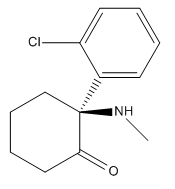
In terms of its chemistry, Ketamine is classed as an arylcyclohexylamine drug. The Ar group is chlorobenzene in ketamine. The nitrogen has one substituted methyl group. There is an acetyl group attached at carbon R2.
In terms of its pharmacology, Ketamine acts as a competitive NMDA receptor antagonist. NMDA receptors allow for electrical signals to pass between neurones in the brain and spinal column; for the signals to pass, the receptor must be open. NMDA receptor antagonists close the NMDA receptors by blocking them. This disconnection of neurones leads to loss of feeling, difficulty moving, and eventually the famous “hole”.
The effects listed below are based upon the subjective effects index and personal experiences of PsychonautWiki contributors. The listed effects will rarely if ever occur all at once but heavier dosages will increase the chances and are more likely to induce a full range of effects.
Physical effects:
The subjective physical effects of Ketamine can be broken down into eight components all of which progressively intensify proportional to dosage. These are described below and generally include:
Cognitive effects:
In comparison to other dissociatives, the cognitive effects of ketamine are often described as particularly forceful towards introspection and with more analytical thought process when compared to that of DXM and MXE.
These effects can be broken down into 9 separate subcomponents which are listed and described below:
It has been demonstrated that Ketamine, even if taken in small doses, is very effective for patients suffering from chronic depression and bipolar disorder. Studies have shown that the effect of the drug is immediate or within 2 hours and consistent in relieving a patient’s depressive and/or suicidal symptoms, lasting up to 3 days after a single dosage. In comparison, common antidepressents, such as Prozac, are entirely ineffective for 40% of the population and can take weeks to show effects. This gives Ketamine the potential to become an indispensable tool in the treatment of depression and bipolar, which is currently being held back by institutionalised drug prohibition.
The mechanism behind this has been shown by studies to stem from the way in which Ketamine triggers the release of glutamate, which is a neurotransmitter that immediately stimulates the growth of damaged synapses which have been damaged by stress and depression.
Visual effects:
Suppression
This substance does not enhance visual stimuli; instead it tends to degrade and decrease visual aptitude in a variety of ways which generally includes:
Distortions
Ketamine exhibits a full array of dissociative distortions and alterations in visual perception which generally includes:
Geometry
The visual geometry found within ketamine can be described as very brightly coloured in scheme when compared to that of MXE but not as complex or psychedelic as that of DXM. It does not extend beyond level 4 and can be comprehensively described through its variations as simplistic in complexity, algorithmic in style, synthetic in feel, unstructured in organization, dimly lit in lighting, multicoloured in scheme, glossy in shading, soft in edges, large in size, fast in speed, smooth in motion, equal in rounded and angular corners, immersive in depth and consistent in intensity.
Hallucinatory states
At high dosages, Ketamine can produce a full range of high level hallucinatory states in a fashion that that is less consistent and reproducible than that of many other commonly used psychedelic. These effects include:
Auditory effects:
The auditory effects of ketamine are common in their occurrence and exhibit a range of effects which commonly includes:
Health effects, addiction potential and tolerance:
The first large-scale, longitudinal study of ketamine users found that frequent ketamine users (at least 4 days/week, averaging 20 days/month) had increased depression and impaired memory by several measures, including verbal, short-term memory and visual memory. However, infrequent (1–4 days/month, averaging 3.25 days/month) ketamine users and former ketamine users were not found to differ from controls in memory, attention and psychological well-being tests. This suggests the infrequent use of ketamine does not cause cognitive deficits and that any deficits that might occur may be reversible when ketamine use is discontinued. However, abstinent, frequent, and infrequent users all scored higher than controls on a test of delusional symptoms.
According to a recent systematic review, 110 documented reports of irritative urinary tract symptoms from ketamine dependence exist.[Urinary tract symptoms have been collectively referred to as “ketamine-induced ulcerative cystitis” or “ketamine-induced vesicopathy” and they include urge incontinence, decreased bladder compliance, decreased bladder volume and painful haematuria (blood in urine).
Fatal ketamine overdoses are particularly rare but not completely unheard of. The LD50 for ketamine when injected into mice is 400mg/kg. As humans are generally more sensitive to drugs, we divide it by 2, making 200mg/kg the estimated human lethal dose. Assuming the human weighs a conservative 50kg, this would require the lethal dosage to be at least 10 grams – forty times the amount of 250mg necessary for a high dose K-hole experience.
In terms of ketamine tolerance, this can take weeks to build up for some, but for others it can take a single night of heavy use. Once a physical tolerance to ketamine has set itself in, it can often take a month or more to reset itself. Ketamine has a fairly high potential to be abused with addiction widely reported across the world.
Legal issues:
Conclusion:
Ketamine and dissociatives in general are a truly fascinating experience which open up a whole new world completely unlike anything found with the world of psychedelics. However, they are not nearly as insightful and are something which I only try on a very rare basis due to their addictive potential and adverse health effects.
I am writing this article to serve as a dedicated analysis and description regarding my current understanding towards what I consider to be the most profound and important freestanding component within the entirety of the hallucinogenic experience. In the past, I have already written about the experience of states of unity and interconnectedness within this article here. This piece of writing however makes the incorrect assumption that this state is exclusively associated with level 7B visual geometry. It was also written from a perspective which is extremely limited in comparison to the understanding which I have since built up over the past few months. However, it is extremely important for me to make it clear that I have not come even remotely close to fully grasping or even comprehending both the logic behind this experience and its many potential consequences.
This is a level of understanding which I do not expect to ever reach. Despite this however, I am determined to steadily progress what I have already learnt through a combination of constant analysis and in-depth discussions with an increasingly large amount of people who have undergone this component.
To begin with, I will describe the specific subjective experience and consistent effects of this component in as much detail as possible.
It starts with a change in perspective which is consistently interpreted as the lifting of a deeply embedded and all encompassing illusion. The destruction of this leads onto feelings that the tripper has undergone some sort of profound “awakening” or “enlightenment”.
This illusion feels as though it has always been in place, forcing a person’s perspective of the world into feeling as if their concept of “self” or “I” with which they identify themselves as, is assumed to intrinsically follow two fundamental rules. The first of these rules is that the self is inherently separate from the external environment and could not possibly extend into it. The second is that the self is specifically limited to not even the physical body as a whole, but exclusively a person’s ego or internal narrative and the image of their own personality as built up through social interactions with other people.
Once removed, the absence of this inbuilt illusion can lead onto two possible levels of cognitive intensities which both follow very consistent and interlocking themes.
The lower and more basic of these two levels can be referred to as external environment specific states of unity and interconnectedness. It can be described as a loss of perceived boundaries between the physical body and either the entirety of the external environment or specific things contained within it. This is felt to be the result of a person’s central sense of self becoming attributed to not just the internal narrative of the ego but in equal measure, to the human body in its entirety and the things around it which it is physically connected to through the senses. This creates the undeniable perspective that the external environment is no longer a separate world which the “I” is confronting and disconnected from, but a single unified system of behaviour. This experience provides the perspective that you are the external environment experiencing itself through the specific point within it that this body’s physical sensory awareness and conscious thought happens to reside in. This sensation is generally described by most people as “becoming one with the things around me”.
The most common and relatable examples of states of unity and interconnectedness, which are manifested as specific to the external environment, include but are certainly not limited to the following perspectives:
The second and highest level of intensity for this component can be referred to as all encompassing states of unity and interconnectedness. It is at this point of intensity when the experience become infinitely more profound and limitless in its effects.
Once this level is reached, the external systems which a person’s central sense of self has become attributed to and one with is no longer limited to the immediately perceivable environment. Instead, it envelops and becomes attributed to the entirety of a person’s internally stored model of reality, existence and the universe as a whole.
This creates the sudden undeniable perspective that you are literally the entire universe experiencing itself, exploring itself and performing actions onto itself through the very specific point of space and time which your ego and conscious perception happens to reside in.
This is a feeling that when experienced, is immediately and universally understood to be an undeniable truth by anybody who undergoes it. It results in a number of profound consequences and changes in worldview or philosophical perspective which seem to follow fairly consistent themes across almost all people who experience this component. These include but are certainly not limited to:
This is a component which can either be felt as a temporary sensation that disappears as the tripper sobers up or it can become integrated into a new perspective of the world for weeks, months or years after the experience itself.
It is seemingly completely spontaneous in its rate of occurrence but seems to be particularly common during states of level 7B visual geometry when the tripper is by themselves. It also seems to occur when deep introspection results in the tripper truly resolving and coming to terms with each of their specific sets of insecurities in a way that has allowed them to become finally acceptant and content with who they are as a person.
In terms of the specific substances which are capable of inducing this component, the list currently confirms that it is possible within,
Psilocin, 4-AcO-DMT, DMT, LSD, MDMA, Ketamine, DXM and Salvia divinorum.
Similar notions of unity and the illusory nature of the self seem to be discussed heavily throughout a huge variety of religious, philosophical and psychological sources, which have been produced across both modern and ancient human history. Each of these exist independently from the experience of hallucinogenic substances. I have done my best to collect and list all of these below:
My personal interpretation or description of the themes within these philosophies (which may well be overly simplified or completely wrong) is that the individual and the universe cannot be logically defined as separate systems. This is because, to define a physical object of any sort in even the most basic level of detail, you must also provide an account of the way in which it physically interacts with and is completely dependent on its particular external environment. In turn, the external environment which the original object resides within cannot be fully defined without taking into account the surrounding systems which it is also contained within and so on outwards to encompass existence as a whole. This renders the self or any individual concept as something which can not logically be defined as a contained and separate system from the rest of the universe.
In the very same way that you cannot logically have up without down, left without right, something without nothing, light without dark or positive without negative. You cannot have self without other or each without all because the two concepts inter-depend and exclusively exist in an inseparable and unified relationship to each other.
This suggests to me that one is permitted to use terms such as “I”, “you”, and so on, not because they refer to an empirical and separate self, but simply because they are convenient linguistic tools for use in conversation which should not be considered as anything more than a symbolic approximation or measurement.
Regardless of the legitimacy of these theistic and philosophical perspectives which may be inherently delusional or false, feelings of becoming “one with universe” which are pervasive within human culture, is undoubtedly one of the most profoundly positive changes in perspective that a human being could possibly go through.
Assuming however that this is a rational and logically sound perspective, I am left with two alternate hypotheses in regards to why this illusion seems to be so deeply embedded into each and everyone of us.
The first of these is that it perhaps this illusion formed because it is an evolutionary advantage for the ego to feel intrinsically separate from and more significant than, the external environment as a means of ensuring the motivation for survival. This was my previous theory but upon further analysis has proven implausible. I do not see any physical route through which a drug that simply activates or deactivates receptors could change something that is hard wired into the very structure of the brain.
The second of these personal hypotheses is that the illusion of separateness does not stem from a hardware problem but a software problem. I personally believe that unity may well be the default evolutionary perspective through which human beings originally operated, but it has been suppressed through a purely cultural or more specifically, linguistic problem. This could potentially stem from the way that despite the many obvious benefits of language, it pays a price through completely reorganizing our perception of the world into a system of intrinsically separate labels that in reality, are merely glimpses of a unified whole. It’s an overcoming of this deeply embedded illusion that hallucinogens could theoretically rise above through the way in which they forcibly induce embedded and otherwise hidden states of mind that exist within the subconscious.
If myself and the psychedelic community as a whole dedicate themselves to coming to a total understanding of this important component, the potential consequences could have historical significance. Were the subtle environmental triggers to be accurately determined, it would be theoretically possible to consistently induce permanent and all encompassing states of unity and interconnectedness in a clinical setting. This would provide the entirety of the human species to a total freedom from our psychological, unnecessary and purely ego driven suffering which consumes our entire perspective of the world.
If you have had any experience with this component whatsoever please do report this in the comment section below and the drug which it occurred on. This provides myself and everybody else with extremely valuable data and would be greatly appreciated.
From Steve Jobs to the Beatles, many of Western culture’s most brilliant minds hold a special place in their hearts for LSD, the psychedelic substance that Timothy Leary once said “allow us to peer into bits and zones of Chaos.” Although Leary’s description sounds intriguing, if you haven’t dropped acid yourself it’s hard to imagine what these “bits and zones of Chaos” actually look like. That’s where Chelsea Morgan comes in.
The Huffington Post recently featured my girlfriends photography as an example of modern drug art and linked back to this very website.
They also interviewed us both with a few quick questions over email and it’s now up online, so feel free to go take a look!
This is the very first media inquiry we've received so far, who knows whether or not it will be the last.
I am currently in the process of updating, rewriting and reorganizing every single thing on this website. During this process I am adding and documenting a few new cognitive components of the psychedelic experience which were previously undocumented and will be posting them over the next week or two as they are finished.
Below is a list of changes which I have made around the site…
As for the new components, below are the two which I have managed to complete so far…
Feelings of Deja vu:
Deja vu is a commonly known phrase from the French language which translates literally into “already seen”. This is a well documented phenomenon which commonly occurs at spontaneous points throughout both sober living and psychedelic experiences. It can be described as having the strong sensation that the current event or situation has already been experienced at some point within the past, when in fact it hasn’t.
Psychedelic drugs are commonly capable of inducing spontaneous and often prolonged states of mild to intense senses of Deja vu. This provides trippers with an overwhelming sense that they have “been here before”. Which is accompanied by an obviously false feeling of familiarity with the psychedelic experience itself, the current location or setting, the current physical actions being performed and the situation as a whole. Something which becomes triggered and felt by the tripper despite the fact that they are rationally aware that the circumstances of the “previous” experience (when, where, and how the earlier experience occurred) are clearly quite uncertain or simply impossible.
This component is commonly experienced throughout every psychedelic and does not seem to have any obvious trigger behind it.
Feelings of predeterminism:
Predeterminism is defined as the belief that all events, including human actions, are established or decided in advance by prior causes.
This is a perspective that can become spontaneously triggered and felt through an undeniable change in thought processes which is accompanied by an intense set of physical sensations.
In terms of how his component feels subjectively, it can be described as the sensation of the ego or internal narrative as an independent decision making agent being lifted from your perception of the world and revealed to be illusory. This creates the sudden undeniable sensation that your physical actions, current situational perspective and linguistic content of your current thought stream have always been completely predetermined and under the full control of the subconscious’s autonomous decision making faculties. Meaning that thoughts, decisions and physical actions are not reached through a conscious choice or planning of the ego and never have been at any point throughout a persons life. Instead they are revealed to have always been a vast and complex set of internally stored, instantly decided and completely autonomous preprogrammed responses to specific sets of received sensory stimuli that are acted out by the subconscious faculties.
Along side of this, there is also a powerful physical sensation that makes the precise arrangement of your external environment and the objects within it become felt to be the true deciding force in regards to the way in which you physically interact with it. This is done by instantly triggering your responses and decisions towards them through the simple sensory perception of them.
The experience of this component as a whole is consistently interpreted by anybody who undergoes it as a profound revelation or insight into the illusory nature of freewill.
It lifts the tripper above the culturally ingrained illusion of being an independent decision making agent that is somehow intrinsically separate from external physical systems, allowing triers to see themselves as what they really are. Which is the suddenly undeniable perspective that living organisms are nothing more than complex electrochemical systems, walking around and responding to sensory stimuli in a completely predetermined and mechanical fashion.
This component has so far been confirmed to occur during high dose trips with LSD, Psilocin and 4-aco-dmt. It usually seems to occur spontaneously during the experience of level 7B visual geometry.
If anybody is interested in learning more information on both the science and philosophies behind physical predeterminism which this component is essentially the subjective experience of, I would highly recommend that they watch this lecture here.
If you have experienced any thing described above during a psychedelic experience, please use the comment system below to report it and confirm the specific substance which it was experienced on. This helps provide genuinely useful data.
Besides the components above, the complete list of new cognitive effects will include,
Induced mindfulness, outrospection, induced spiritual and religious perspectives, thought loops and delusions.