
Disregard Everything I Say
Month
Dosage (oral)
Threshold : 0.5 - 1mg
Light : 1 - 2mg
Common : 3 - 5mg
Strong : 8 - 10mg
Heavy : 10+mg
Duration (oral)
Total Duration : 12 - 16 hours
Onset : 20 - 90 minutes
Come up : 1 - 2 hours
Peak : 8 - 12 hours
Come down : 1 - 3 hours
After effects : 2 - 4 hours
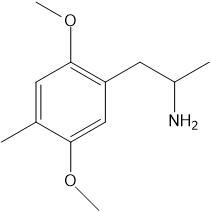
2,5-Dimethoxy-4-methylamphetamine (DOM) or STP is a psychedelic drug of the substituted phenethylamine and substituted amphetamine chemical classes. It is a member of the DOx family of compounds. The phenethylamine equivalent (lacking the alpha-methyl group) is 2C-D.
This substance was first used recreationally in the mid-1960s and has little to no history of human usage prior to the 1991 publication of its synthesis and pharmacology in the PiHKAL (Phenethylamines i Have Known And Loved) by Alexander Shulgin. In modern times, it is used as a recreational drug and an entheogen, rarely sold on the streets and almost exclusively obtained as a grey area research chemical through the use of online vendors.
In terms of its pharmocology, DOM acts as a selective 5-HT2A, 5-HT2B, and 5-HT2C receptor partial agonist. Its psychedelic effects are mediated via its actions on the 5-HT2A receptor. Due to its selectivity, DOM is often used in scientific research when studying the 5-HT2 receptor subfamily.
DOM is a highly dose sensitive psychedelic that is often sold on blotting paper and known for its strong visuals and intense body load. Many reports also indicate that the effects of this chemical may be overly intense for those who are not already experienced with psychedelics.
The DOC experience contains a complex and wide array of effects which based on the predefined potential subjective effects index found here, I will now begin to breakdown and describe.
Physical effects:
The physical effects of DOM can be broken down into six components all of which progressively intensify proportional to dosage. These are described below and generally include:
Cognitive effects:
The head space of DOM is described by many as one of extreme mental stimulation and a powerful enhancement of a person’s current mental state.
The total sum of these cognitive components regardless of the setting generally includes:
Visual effects:
Enhancements
DOM presents a full and complete array of possible visual enhancements which generally includes:
Distortions
As for visual distortions and alterations, the effects experienced are detailed below:
Geometry
The visual geometry that is present throughout this trip can be described as more similar in appearance to that of 4-AcO-DMT or ayahuasca than that of LSD, 2C-B or 2C-I. They can be comprehensively described as structured in their organization, organic in geometric style, intricate in complexity, large in size, fast and smooth in motion, colourful in scheme, glossy in color, sharp in their edges and equally rounded and angular in their corners. They give off a contradictory natural and synthetic feel to them that at higher dosages are significantly more likely to result in states of Level 7B visual geometry over Level 7A.
Hallucinatory states
DOM and other substituted amphetamines produce a full range of high level hallucinatory states in a fashion that is more consistent and reproducible than that of many other commonly used psychedelics. This holds particularly true in comparison to other substances within the phenethylamine family. These effects include:
Auditory effects:
The auditory effects of DOM are common in their occurrence and exhibit a full range of effects which commonly includes:
Health effects, addiction potential and tolerance:
The toxicity and long term health effects of recreational DOM have been studied in a very limited amount of scientific context and the exact toxic dosage is unknown. This is because DOM is a research chemical with very little history of human usage. Anecdotal evidence from people who have tried DOM within the psychedelic community suggests that there are no negative health effects attributed to simply trying this drug at low to moderate doses or using it very sparingly (but nothing can be completely guaranteed).
DOM is not physically addictive and many users experience a frequency self-regulating quality to the drug. Tolerance for DOM seems to be very mild and does not build up without repeated use over a short period of time.
Legal issues:
Conclusion:
In conclusion, DOM is a very worthwhile compound and I was intrigued by its ease in ability to invoke higher level visual and cognitive effects. It deserves its place in Shulgin’s magical half dozen and (while long-lasting) is definitely one of the more interesting and unique phenethylamines I have tried.This substances subjective effect breakdown was contributed by PsychonautWiki admin, Cocoanatta.
Although each piece of content found within this blog has previously focused exclusively on areas of psychonautics which necessitate the use of hallucinogenic substances, it’s important to note that these are not the only means of exploring profoundly altered states of consciousness available for us as human beings to utilize. There may well be many substances which are extremely capable of inducing profoundly altered states of mind but specifically in terms of the hallucinations and not the accompanying effects, each and every one of these compounds is simply inducing a state of mind during waking consciousness which the brain is already perfectly adept at generating during normal sleep.
These familiar states of mind are recognizable to all of us and known by the scientific literature as dreams. They are defined as successions of hallucinatory images, scenarios, ideas, emotions, and sensations that occur involuntarily within the mind during certain stages of sleep. Although the content and purpose of dreams are not definitively understood, they have been a topic of scientific speculation as well as philosophical and religious interest throughout many aspects of recorded history. There is also solid scientific evidence which clearly indicates that dreams are a common occurrence throughout the lives of most human beings and other mammals in general.[1]
The reason I am writing this article is for it to serve as a dedicated descriptive breakdown, analysis and instructional guide regarding my extensive knowledge of dreams, the behaviour of their general content, their embedded limitations and most importantly, the skill sets necessary to consciously utilize them as powerful methods of self exploration.
I will begin by defining the individual subcomponents and relevant levelling systems which comprise all dreams before providing instructional information on how to gain, maintain and harness a sense of lucidity within them.
The list below begins with the lower base components and progressively works its way up through the higher individual subcomponents.
Internally Sourced Sensory Input:
The most fundamental and basic component of any dream or hallucinatory state can undoubtedly be defined as some form of perceivable sensory input. This differs from that of everyday sensory input in the way that it is received from an internal source created by one’s own mind as opposed to an external source within the immediately perceivable surrounding environment. The dream scape of a human being is capable of manifesting completely realistic, convincing and detailed equivalents of all 5 senses across varying degrees of vividness and intensity.
These themselves can be broken into 4 differing levels of clarity which are broken down and defined below.
Perspective:
In terms of the perspective in which dreams are perceived through, just like literary plots, dreams can be experienced through four alternate vantage points which are described and listed below.
Setting:
At level 4 - 5 dreams consistently manifest themselves through the essential component of extremely detailed imagined landscapes, locations and sceneries of an infinite variety. These exist for the purpose of acting as the setting in which the plot of the dream occurs. The geography of these settings is capable of rendering itself as static and coherent in organization but will usually result in a non-linear, nonsensical and continuously ever-changing layout which does not obey the rules of everyday physics. In terms of the chosen locations, appearance and style of these settings, they seem to be selected at random and are often entirely new and previously unseen locations.
They do however play a heavy emphasis on replicating and combining real life locations stored within the dreamer’s memories, especially those which are prominent within one’s life and daily routine.
Within the settings themselves, relevant and irrelevant objects or props will be placed in appropriate but sometimes inappropriate locations throughout them. These can be interacted with in exactly the same way that any real life object can and can often react in unexpected and spontaneous ways (but usually behave exactly as the dreamer expects them to).
Dream characters:
Across the setting of almost any dream, the scenery is inhabited and populated by conscious dream characters who can be spoken to and communicated with in extreme amounts of detail. These entities generally appear to be the inhabitants of a perceived independent reality - they are expectant of your appearance and interact with the dreamer in various ways.
In terms of their appearance, dream characters can show themselves as literally anything but will usually display themselves as perfectly ordinary people. These people are equally likely to be complete strangers or randomly selected people which the dreamer has encountered throughout their life. The more prominent and emotionally significant the person is, the more likely they are to be encountered within the dream scape.
There are distinctly different types of dream characters which one may encounter, each of which represent a particular subsection of one’s own consciousness through both their visible form and their personality. These can be broken down into 3 separate categories and include:
When communicated with through spoken word the level of coherency in which these entities can reply with is highly variable but can be broken down into 4 distinct levels of communication:
Scenarios and plots:
Each of the above components are randomly shuffled and spliced into any number of an infinite variety of potential plots and scenarios. These may be positive or negative to experience and are difficult to define in a comprehensive manner in much the same way that we cannot predict the plot of abstract literature and films. They can however be broken down into extremely basic occurrences which generally entail visiting some sort of setting, or a number of them which contain within them, interactive, multiple, or lone dream characters. Alongside of these, completely unpredictable plot devices, events and occurrences, force the dreamer to become involved within the specific scenario of the particular dream.
These scenarios and plots can be linear and logical with events that occur in a rational sequence which lead onto each other through cause and effect. They are equally likely however to present themselves as completely nonsensical and incoherent. This means that the plot will occur with spontaneous events which are capable of ending, starting and changing between each other repeatedly in quick succession and as they please. The plots themselves can either be entirely new experiences that are unlike anything experienced within the real world, old experiences such as accurate memory replays or a combination of the two.
In terms of the amount of time in which they are experienced, hallucinatory dream plots and scenarios usually feel as if they are being experienced in real-time. This means that when 20 seconds have been felt to have passed within the hallucination, the exact same amount of time will have passed in the real world. At other points, however, distortions of time can make themselves present, resulting in plots and scenarios that can feel as if they literally last days, weeks, months, years, or even infinitely long periods of time.
An important part of any dream which entails obviously unlikely and absurd scenarios is a strong sense of uncontrollable and powerful plot acceptance. This sense of plot acceptance allows the dreamer to accept any plot as it comes as a completely real event in which the results of one’s own actions will have genuine consequences regarding the dreamer’s life. This delirium motivates the dreamer to avoid danger, solve puzzles and accept the scenario as reality even if it is clearly and undeniably more likely to be a dream than an event which could ever occur within real life.
Sleep paralysis:
Sleep paralysis is a phenomenon in which people, either when falling asleep or wakening, temporarily experience an inability to move. More formally, it is a transition state between wakefulness and rest characterized by complete muscle atonia (muscle weakness). It can occur at sleep onset or upon awakening, and it is often associated with terrifying visions and external hallucinations (e.g. an intruder in the room or a demon sitting on ones chest), to which one is unable to react due to paralysis. It is believed a result of disrupted REM sleep, which is normally characterized by complete muscle atonia that prevents individuals from acting out their dreams.
Many people find sleep paralysis to be a horrific and negative experience but it can be easily escaped by simply changing the rythm of ones breathing. When you change your breathing pattern, such as breathing much more deeply and longer, for about 15 seconds your body will notice the change and automatically exit sleep paralysis.
Lucid dreaming techniques:
Despite powerful senses of delirium and plot acceptance, there are however moments within dreams in which a person realizes that they are dreaming and takes control of the situation. These are known as lucid dreams and are formally defined as any dream in which for an uninterrupted and prolonged amount of time, one is consciously aware that they are dreaming.
The second half of this article will focus not on defining the principles behind the physics and behaviour of the dream scape but on gaining a stabilized sense of lucidity within ones own dreams and the techniques for utilizing and harnessing specific control and navigation techniques once this has been achieved.
Improving memory recall:
Reality checks:
In order to determine whether or not you are dreaming, it is necessary to develop a habit of performing frequent reality checks. A reality check simply involves asking yourself a question, such as “Am I dreaming?” or “Is this a dream?”, alongside of a specific action which is capable of determining if you are awake or dreaming.
Because most of us are not in the habit of asking ourselves “Am I dreaming?” while in the midst of a dream, we must train ourselves to get into the habit of questioning our reality if we want to achieve a state of lucidity throughout them. By training yourself to habitually question your reality during waking life to determine whether or not you are dreaming, the habit will eventually carry over to your dreaming life and ultimately you will find yourself posing the question while dreaming. When that happens, if you learnt to really ask and focus yourself on this question alongside of a habitually performed reality check you will greatly increase the odds of realizing you are within a dream and thus increase the odds of achieving lucidity.
There are many simple reality checks that can be used to accurately determine whether or not you are currently dreaming and these are listed below:
In order to gain the best results possible, these reality checks should be performed habitually every time the situation changes and on a daily basis. For example, every time one walks through a door or enters a new environment a reality check should be performed, every time one talks to a new person or simply remembers that they they may well be dreaming a reality check should be performed. If this is done 10 - 30 times a day the habit will quickly spill over into ones own dreams.
An excellent way to remind oneself to perform reality checks is to put notes containing messages such as “are you dreaming?” or “perform a reality check” in places which you frequently look at throughout the day. For example, putting a visible note by your computer screen, writing a message on your hand or changing your desktop wallpaper to the image found here will greatly improve ones own sense of general lucidity.
Stabilization:
Once lucidity has been achieved the dreamer will usually have a tendency to become very excited as the realization that one is dreaming washes over them. This flood of emotions rapidly results in dream destabilization and quickly causes the setting to begin to collapse in on itself and the dreamer either wakes up or falls unconscious before losing lucidity and finding themselves back within another dream.
This can be extremely frustrating but easily overcome through the stabilization technique which is quite literally as simple as maintaining sensory input through the basic action of rubbing ones hands together. When the dreamer begins to rapidly rub their hands together the sensory input somehow keeps the dream perfectly stable and grounded. This can be further taken advantage of by continuously rubbing ones shoulder with their hand to maintain sensory input while walking around and admiring or exploring the scenery.
Activities and control techniques:
Once lucidity has been gained and the dream has been stabilized, the dreamer can now begin to practise taking control of the dream and exploring their own mind. Through the power of expecting an action or task to work, anything is possible within the dream scape and this can allow for some truly incredible experiences in which the only limit is ones own imagination. The most common of these actions and the techniques behind achieving them are listed out below:
Alternative/Advance LD techniques:
Analysis and conclusion:
It has taken me over 2 years of practical first hand research and experimentation to reach a point where I can comprehensively define the physics behind everyday hallucinatory sleeping dream states. Although the evolutionary and neurological purpose behind the existence of these states remains a mystery to modern science, I would like to use this article as an opportunity to suggest a personal hypothesis. Through first hand experience with the nature and behaviour of these states, it seems to me that dreams are simply a neurological computer simulation framework comprised of internally stored concepts which one encounters throughout their life. This randomizes, shuffles and splices its particular set of memories, concepts and variables together in a completely unpredictable and spontaneous fashion, existing for the simple and basic purpose of generating potential scenarios which one may encounter in life as a means of internal practise to encourage survival should the potential event occur in real life. This would explain why dreams play such a huge emphasis on ones own fears and desires and indicates that they therefore serve a fundamentally important evolutionary function.
I would encourage everybody to learn how to lucid dream as once learned, the techniques behind this skill offer anybody the opportunity to explore extremely vivid hallucinatory scenarios of infinite variety and hyper-realism with god-like powers of control which are only limited by the dreamer’s imagination. Depending on the level of dedication involved, these experiences can occur on a nightly basis and effectively open up a completely new and profoundly rich field of experience to one’s life in place of that which was previously a purely unconscious activity.
Dosage (oral)
Threshold : 0.5 - 1mg
Light : 1 - 1.5mg
Common : 1.5 - 2.5mg
Strong : 2.5 - 5mg
Heavy : 5+ mg
Duration (oral)
Total Duration : 8 - 20 hrs
Onset : 20 - 90 minutes
Initial effects : 1 - 2 hours
Peak : 8 - 12 hours
Coming down : 1 - 3 hours
After effects : 2 - 4 hours
Dosage (insufflated)
Threshold : 0.5mg
Light : 0.5 - 1mg
Common : 1 - 2mg
Strong : 2.5 - 3.5mg
Heavy : 3.5 - 4+mg
Duration (insufflated)
Total Duration : 5 - 8 hrs
Onset : 1 - 2 minutes
Initial effects : 10 - 20 minutes
Peak : 2 - 4 hours
Coming down : 1 - 2 hours
After effects : 2 - 4 hours
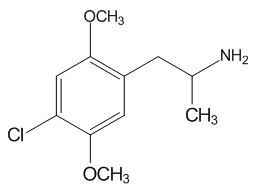
2,5-Dimethoxy-4-chloroamphetamine (DOC) is a psychedelic substituted alpha-methylated phenethylamine, a class of compounds commonly known as amphetamines. The phenethylamine equivalent of this substance (lacking the alpha-methyl group) is 2C-C.
This substance has no history of human usage prior to the 1991 publication of its synthesis and pharmacology in the book PiHKAL (Phenethylamines i Have Known And Loved) by Alexander Shulgin. In modern times it is used as a recreational drug and an entheogen, rarely sold on the streets and almost exclusively obtained as a grey area research chemical through the use of online vendors. It was first synthesized by Alexander Shulgin and described in his 1991 book.
In terms of its pharmacology, this substance acts as a selective 5-HT2A, 5-HT2B, and 5-HT2C receptor partial agonist. Its psychedelic effects are thought to be mediated via its actions on the 5-HT2A receptor.
DOC is a highly dose sensitive psychedelic that is often sold on blotting paper and known for its strong visuals and intense body load. Many reports also indicate that the effects of this chemical may be overly intense for those who are not already experienced with psychedelics.
The DOC experience contains a complex and wide array of effects which based on the predefined potential subjective effects index found here, I will now begin to breakdown and describe.
Physical effects:
The physical effects of DOC can be broken down into six components all of which progressively intensify proportional to dosage. These are described below and generally include:
Cognitive effects:
The head space of DOC is described by many as one of extreme mental stimulation and a powerful enhancement of a person’s current mental state.
The total sum of these cognitive components regardless of the setting generally includes:
Visual effects:
Enhancements
DOC presents a full and complete array of possible visual enhancements which generally include:
Distortions
As for visual distortions and alterations, effects experienced are detailed below:
Geometry
The visual geometry that is present throughout this trip can be described as more similar in appearance to that of 4-AcO-DMT or ayahuasca than that of LSD, 2C-B or 2C-I. They can be comprehensively described as structured in their organization, organic in geometric style, intricate in complexity, large in size, fast and smooth in motion, colourful in scheme, glossy in colour, sharp in their edges and equally rounded and angular in their corners. They give off a contradictory natural and synthetic feel to them that at higher dosages are significantly more likely to result in states of Level 7B visual geometry over Level 7A.
Hallucinatory states
DOC and other substituted amphetamines produce a full range of high level hallucinatory states in a fashion that is more consistent and reproducible than that of many other commonly used psychedelics. This holds particularly true in comparison to other substances within the the phenethylamine family. These effects include:
Auditory effects:
The auditory effects of DOC are common in their occurrence and exhibit a full range of effects which commonly include:
Health effects, addiction potential and tolerance:
The toxicity and long term health effects of recreational DOC use do not seem to have been studied in any scientific context and the exact toxic dosage is unknown. This is because DOC is a research chemical with very little history of human usage. Anecdotal evidence from people who have tried DOC within the psychedelic community suggests that there are no negative health effects attributed to simply trying this drug at low to moderate doses or using it very sparingly but nothing can be completely guaranteed.
DOC is not physically addictive and many users experience a frequency self-regulating quality to the drug. Tolerance for DOC seems to be very mild and does not build up without repeated use over a short period of time.
Legal Issues:
Conclusion:
In conclusion, I was surprised at the extent to which DOC manifested positive cognitive alterations, hallucinatory states and a style of visual effects which is similar in appearance to mushrooms or 2C-E. The substances ability to maintain a level of stimulation which is not overly forceful makes it extremely useful for both psychonautic exploration and recreational events such as music festivals and raves.
This substances subjective effect breakdown was contributed by PsychonautWiki admin, Cocoanatta.
Dosage (oral)
Threshold : 3-5mg
Light : 5-8mg
Common : 8-14mg
Strong : 14-20mg
Heavy : 20-25+mg
Duration (oral)
Total Duration : 5 - 8 hrs
Onset : 20 - 60 mins
Initial effects : 30 - 45 mins
Peak : 1 - 2 hrs
Coming down : 1 - 2 hrs
After effects : 1 - 8 hrs
Dosage (smoked)
Threshold : 5-8mg
Light : 8-10mg
Common : 10-15mg
Strong : 15-20mg
Heavy : 20-25+mg
Duration (smoked)
Total Duration : 5 - 8 hrs
Onset : 20 - 60 mins
Initial effects : 30 - 45 mins
Peak : 1 - 2 hrs
Coming down : 1 - 2 hrs
After effects : 1 - 8 hrs
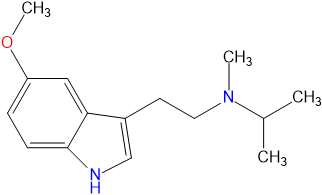
5-MeO-MIPT, or 5-methoxy-N-methyl-N-isopropyltryptamine also known as “Moxy” is a psychedelic and entactogenic drug in a class of compounds commonly known as tryptamines. It is the N-methyl-N-isopropyl homologue of the well know psychedelic 5-MeO-DMT. It has structural and pharmacodynamic properties similar to the drugs 5-MeO-DiPT, DiPT, and MiPT.
This substance has no history of human usage prior to the 1985 publication of its synthesis and pharmacology in the Journal of Medicinal Chemistry by Repke, Grotjahn, & Shulgin. In modern times it is used as a recreational drug and an entheogen, rarely sold on the streets and almost exclusively obtained as a grey area research chemical through the use of online vendors.
The mechanism that produces the hallucinogenic and entactogenic effects of 5-MeO-MiPT is thought to result primarily from 5-HT2A receptor agonism, although additional mechanisms of action such as inhibition of MAO may also be involved.
The 5-MeO-MiPT experience contains a complex and wide array of effects which based on the predefined potential subjective effects index found here, I will now begin to breakdown and describe.
Physical Effects:
The physical effects of 5-MeO-MIPT can be broken down into three components all of which progressively intensify proportional to dosage. These are described below and generally include:
Cognitive Effects:
The head space of 5-MeO-MIPT is described by many as one which is both insightful and moderately relaxing, but at some points quite stimulating. This substance produces a large number of general psychedelic cognitive effects. The most prominent of these effects generally include:
Visual Effects:
Enhancements
5-MeO-MIPT presents a complete array of possible visual enhancements which generally include:
Distortions
As for visual distortions and alterations, these generally include:
Geometry
The visual geometry that is present throughout this trip can be described as more similar in appearance to that of psilocin, 4-AcO-DMT, or ayahuasca than that of LSD or 2C-B. They can be comprehensively described as structured in their organization, organic in geometric style, intricate in complexity, large in size, fast and smooth in motion, colourful in scheme, glossy in colour, equal in blurred and sharp edges, and equal in rounded and angular corners. At higher dosages, they are significantly more likely to result in states of level 7B visual geometry over level 7A.
In terms of their manifestation, they are progressive in nature and continuously self-complexify in settings with little to no visual input and disturbances. For example, darkness will cause the geometry to progressively intensify, but this can immediately be reset back down to base level by simply turning on a bright light or actively performing a physical task which requires any level of concentration.
Hallucinatory States
5-MeO-MIPT produces a full range of high level hallucinatory states in a fashion that is more consistent and reproducible than that of many other commonly used psychedelics.
These effects generally include:
Auditory Effects:
The auditory effects of 5-MeO-MIPT are common in their occurrence and exhibit a full range of effects which commonly include:
Differences in Methods of Consumption:
This substance can be taken via oral ingestion or it can be smoked. When ingested orally, the experience puts more of an emphasis on visual effects but can be broken up into two stages. The first half of the trip feels stimulating and entactogenic while the second half feels more similar to a traditional typtamine psychedelic.
If smoked, however, these stages of experience are not present and the experience places more of an emphasis on physically and cognitively stimulating effects accompanied by subtle and mild changes in visual perception.
Health Effects, Addiction Potential, and Tolerance:
The toxicity of 5-MeO-MiPT is not known but (as with all research chemicals doses) should be carefully weighed on an accurate milligram scale and users should take extreme caution to work their way up from threshold dosages. There are many reports of vasoconstriction and uncomfortable increases in heart rate and this should be taken into account.
5-MeO-MIPT and MAOIs are a potentially dangerous combination. It is likely that MAOIs could increase the effects of 5-MeO-MIPT unpredictably. Taking this chemical while under the influence of ayahuasca, harmala alkaloids, AMT and prescription MAOIs (such as certain antidepressants) is strongly discouraged.
5-MeO-MIPT is not physically addictive and many users experience a frequency self-regulating quality to the drug. Tolerance seems to be very moderate and does not build up without repeated use over a short period of time.
Legal Issues:
Conclusion:
5-MeO-MiPT is an extremely interesting and powerful substance and can be considered as the most useful and therapeutic entactogenic experience found with the tryptamine compunds. For those who are familiar with them, the overall effects of this substance can be described as mixture between ayahuasca, MDMA, psilocin and 5-MeO-DMT.
This substance effect breakdown was contributed by PsychonautWiki admin, Cocoanatta.
Click here for a more comprehensive breakdown.
