 Disregard everything I say. Every bit of writing here can be considered a work of fiction. Do not ever use anything I've ever said here for anything ever and if you do you are doing so at your own legal risk as I am not responsible for anything that may or may not happen to you. I did after all tell you to disregard everything I say as in reality I actually have no idea what I'm talking about and shall continue to be a retarded teenager with an Internet connection. Please point out as many flaws in my reasoning, claims, factual information and grammar as possible. MYSOURCESARE: Personal Experience, the Internet and nowhere I could just be making things up so don't say I didn't warn you.
Ketamine, broken down and described
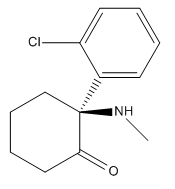
Dosage (insufflated),
Threshold : 10 - 15 mg
Light : 15 - 30 mg
Common : 30 - 75 mg
Strong : 60 - 125 mg
The K Hole : 100 - 250 mg
Duration (insufflated),
Onset : 5 - 15 minutes
Duration : 45 - 60 minutes
Normal After Effects : 1 - 3 hours
Dosage (oral),
Threshold : 40 - 50 mg
Light : 50 - 100 mg
Common : 75 - 300 mg
Strong : 200 - 450 mg
The K Hole : 500 + mg
Onset : 5 - 20 minutes (depending on stomach contents)
Duration : 90 minutes
Normal After Effects : 4 - 8 hours
Ketamine is a hallucinogenic drug used in human and veterinary medicine, primarily for the induction and maintenance of general anesthesia, usually in combination with a sedative. Other uses include sedation and anestheticin intensive care, (particularly in emergency medicine), and treatment of bronchospasm (a sudden constriction of the muscles in the walls of the lungs bronchioles).
Ketamine was originally developed as a medicine in 1965 as a derivative of phencyclidine (PCP), which was synthesized in 1926. It became popular among recreational users in the 1970’s but remains a ‘core’ medicine in the World Health Organization’s “Essential Drugs List”, a list of minimum medical needs for a basic healthcare system.
This substance is a dissocitive which falls into the arylcyclohexylamine class of chemicals, and possesses NMDA receptor antagonist properties. NMDA receptors allow for electrical signals to pass between neurones in the brain and spinal column; for the signals to pass, the receptor must be open. NMDA receptor antagonists close the NMDA receptors by blocking them. This disconnection of neurones leads to loss of feeling, difficulty moving, and eventually the famous “k-hole”.
This drug is the most famous of the classical dissociative hallucinogens and exhibits a wide array of complex subjective effects which are described in detail below…
Physical effects:
Assuming the substance has been insufflated, the very first physical effect hat is noticed is a sharp but relatively painless sensation within the nostril. An unpleasant taste is present for 15 - 20 minutes after insufflation and seems to come and go in an unpredictable manner.
At lower dosages, the physical sensations produced by the trip itself can be broken down into two distinct sensations. The first is a sharp, pleasurable tingling sensation which is location specific to the hands, feet and head. The second is a warm euphoric glow which emanates outwards from the centre of the body’s torso. Alongside of this, a significant decrease in the body’s overall weight is felt. This creates sensations of being extremely light and floaty in a way which is not necessarily stimulating, but still encouraging towards the act of moving around and engaging in physical activities.
As dosage increases, the physical sensations induced by the trip begin to become encompassed by feelings of physical detachment. This begins with feeling as if you are becoming removed from the body with a proportional loss of motor control and tactile sensation that increases along side of it. These sensations of dosage relative physical detachment are often described as feeling as if your body is not your own or feeling as if its movements have become partially to fully autonomous. As this effect increases motor control and bodily awareness are completely lost as total detachment from the physical senses and out of body experiences begin to take toll. This is accompanied by significant changes in the perceived direction and pull of gravity which results in feelings of flying over vast distances in multiple directions and varying speeds.
It’s worth noting that high dose ketamine trips can sometimes result in nausea and vomiting at the peak of trip. For most people, this is surprisingly not as unpleasant as they would initially expect due to the accompanying detachment from the physical senses.
Cognitive effects:
The most noticeable change in mental perception within the ketamine trip can be defined as a mild to complete detachment from the self and conscious awareness, which is the very definition of psychological dissociation. At lower levels this is usually described as feeling somehow separate and withdrawn from the external environment, as if life has somehow become a vague dream or film that plays out in front of you. Alongside of this, feelings of partial to complete autonomy associated with your thought stream and spoken conversation are often noted. As dosage increases, the cognitive detachment and dissociation eventually becomes so all-encompassing that ego death is inevitably reached, this is usually during high level out of body experiences. Along side of this, ketamine exhibits states of therapeutic dissociated introspection and spontaneous environment specific states of unity and interconnectedness.
It has also shown that ketamine, if taken even in small doses, is very effective for patients suffering from chronic depression and bipolar disorder. Specific studies which can be read about here and here have shown that the effect of the drug is immediate or within 2 hours and consistent in relieving patient’s depressive and/or suicidal symptoms, lasting up to 3 days after a single dosage. In comparison, common antidepressents, such as Prozac, are entirely ineffective for 40% of the population and can take weeks to show effects. This gives ketamine the potential to become an indispensable tool in the treatment of depression and bipolar, which is currently being held back by institutionalised drug prohibition. The mechanism behind this has been shown by studies which can be read about here. It stems from the way in which ketamine triggers the release of glutamate, which is a neurotransmitter that immediately stimulates the growth of damaged synapses which have been damaged by stress and depression.
Visual effects:
At lower levels of dissociation, the visual effects of ketamine can be described as the onset of a progressive detachment from the perception of sight and the brain’s ability to process it. This begins with blurred and doubled vision which leads onto the external environment, appearing as if it is being watched through a screen that becomes proportionally more distant dependent on dosage. Accompanying this, visual geometry similar in style to that of a psychedelic trip occurs. This experience is limited to level 1 - 4 experiences however and appears as significantly more colourful and intricate than anything found within MXE, but equal in complexity to that of DXM. Open eye perspective distortions such as alterations in the perception of size and distance attributed to the self and / or the external environment are commonly present.
Other dissociative specific visual distortions and alterations such as scenery slicing and environmental cubism are also present. As overall visual detachment increases in perfect proportion to its physical counterpart, out of body experiences eventually begin to set in. This takes a person’s conscious awareness into a place which can only be described as entering a vast and dark void, space or hole. It is commonly referred to by the drug community as “The k-hole” and contains within it an infinite array of level 1 - 4 hallucinatory structures.
Alongside of this, fully 3-dimensional hallucinatory states such as autonomous entity contact, landscapes and concepts are occasionally present, but significantly less consistent in their manifestation than psychedelics and deliriants.
Auditory effects:
At lower levels of detachment, a greatly enhanced sense of music appreciation becomes present. This can be described as the sensation of being able to comprehend and pay attention to each and every layer of sound to a complex piece of music. As dissociation increases however, sound can eventually become muffled, distant and extremely hard to perceive. Alongside of this, distortions in noise volume perception are often extremely altered at random points creating the sensation that everything is abnormally loud or silent.
Health effects, addiction potential and tolerance:
There are multiple dangers associated with compulsive ketamine abuse. It is because of this that I highly recomend doing as much research as you possibly can before considering trying this drug.
Extreme ketamine use can injure the bladder, causing ulcers (wounds) and fibrosis (stiffening of the bladder walls and shrinkage). This is strictly associated with regular overuse of ketamine and results in urinary frequency, urgency, pressure, pain, incontinence and/or bleeding from the bladder. They can receive a variety of diagnoses including ulcerative bladder, interstitial cystitis or ketamine cystitis.
Ketamine is also psychologically addictive when used on a regular basis. This can be avoided however by manually limiting your usage and not taking it compulsively.
Fatal ketamine overdoses are particularly rare but not completely unheard of. The LD50 for ketamine when injected into mice is 400mg/kg. As humans are generally more sensitive to drugs we devide it by 2, making 200mg/kg the estimated human lethal dose. Assuming the human weighs a conservative 50kg, this would require the lethal dosage to be atleast 10 grams. 40 times the amount of 250mg necessary for a highdose K-hole experience.
In terms of ketamine tolerance, this can take weeks to build up for some but for others it can take a single night of heavy use. Once a physical tolerance to ketamine has set itself in, it can often take a month or more to reset itself.
Legal issues:
- The increase in illicit use prompted ketamine’s placement in Schedule III of the United States Controlled Substance Act in August 1999.
- In the United Kingdom, it became labeled a Class C drug on 1 January 2006.
- In Canada, ketamine is classified as a Schedule I narcotic, as of August 2005.
- In Hong Kong, as of 2000, ketamine is regulated under Schedule 1 of Hong Kong Chapter 134 Dangerous Drugs Ordinance. It can only be used legally by health professionals, for university research purposes, or with a physician’s prescription.
- By 2002, ketamine was classified as schedule III in Taiwan.
Conclusion:
Ketamine and dissociatives in general are a truly fascinating experience which open up a whole new world completely unlike anything found with the world of psychedelics. However, they are not nearly as insightful and something which I only try on a very rare basis due to their addictive potential and adverse health effects.
Defining formal guidelines for documenting the subjective effects of hallucinogens
I am writing this article to define the exact analytical processes that I run through when breaking down and describing the subjective effects of any specific substance. This is because I consistently receive messages on a regular basis from people who seem to be genuinely astonished that I can seemingly describe “the impossible” in a clear and understandable format. This is despite the fact that many of the people who send me these messages seem to be vastly better spoken as well as considerably more intelligent and educated than I will ever be. Something which has led me to the conclusion that it has almost nothing to do with a person’s intelligence, use of language or background because at this point, I am simply well practised and nothing more. This is because over the last two years I have gradually and unconsciously developed a technique which can be applied to literally any substance in existence for the purposes of documenting their subjective effects in a formal and understandable manner.
It’s here in this article that I will explain in detail every single variable and piece of information that needs to be analyzed and questioned when a person is breaking down, for the first time, the experience of a previously undocumented hallucinogen. It will serve as an organized index of hallucinogenic effects and also provide people with guidelines on the pre-existing knowledge and experience they should have as well as general tips regarding the easiest and most convenient ways to record accurate data in the correct setting with minimal amounts of external influence.
I am doing this for two reasons, to better define the process for myself and so that if I die in some sort of horrible accident tomorrow, the project can continue regardless.
Preparation:
It’s important to note that before anybody is capable of accurately documenting the subjective effects of any class of specific hallucinogen, they need to have a good understanding of what they are getting into. There are two equally important methods behind this that are both necessary to ensure the tripper is not overwhelmed with disorientation and that they have the appropriate vocabulary to describe very specific details regarding the experience.
The first of these is to study and understand in as much detail as possible, the exact effects which their chosen class of hallucinogen is going to induce. This can be done by thoroughly reading through and studying the pre-existing guides which I have already written for psychedelics, dissociatives and deliriants. If this is done, it will ensure that you are completely familiar with the names, descriptions and preset terminologies’ regarding each and every specific effect that you are likely to come across. This will equip you with the appropriate vocabulary to understand and describe the experience which you are currently going through in a level of detail which would be otherwise impossible. It will also guarantee that others can understand your writings, because knowledge of the preset terminologies and names will mean that your use of language should be consistent with how other people would describe the same experience.
The second of these methods is to ensure that you not only understand what you are getting into but are completely familiar with it. This should be done by ensuring that you have had prior in-depth experience with at least one class of hallucinogen to the point where you can remain calm and aware of the current situation throughout the entirety of the experience with minimal confusion. This is completely necessary because without prior experience you will not be able to accurately describe the effects to others and will simply become overwhelmed with the disorienting intensity of the trip instead. So, if you are not already familiar with the class of hallucinogen which the specific substance resides in, you can do so by simply experimenting with it. Starting with low threshold dosages and working your way up in small increments as you feel comfortable, until you feel that you are completely familiar the substance. If you want to be truly familiar and experienced, the goal should be to become capable of comfortably withstanding the specific style of ego loss and eventually ego death which the substance you are experimenting with has to offer. This could take anywhere from 3 to 50 separate trips and is completely dependant on the individual but it is extremely important to note that nothing should be rushed and the user should only increase their dosage as they feel comfortable.
Finally, although this is not 100% necessary, it’s worth noting that if you are categorizing the effects of specific psychedelics it can be extremely helpful to do this not just as they stand for themselves but in comparison to other more commonly used psychedelics such as LSD or Psilocin (Mushrooms / 4-aco-dmt). These are the two substances which I write every specific substance guide in relation to simply because they are the two most widely used psychedelics in existence and writing about substances in relation to them provides a significantly clearer picture to potential users.
Documentation:
First and foremost, the most important thing to understand when you are documenting the effects of hallucinogens is to understand exactly what you should and shouldn’t be recording. The goal of categorizing and documenting the subjective effects of hallucinogens is to describe in an easy to understand, empirical and objective manner the very specific effects which these hallucinogens induce across all people. This should be done in a way that uses clear, rational language that does not depend on metaphor or analogy. It is not a trip report and therefore does not include personal experiences but should concentrate exclusively on the universally experienced effects.
The easiest and most efficient way to ensure accurate documentation of the subjective effects of any hallucinogen is to record your experience through audio or video as it is happening or having a close friend write down everything which is being said. This should ensure that you do not become a victim to drug induced amnesia and simply forget the experience immediately after it has happened.
A close friend who is equally as knowledgeable, experienced and familiar with these states as the tripper should be there to facilitate the experience by interviewing them in as much detail as possible. They should do this by ensuring that they are comfortable and by actively encouraging the tripper to describe the effects, ensuring that each and every relevant comment which they make is recorded.
In the section below I am going to provide every one of the differing variables between the various categories of sensation which are experienced throughout every specific hallucinogen. To determine and comprehensively document the exact nature of the drug which you are using, simply study the information below and use it as a check list which allows you to choose and note down the specific components and sub-components which most accurately fit and describe the exact experience you are currently going through.
Be sure to not only note their presence and how often they occur, but to comment on their level of intensity in relation to the current level of visual effects and experience. It’s also important to note that many of the subcomponents below can only be described in relation to their opposites. This means that a large portion of the sensations are usually lying somewhere between the two conflicting extremes but can also be felt as a mixture of the two. If they are felt as a mixture of the two, be sure to note down whether these conflicting effects occur simultaneously or if they alternate between the two in an either spontaneous or consistent rhythm.
Potential Physical effects:
Increase in pre-existing tactile sensations,
This can be described as a mild - extreme increases in a persons awareness of the nerve endings across the body.
This can result in an the pleasure derived from tactile sensations such as touching, hugging, kissing and sex becoming greatly enhanced, or it can result in an oversensitivity of the skin which causes the same sensations to become overwhelming and uncomfortable.
Effects such as these are a near universal experience with psychedelics but seemingly non existent and unconfirmed for both dissociatives and deliriants.
Decrease in Pre-Existing Tactile Sensations,
This can be described as sensations of Physical Anaesthesia and a simple lack of sensation and general numbness across the body. It eventually increases until nothing is felt and the body is completely anaesthetized.
This effect is universally present throughout dissociative experiences but currently unconfirmed with pyschedelics and deliriants.
Spontaneous Tactile Sensations (body high),
The differences between each differing style of body high can be broken five basic opposites of sensation.
- Moving vs. Motionless – Feelings of tingling nerve endings will either fluidly move themselves up and down various parts of the body in spontaneous directions or they will remain still and consistent in their position.
- Constant vs. Spontaneous – Feelings of tactile noise will either be constantly present throughout a significant portion of the trip or they will spontaneously and temporarily manifest themselves at random points for differing durations of time.
- Sharp vs. Soft – Feelings of tingling nerve endings will either be perceived to feel soft, warm and gentle on the skin or sharp and cold.
- All encompassing vs. Location specific - Feelings of tactile noise can either be felt across every square inch of the skin or in very specific locations such as the ends of the fingers and toes, up and down the spinal column or across/ within the head.
- Euphoric vs. Dysphoric – At appropriately high dosages, feelings of tactile noise and tingling nerve endings can either be interpreted as immensely and overwhelmingly pleasurable or they can go in the opposite direction and become extremely uncomfortable.
- Tactile hallucinations – This particular subcomponent of hallucinogen induced spontaneous tactile sensations is unique in that it behaves differently and feels as if it is generated by a different neurological mechanism entirely. Instead of differing styles of euphoric tingling sensations, these manifest themselves as hallucinations which occur across the skin. They are best described as feelings of physical things such as people or insects touching the body and in various places in a wide variety of ways. In addition these hallucinations can be felt as complex and structured arrangements of vibration across the skin.
The above effects are a universal experience with psychedelics and a common experience with dissociatives and deliriants.
Changes in energy levels,
A persons energy levels can be changed in a way that is either interpreted as physically stimulating and encouraging when it comes to movement or physically sedating and discouraging through sensations of bodily calmness and relaxation.
Changes in Physical Perception,
This can be described as not a change in the amount of tactile sensation that is received from the physical body but a change in the way in which our body is perceived. It can be manifested in three differing styles.
- Increase vs. Decrease in weight – Feelings of a change in physical perception can manifest itself as feelings of the body becoming extremely heavy and difficult or sometimes impossible to move, resulting in feelings of slowness and sluggishness. In contrast however, feelings of the body becoming extremely light and easy to move are also possible, resulting in feelings of increased energy and a general sense of bounciness.
- Increase vs. Decrease in size – Feelings of a change in physical perception can manifest itself as feelings of the body becoming moderately to infinitely larger in size. In contrast, the perceived size of the body can decrease and become anywhere from moderately to infinitely smaller in size.
This effect is extremely common on dissociatives, possible on psychedelics and specifically on amanita muscaria but is so far unconfirmed for deliriants. - Changes in the direction and intensity of gravity – Feelings of gravity changing in its direction and intensity are most common throughout high level experiences on certain hallucinogens. For example, feeling as if you are flying forwards, backwards, upwards, downwards, in multiple directions at once or in a singular direction that doesn’t make sense are extremely common throughout dissociatives, Salvia divinorum and high dose psychedelics such as DMT and Ayahuasca.
- Shifts in felt bodily form - Feelings of a change in physical perception can manifest itself as feelings of the body shifting in its perceived physical form without any visual alterations. For example, feelings of the body folding into itself many times over as well as stretching, expanding and condensing into, over and across itself in extremely complex ways are entirely possible.
This effect has only been confirmed to exist within dissociatives and remains unconfirmed for psychedelics and deliriants.
Changes in motor control,
This can be described as a simple increase or decrease in a person’s gross and fine motor control which can be defined as a persons ability to perform physical tasks such as walking, balancing, crawling, running, house hold tasks, instrument playing, writing, spliff rolling, etc.
Depending on the substance consumed, motor control can either decrease or increase throughout the experience. If it is decreased a general loss of balance and difficulty performing physical actions combined with unsteady and shaky hands will either partially or completely prevent the tripper from moving. If it is increased however, a greater sense of physical connection to the body will manifest itself, resulting in a newfound ability to accurately control every single muscle across the entire body with the tiniest of precise mental triggers and leading onto feelings of nimbleness and a sense of ease when performing any physical action.
Another direction in which a person’s motor control can be altered into is a sense of physical autonomy. This can be described as movement not necessarily becoming any easier or more difficult but completely automatic in its processes, creating the sensation that the body is performing the actions which you wish it to act out on its own accord.
Negative side effects,
Although most hallucinogens are a safe and generally a physically comfortable experience for the prepared, there are still certain hallucinogens that can come with a range of negative side effects which happen throughout the experience, immediately after it once the substance has worn off or both and it is important to note the specific part of the trip which these effects are felt.
Negative side effects, “come downs” or “hangovers”, are just as important to document as the positive effects. There are a number of negative side effects and I have tried to list as many of them as possible below.
- Nausea and/ or vomiting.
- Head aches.
- Jaw clenching.
- Vasoconstriction.
- Bodily aches and throbbing.
- Frequent urination.
- Difficulty urinating.
- Sensitivity to sunlight.
- Serotonin depletion.
- Loss of coordination.
- Dry mouth and dehydration (sometimes to the point where it becomes impossible to swallow).
- Excessive sweating.
- Difficulty regulating body temperature.
- Abnormal heart beat.
- Temporary Erectile Dysfunction.
- Dizziness.
- Drowsiness.
- Muscle cramps.
Some of these side effects (particularly nausea and vomiting) may not be a result of the drug itself but the way in which it has been consumed and potential contaminants which may have been ingested with it. If you are documenting the subjective effects of any hallucinogen, be sure to differentiate between the two potential causes of any negative side effects which may occur.
Potential Cognitive effects:
In this section I am going to break down and organize each and every one of the differing variables and subcategories of effects between the various cognitive sensations and alterations in thought processes which are experienced throughout every specific hallucinogen.
Enhancement of pre-existing mind state and thought processes,
This can be described as profound and exponential enhancements of a person’s current emotional state and perspective on the world. Alongside this enhancement of current mind state there are alterations and enhancements of thoughts that allow people to look at them selves and the world around them with levels of mental insight so far beyond sober living that they are often capable of having life changing consequences. These enhancements and alterations of thought patterns can be broken down into 5 basic categories.
- Acceleration of thought - This can be described as the mental process of thought being sped up significantly resulting in an abundance of new and insightful ideas.
- Increased connectedness of thought - This can be described as thought patterns becoming characterized by a powerful and fluid association of ideas with extremely wandering thoughts that are highly interconnected, resulting in the removal of any creative block as the thoughts begin to flow free.
- Increased empathy and sociability – Many hallucinogens possess what are referred to in the scientific literature as “entactogenic” or “empathogenic” effects. An entactogen or empathogen is a specific class of substance which share an ability to produce intense feelings of empathy, love, and emotional closeness to others. Many psychedelics such as 2C-B, 2C-E, 2C-I, MDA, AMT, 2C-T-7, and 2C-T-2 possess entactogenic effects and certain entactogens such as MDMA are capable of producing psychedelic effects. These can be described as general feelings of,
- Increased sociability and feelings of communication being easy or simple.
- Increased urge to communicate with others.
- Increased empathy and feelings of closeness or connection with others.
- Reduced insecurity, defensiveness, and fear of emotional injury.
These very therapeutic and mentally beneficial changes are triggered by what feels like a complete breakdown of each and every one of our inbuilt cultural and social boundaries that we have all been raised into. Allowing people to truly express their emotions and understand the perspectives of other people whilst still maintaining full control over their actions.
Suppression of pre-existing mind state and thought processes,
This is the opposite of mental enhancement and can be described as an overall suppression of mental insight and normally functioning analytical abilities. It can be broken down into 5 different simplistic subcategories of thought suppression.
- Thought deceleration – This can be described as a person’s thought stream remaining identical in its capability to reason and process information but simply becoming much slower in its ability to do so.
- Suppression of emotion – This can be described as a person’s current emotional state being suppressed and simply blocked out regardless of it being either positive or negative.
- Suppression of information processing – This can be described as a partial to complete suppression of a person’s ability to process information and logically analyse a situation in an understandable and linear fashion. This is something which can result in irrational behaviour, delirium and an inability to understand or speak in normal language.
- Suppression of memory formation (amnesia) – This can be described as the experience of large periods of time throughout the trip becoming partially or completely impossible to recall after the tripper has sobered up in the exact same fashion that our dreams are often extremely difficult to remember.
- Suppression of cultural filter – This can be briefly described as a partial to complete removal of our cultural filter. This is a psychological filter which exists within human beings and gives us a powerfully consistent, unconscious tendency to notice and assign significance to observations that confirm existing cultural beliefs, while filtering out and rationalizing observations that do not fit with prior beliefs and expectations.
This seems to occur on many psychedelics including LSD, Psilocin, DMT and Mescaline but is so far unconfirmed throughout other hallucinogens such as the 2C-X family, dissociatives and deliriants. - Ego suppression, loss and death - Put simply, the ego is a human being’s sense of self or “I” as intrinsically separate from and somehow more important than the external environment. Every class of hallucinogens reduce and diminishes the trippers ego proportional to the dosage consumed, meaning that as dosage increases the ego goes down with it. This is a process that can be broken down into 3 basic levels.
- Ego suppression - Partial failure of a person’s short term memory resulting in a loss of focus and increased distractibility.
- Ego loss - Complete failure of a person’s short term memory resulting in a complete inability to keep track of the present situation.
- Ego death - Complete failure of a person’s long term memory resulting in an inability to remember any basic fundamental human concept including any sense of what the “I” even is.
Depending on the hallucinogen that has been consumed, the ego will be inhibited at different levels in relation to the visual intensity of the trip. For example, Ayahuasca and DMT will remain at level 1 ego suppression throughout level 5 visual experiences. In comparison, psychedelics such as LSD or Psilocin will set themselves at level 2 or 3 ego loss / death at identical levels of visual intensity. With other substances such as Salvia Divinorum however, level 2 ego loss can occur even at extremely mild levels of visual intensity. It is extremely important to note how proportional the inhibition of a person’s ego is in comparison to the visual intensity of the trip when documenting the subjective effects of any specific hallucinogen.
Inducement of previously non-existent mind states,
This can be described as triggered states of mind that are induced regardless of a persons state of mind prior to ingesting the drug.
- Euphoria vs. Dysphoria – When hallucinogens have an effect on emotion they can either induce states of positive mental euphoria that can be described as mild to overwhelming states of forced happiness, often resulting in uncontrollable smiling and laughter. In contrast to this they can also induce states of mental dysphoria which can be described as mild to extreme feelings of depression, fear and paranoia.
- States of Introspection - This can be described as overpowering levels of thought that consistently direct themselves towards an unbiased analysis of the self and ones actions, leading people to profoundly therapeutic and mentally beneficial changes in their perspective on themselves and the world around them.
- States of Outrospection - This can be described as overpowering levels of thought that consistently direct themselves towards an unbiased and extremely insightful analysis of the external, leading towards a forced contemplation of subjects which regard the “bigger picture” such as life, reality, the past, the future, the universe, our place within it and higher systems of order.
These effects have been confirmed to exist within all of the classical psychedelics and are possible with dissociative experiences but unconfirmed with deliriants. - States of profundity, awe and reverence - This can be described as mild - overwhelming feelings of fascination and awe attributed to the external environment and everything within it. It can be described as a new found and deeply emotional childlike sense of wonder. Giving the impression that everything is profound and important, be it the universe, nature, life or everyday household objects.
This effect has been confirmed to exist on most of the classical psychedelics such as LSD, Psilocin, DMT, Ayahuasca and Mescaline but is so far unconfirmed across the 2Cx family, dissociatives and deliriants. - States of unity and interconnectedness - In terms of how this state subjectively feels it can be generally described as a loss of perceived boundaries between the physical body and the external environment, giving the profound sensation that your central centre of self is no longer confined to the ego but attributed to everything within the external environment and ultimately the entire universe. It can be a temporary experience or it can be a permanent change in perception which lasts a life time after the trip. So far it has been confirmed to exist within LSD, psilocin and 4-aco-dmt but is almost certainly waiting to be documented within other substances.
- Sexual arousal – Although any hallucinogen which includes the physical component of a positive enhancement of tactile sensation will directly increase the amount of pleasure derived from sexual contact if it is forcibly engaged in. Certain hallucinogens such as the 2C-X family will consistently cause people to look at everything around them in a powerfully sexual context regardless of social setting.
Time distortion,
This is an effect that occurs in two different forms and makes the passage of time difficult to keep track of and wildly distorted.
The first and most common of these effects is time deceleration and can be described as the feeling that time has completely slowed down. At its highest level this can increase until the passage of time stops completely.
The second form is known as time acceleration and can be described as the experience of time speeding up and passing much quicker than it generally should.
Visual effects:
In this section I am going to break down and organize each and every one of the differing variables between the various visual enhancements, effects and alterations which are experienced throughout every specific hallucinogen.
Enhancement of Vision,
This can be described as an overall increase in the level of visual input attributed to the external environment that a person experiences and is manifested in a couple of different ways.
- Enhanced visual acuity - A sharp increase in visual acuity which can be described as a new found ability to comprehend the entire visual field at once, including the peripheral vision. This results in the level of visual detail attributed to external the environment heightening to the point where the edges of objects become extremely well defined.
- Enhanced colour perception – This can be described as colours becoming indescribably bright and vivid. Reds will seem “Redder”, Greens will seem “Greener” and all colours will be become much more distinct, powerful and intense than they usually are.
- Enhanced pattern recognition – This can be described as people suddenly noticing patterns and textures that they may have never previously appreciated or paid any attention to before. For example when looking at a carpet, a pavement or tree barks the complexity and beauty of the texture suddenly becomes obvious.
The above components are a universal experience on psychedelic substances but non existent with dissociatives and deliriants.
Suppression of vision,
This can be described as an overall increase in the level of visual input attributed to the external environment that a person experiences and is manifested in a total of 3 different ways.
- Decreased visual acuity – This can be described as vision becoming partially or completely blurred and indistinct.
- Double vision – This can be described as doubled vision that makes fine vision and reading essentially impossible unless the tripper closes one eye.
- Suppression of pattern recognition – This can be described as the registering of objects and concepts becoming partially to completely suppressed. Resulting in the mental process of recognizing objects and sensory input for what they are becoming slowed down or halted completely.
The above components are confirmed to exist within both dissociatives and deliriants but non existent within psychedelics.
Visual distortions,
This subcomponent can be generally described as open eye alterations and changes in perception attributed to pre-existing stimuli such as the external environment appearing to breath, melt, flow and warp. They can also present themselves as alterations in depth perception, colour shifting and tracers. All these distortions come in a variety of different styles but each of these can be broken down into a few basic subcomponents and rules which are described below.
- Visual drifting - This can be described as the experience of the objects and scenery appearing to become progressively warped and morphed across the visual field in a variety of complex ways. It’s important to note the exact level of visual drifting (1 – 4) which has occurred throughout the trip. Visual drifting may come in a huge variety of styles depending on the substance consumed. It has been confirmed as an almost universal experience throughout every psychedelic, but is unconfirmed with dissociatives and available in only mild forms on deliriants such as DPH. Each of these can be broken down into a few basic subcomponents and rules which are described below.
-Intricate vs. Simplistic – In terms of their complexity, distortions will either alter the external environment in a way that spreads out in many different directions and results in the original piece of sensory input becoming completely unrecognisable in appearance. If not, they will be simplistic in nature and stick to simple warping, wiggling and bending even at high dosages.
-Slow vs. Fast – Distortions can manifest themselves as something that progress in their visual alterations at a fast and sudden rate or gradually and slowly as a person stares into it.
-Smooth vs. Jittery – In terms of their motion, distortions can manifest themselves as a smooth and flawless transition or jittery with an extremely slow frame rate that moves in sudden and partial transitions.
- Static vs. Fleeting – In terms of their permanence, distortions will either maintain their position until the tripper double takes or will be extremely fleeting in their nature, meaning that they will reset almost as soon as a person tries to look directly at it.
-Realistic vs. Unrealistic – Distortions will either look convincing in their appearance or extremely cartoon like and unrealistic. - Depth perception distortions - This is where the depths and distances of the scenery in front of you are swapped and reordered. A classic example of this is when objects in the background come into the foreground and objects in the foreground get pushed into the background. This effect is common throughout most psychedelics but so far unconfirmed with both dissociatives and deliriants.
- Shifting colours – This effect can be described as the colours of an object appearing to cycle through every possible colour in a looped animation. It is common throughout most psychedelics but particularly common on LSD and so far unconfirmed with dissociatives and deliriants.
- Tracers – This effect can be described as the experience of trails being left behind moving objects. It is important to note the level of visual intensity (1 – 4) which these tracers are manifested at and their colour in comparison to the moving object itself. This effect is found almost universally on every psychedelic but is so far unconfirmed with both dissociatives and deliriants.
- Texture repetition – This can be described as rough textures and patterns becoming mirrored repeatedly over its surface in an extremely intricate and symmetrical fashion that is consistent across itself. Certain hallucinogens such as LSD, Psilocin and many other psychedelics present this visual alteration as extremely complex in nature even at lower dosages where as other substances such as AMT or 2C-I will present it as simplistic and bland even at higher dosages. This effect is so far unconfirmed on both dissociatives and deliriants.
- Perspective distortions – These can be described as felt changes in perspective attributed to the external environment which can alter the size in a way that makes it seem significantly smaller or larger than it actually is, or they can alter the distance between yourself and objects / scenery to make them seem further or closer away. They are common on dissociatives, rare on psychedelics and unconfirmed with deliriants.
- Scenery slicing – This can be described as the external environment spontaneously being split and cut into sections with extremely clean edges.It differs from experience to experience in terms of how many sections the external environment is sliced into and the shape or complexity of their edges. For example a person’s field of vision could be split into 3 basic horizontal lines or a series of interwoven spirals. This visual is currently confirmed on psychedelics but rare and seemingly triggered at random. It is more common on dissociatives but still never consistently triggered and so far unconfirmed with deliriants.
Visual geometry,
This subcomponent is commonly referred to by the psychonautic community as “visuals”. They are broken into 6 distinct levels of intensity and can be described as the sensation of a person’s field of open and closed eye vision being partially or completely encompassed by fast-moving kaleidoscopic and indescribably complex geometric patterns, form constants, shapes, fractals, structures and colour. Visuals manifest themselves in a variety of different styles but each of these can be broken down into a few basic subcomponents and rules which are described below.
- Intricate vs. Simplistic – Visuals will either present themselves as incomprehensibly intricate and complex in their appearance or simplistic and comprehensible even at higher dosages.
- Algorithmic vs. Organic – In terms of their content, visuals will either appear to follow mathematical rules and logically consistent geometry, often resulting in high amounts of fractals and semi predictable shapes. This is most common on substances such as LSD and the 2C-X family.
In contrast to this, visuals can also be completely random in their geometry and appearance in a way that contains infinite amounts of completely unpredictable variety. This is most common on substances such as Psilocin and DMT. - Structured vs. Unstructured – Visuals will either present themselves across a flat veil of geometry or they will form into an infinite variety of 3-Dimensional mechanistic rotating and ever shifting structures that are comprised out of a material based on condensed visuals.
- Colourful vs. Monotone – The colour scheme that visuals follow will range from extremely varied and multi coloured in style to consisting almost entirely of blues and greys regardless of how high the dosage may be. Below this visuals will consist of dark purples and blacks that are difficult to make out from their background.
- Flat colours vs. Glossy colours – Separate from the variety of colour contained within visual geometry, colours will either be flat and bright or glossy with high lights and shading regardless of the dosage consumed.
- Sharp edges vs. Soft edges – Visuals will either have sharp extremely well defined around their perimeter, sometimes with thick black outlines around their edges. In contrast to this, they can be soft and blurred around their edges, merging seamlessly into each other in a way that does not affect their intricacy.
- Large vs. Small – In terms of their size, visuals can be extremely large and zoomed in or fine and zoomed out in a way that does not affect their level of intricacy.
- Fast vs. Slow – Movement wise, visuals can shift and morph so fast into themselves that the amount of information presented to the tripper in extremely short periods of time becomes incomprehensible to process.
In contrast to this, they can move slowly and comprehensibly, swirling and shifting into themselves to present ever changing geometric forms that can be observed in a much higher level of detail. - Round corners vs. Angular corners – Visuals will either have mostly rounded and circular corners or mostly sharp corners with pointed and angular geometry.
- Immersive vs. Unimmersive – Visuals can be manifested in front of your face on a field of vision that feels separate from you, as if it was beings presented on some sort of television screen or they can feel as if you are completely immersed in and surrounded by them.
Psychedelics usually generate unimmersive visuals but are capable of becoming immersive at appropriately high dosages. Dissociative visuals however seem to be strictly immersive even at mild to moderate levels of tripping. - Level 6A vs. Level 6B – At their sixth and highest level of experience visuals are capable of branching off into two different directions of equal intensity.
The first of these is level 6A – exposure to entirety of neurological structure and the second of these is level 6B – exposure to the inner mechanics of human consciousness. So far, level 6A visuals have been confirmed this state has been confirmed to manifest itself throughout most high dose Psilocin and Mescaline trips and at least occasionally on 2C-E.
Visual geometry is present throughout every class of hallucinogen in varying levels of intensity. It is a universal experience on psychedelic substances, a common experience with dissociative experiences and an occasional experience with deliriants.
Imagery, transformations and hallucinations,
Every single category of hallucinogen is capable of producing vivid hallucinatory states at appropriately high dosages at 3 distinct levels of intensity. The upper two levels of which can be defined as the manifestation of an infinite variety of internally stored concepts in a fashion that feels almost identical to dreams. They are capable of becoming completely realistic and fully 3-Dimensional in their detail and generally consist of imagery, imagined land scapes, concepts, scenarios and contact with autonomous entities. They are presented in a number of different styles depending on the class of hallucinogen or specific substance consumed but can be broken down into a few basic rules and subcomponents of description.
- External vs. Internal – Hallucinations can be presented in two different ways. External hallucinations will manifest themselves seamlessly within the external environment as fully formed delusions. These are extremely common on deliriants but uncommon and rare on psychedelics and dissociatives.
In contrast, internal hallucinations only present themselves when the tripper has reached such a high level that they have broken through and are no longer within or aware of the external environment. This means that they have progressive levels of multiple all encompassing sensory effects, before reaching the level of concrete hallucination. - Lucid vs. Delirious - Hallucinatory states can maintain a consistent level of awareness throughout them regarding the fact that none of these event are really happening and that the current situation is simply a result of drug induced hallucination. In contrast to this, hallucinations can also become completely believable no matter how nonsensical they may be in exactly the same way that we do not have any problem accepting absurd and non linear plots within our dreams.
- Interactive vs. Fixed – Hallucinatory states can either present themselves to you as completely separate in a manner that is similar to watching a video play out in your field of vision or they can be completely interactive. For example, conversing with autonomous entities or manually exploring landscapes in a fashion similar to a lucid dreaming is entirely possible.
- New experiences vs. Memory replays – In terms of their subject matter, hallucinations can either be entirely new experiences that are completely impossible to compare to anything previously experienced through out sober living or they can follow themes of normal every day concepts and a replaying of specific of memories.
- Controllable vs. Autonomous – Imagery and hallucinations are often partially to fully controllable, this can be described as the content of their appearance always seeming to follow and fit the general topic and subject matter of your current thought stream. This allows you to visually manifest any concept which you can possibly imagine in front of your field of vision.
In contrast, autonomous hallucinations are completely spontaneous in their subject matter and uncontrollable in every way.
Hallucinations which are controllable do not yet seem to be found within dissociatives or deliriants and can be found on occasion within any psychedelic but are more common with LSA, 2C-E, Harmine and Ayahuasca. - Embedded vs. Separate – Hallucinations can appear as completely separate and distinct from the experience visual geometry or they can be comprised of it and embedded within it.
Audible effects:
In this section I am going to break down and organize each and every one of the differing variables between the various sensory enhancements, effects and alterations of sound that are experienced throughout every class of hallucinogen.
Audial enhancement,
This can be described as the sensation of sound becoming vastly crisper and clearer than anything felt during normal sober living and the sudden feeling of being extremely aware of all of the sounds around you, with an enhanced ability to pinpoint the exact direction from which multiple layers of noise are coming from. This often results in a greatly enhanced appreciation for music and is an effect which seems to be consistently present throughout any psychedelic experience. It is occasionally present on dissociatives but unconfirmed with deliriants.
Audial suppression,
This can be described as the sensation of sound becoming partially to completely muffled and indistinct. It is essentially unheard of with psychedelics and deliriants but extremely common throughout the classical dissociatives such as DXM, MXE, Ketamine and PCP.
Audio distortions,
This can be described as alterations of pre-existing sound, commonly manifesting itself as the experience of an echo or murmur rising in the wake of each sound, accompanied by distorted changes of pitch. These increase proportionally with dosage up until the original sound is completely unrecognisable.
They are found throughout each class of hallucinogen but are more prevalent with certain substances such as Mescaline and DiPT than others.
Audio hallucinations,
Audio hallucinations are essentially the heard equivalent of imagery and open eye transformations. They can be described as spontaneous imaginary noises that are either triggered at complete random or manifested in the place of noises that are subconsciously expected to happen. The most common examples of these are usually experienced as clips of recorded sound such as imagined music or voices. At their lowest level, voices and music appear to be garbled but distinct, with the voices sounding devoid of meaning and the music difficult to make out. At their highest levels however, they eventually evolve into completely coherent hallucinations such as heard conversations with spirits and autonomous entities or fully formed and completely original, extremely detailed symphonies and songs with multiple perfectly played instruments that have never been heard before.
This particular component of hallucinogen induced audial effects is almost universal on deliriants, common on psychedelics and so far unconfirmed with dissociatives.
Audio effects,
This effect can be described as hearing an infinitely wide array of random and nonsensical sounds from within the brain. Sometimes fleeting and seemingly triggered at random but other times maintaining an internal consistency that follows and fits itself around the rhythm of a persons thought processes. Common examples of these include hearing noises such as; reverb, tones, and general sound effects. Including pitches and notes that increase in intensity the harder you concentrate. They can also be experienced in the form of sounds such as a soft purring or multiple tones and phasers, but they are essentially limitless in their possibilities in and completely rhythm-less in tune.
These are confirmed to exist on both psychedelics and dissociatives but unconfirmed with deliriants. They are most common on Nitrous Oxide, Harmine, DMT and 2C-E.
Multi Sensory effects:
In this section I am going to break down and describe the effects which exclusively occurs across multiple senses at once.
Synaesthesia,
This is known as synaesthesia and is defined as a blending, merging or mixing of the senses. For example, alterations to sensory perception such as seeing music, tasting colors, hearing smells or any other possible combination of the senses are all possible. At its highest level, synaesthesia becomes so all encompassing that every one of senses becomes completely intertwined and experienced through all of the other senses. This is a complete blending of human perception and extremely profound when experienced.
It is triggered spontaneously on most of the classical psychedelics and unconfirmed with dissociatives and deliriants, seemingly more common on stimulating psychedelics such as LSD or the 2Cx family.
Dissociation and detachment,
Feelings of dissociation and detachment from the senses, the external environment and the mind are extremely common on dissociative hallucinogens. It can be broken down into 5 distinct levels of disconnection starting with feeling generally separate from the external world and eventually leading onto complete detachment and out of body experiences.
It is extremely important to note which of level of detachment (1 – 5) is present throughout the trip.
Feelings of detachment and dissociation are a universal experience throughout every dissociatives including ketamine, MXE, DXM, PCP and Nitrous as well as Salvia divinorum.
At level 3 and above, these feelings of detachment and out of body experiences are capable of triggering a specific component of the dissociative experience known as Hallucinatory structures. It is extremely important to note not just the level of visual intensity (1 – 4) which these structures are occurring at but also the methods of transition which are being used to switch between them. Hallucinatory structures usually manifest themselves in differing styles but are generally quite similar. Changing in their colour scheme, darkness, clarity and complexity depending on the substance consumed.
So far, these have been confirmed to be consistently found on dissociatives such as MXE, DXM, Ketamine and PCP as well as Salvia and potentially ibiogaine.
Conclusion:
The above descriptions can essentially be used as a check list for documenting the subjective effects of hallucinogens. This allows people to describe and discuss any hallucinatory experience with any specific substance on a level of detail that would not be possible without the use of preset terminologies, definitions and descriptions to ensure that peoples use of language remains formally consistent and understandable across itself.
I have tried to make this as comprehensive as I possibly can but know for a fact that it cannot possibly include every single effect that hallucinogens induce, it just documents the ones which I have personally encountered, named and described so far. This means that if you are documenting the effects of any specific hallucinogen, do not limit your questioning and writings to this article. Be ready to encounter and discover effects that have never before been documented in all of history.
As time goes on it is becoming more and more obvious that hallucinogens are quite literally, uncharted territory for the human race. We are with no exaggeration, on the brink of an unexplored dimension of historical significance and infinite proportions that has existed within human beings all along. In my opinion this is the next frontier for the human race and if our nations governments are too busy being wrapped up in cultural delusion to concentrate on something besides shooting people in the desert and arresting stoners then it is down to us, the people to try and come to an understanding of these states on our own.
Even from a scientific perspective, hallucinogens are only being studied in two different contexts. The first of these is the precise effect which hallucinogens have on the brain and our neurochemistry while the second is the study of the many potential uses which hallucinogens have in therapeutic contexts. Although these are worthwhile pursuits, there does not seem to be a single formalized attempt from any organization on the planet at coming to an empirical reason based analysis regarding the subjective experiential effects which hallucinogens induce, despite the fact that this is obviously and without a doubt the single most important defining feature which they possess.
Terrence Mckenna has been quoted as saying that we will not be able to discuss or come to an understanding of the psychedelic experience until we finally map it out. This is a statement that I completely agree with, it’s developing a formalized and rational approach to this that will be the first of many steps in the important mission of promoting psychonautics from a field of mysticism, to a legitimate field of science.
An Explanation of the Effect of Hallucinogens upon the Nervous System at the level of the Neurone
This article is intended to be a detailed explanation of how hallucinogens affect the brain, via the inhibition and excitation of neurotransmitters in the nervous system. This article is not written by me, but an extremely close friend of mine who is significantly more knowledgeable when it comes to science, and specifically chemistry. She is also my editor and grammar-checker, as well as scientific advisor and participator in 100% of the field of research that has gone into the previous several specific substance guides which have been posted on this website.
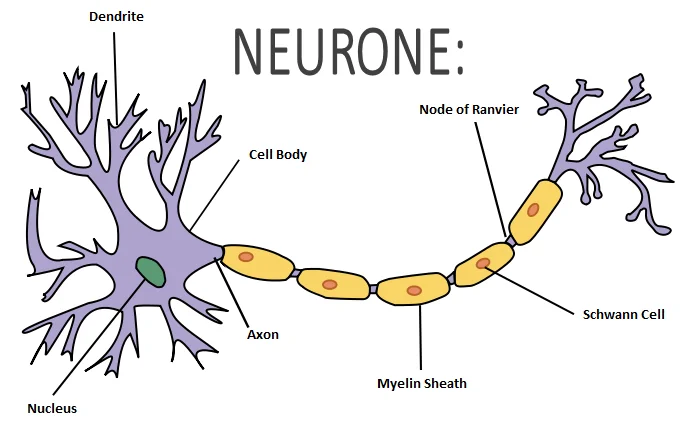 A neurone is a cell that carries electrical impulses. Information is processed and transmitted by the nervous system in the form of electrical and chemical signals. The neurone primarily comprises of a cell body, an axon and dendrites. The axon is a nerve fibre that carries electrical signals away from the cell body, to the end of the neurone. The end of the neurone then connects to the dendrites on the cell body of the next neurone, via a synapse. Drugs cause their effects due to their action on the neurones in the nervous system.
A nerve impulse is a self-propagating wave of electrical disturbance that travels along the surface of the axon membrane. This electrical disturbance comprises of a temporary reversal of the electrical potential difference; not an electrical current. The axon is usually negatively charged compared to the outside of the axon, and this is known as the resting potential, the value of which is usually around -65mV. When a stimulus is received, a reversal in electrical potential difference is caused, and this is known as the action potential (normally around +40mV).
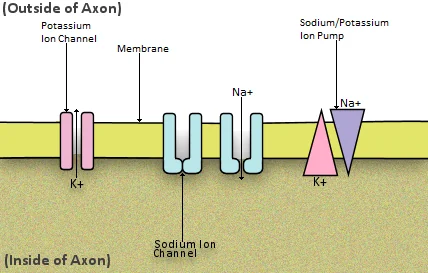
To begin, the inside of the axon is negatively charged, compared with the outside of the axon. The change in potential difference, that is needed to fire off an action potential, is controlled by the movement of sodium and potassium ions in and out of the axon. An ion is a positively or negatively charged molecule. This movement occurs via the action of ion pumps and channels. The ions cannot just diffuse in and out of the axon uncontrollably; this diffusion is prevented by a membrane around the axon. Periodically placed along the membrane are proteins that act as channels for ions to pass through. Sodium gated channels and potassium gated channels open and close to allow the ions to pass through only at specific times. Sodium-potassium pumps transport Na+ and K+ in and out of the axon.
The inside of the axon starts at around -65mV compared to the outside of the axon. An action potential is reached when the axon is at +40mV compared to the outside of the axon. This value of +40mV is reached by the movement of sodium and potassium ions in and out of the axon. Sodium-potassium pumps transport 2K+ into the axon for every 3Na+ transported out of the axon. Both sodium and potassium are in the forms of positive ions here. However, more sodium is removed from the axon compared to the potassium brought. This means the overall electro negativity is decreasing in the axon, and the axon is getting closer to reaching the potential difference of +40mV. Sodium ions then begin to diffuse back into the axon naturally, and potassium ions diffuse back out. At this stage however, potassium gated channels are open, whereas sodium gated channels are closed. This means the K+ can diffuse out faster than the Na+ can diffuse back into the axon. This increases the potential difference further between the inside and the outside of the axon.
Once an action potential has been established, it “moves” along the axon in a neurone. The action potential doesn’t move in a physical sense of the word; the reversal of electrical charge is instead reproduced at different points along the axon, in a “Mexican wave” effect. One point in an axon will become depolarised (depolarisation is a change in a cell’s membrane potential, making it more positive, or less negative), and this depolarisation is a stimulus for the next region of the axon to depolarise. As the next region depolarises, the previous region returns to normal and repolarises.
Eventually, the action potential will reach the end of an axon, known as a synaptic knob. A synapse occurs at a point where the axon of one neurone meets the dendrite of another neurone.
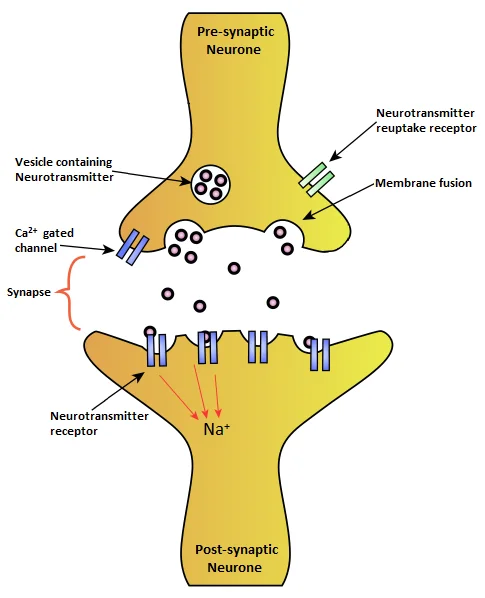
When an action potential reaches the synaptic knob, the calcium ion channels open, and Ca2+ enters the synaptic knob. As the Ca2+ enters, the vesicles containing the neurotransmitters fuse with the membrane of the pre-synaptic neurone, and the neurotransmitters are released into the synapse. The neurotransmitter molecules attach to the receptors on the sodium ion channels, which allow Na+ ions to diffuse into the post-synaptic neurone. This influx of Na+ generates a new action potential in the post-synaptic neurone. An enzyme is then released into the synapse that breaks the neurotransmitters down into small, precursor molecules. These fragments are reabsorbed by receptors on the pre-synaptic neurone, and they are then used to remake the neurotransmitters. The neurotransmitters are then ready to release when a new action potential reaches the pre-synaptic neurone. This reabsorbing prevents the neurotransmitters from continuously binding with the sodium ion channels on the post-synaptic neurone, and firing off repeated new action potentials.
Neurotransmitters can have one of two effects. Excitatory neurotransmitters/receptors make it more likely that a new action potential will fire off. Inhibitory neurotransmitters/receptors make it less likely that a new action potential will fire off. Many drugs work by affecting the way neurotransmitters work. There’s a handy table listing the effects of different neurotransmitters right here.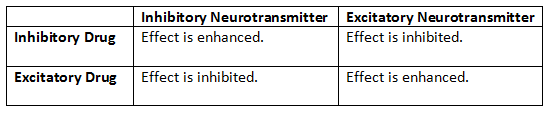 Drugs can stimulate the nervous system by creating more action potentials in the post-synaptic neurone. They can do this by mimicking a neurotransmitter, stimulating the release of more neurotransmitter, inhibiting the re-uptake receptor on the pre-synaptic neurone or by inhibiting the enzyme that breaks down the neurotransmitter. Agonists are chemicals that bind to a receptor and trigger a response, often by mimicking the neurotransmitter.

Drugs are also capable of inhibiting the nervous system by creating fewer action potentials in the post-synaptic neurone. This can be done by inhibiting the release of neurotransmitter, or blocking receptors on the sodium/potassium ion channels. This reduces the body’s response to impulses. Antagonists work by blocking or dampening signals of agonist drugs/neurotransmitters.
The Action of Different Drugs on the Nervous System
Psychedelics mostly act on serotonin receptors, and act as full or partial agonists. LSD, LSA, psilocin, DMT, mescaline and the 2Cx family all work as partial agonists. The table below shows a few of the commonly known psychedelics, and their action on receptors. The 5HT receptor system acts via the neurotransmitter of serotonin, D1 acts via dopamine, and the A-2 system acts via noradrenaline. 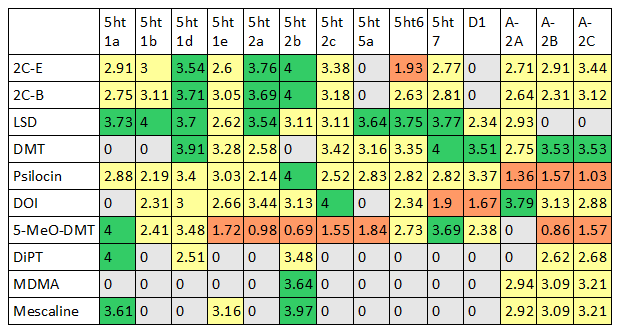 The scale is from 0 to 4, with 4 being the highest affinity. The chart above is colour coded with a traffic light system. Green refers to an affinity of 3.5-4, representing a very high affinity. Yellow is 2-3.5, representing medium affinity. Orange is below 2. Any value that is orange/below 2 should be disregarded, as the affinity isn’t high enough to cause any great effect. Grey is 0, meaning no affinity at all to the receptor.
The current scientific consensus is that the 5HT-2A receptor is the one targeted by drugs responsible for psychedelic experiences. However, drugs like mescaline and MDMA are both capable of inducing psychedelic experiences on par with that of psilocin and LSD, but show no affinity to the 5HT-2A receptor.
LSD, for example, works by fitting into the receptors on the post-synaptic neurone. It has a higher affinity than serotonin itself for the serotonin receptors, specifically 5HT receptors, and therefore prevents serotonin binding to the receptors by competing with it.
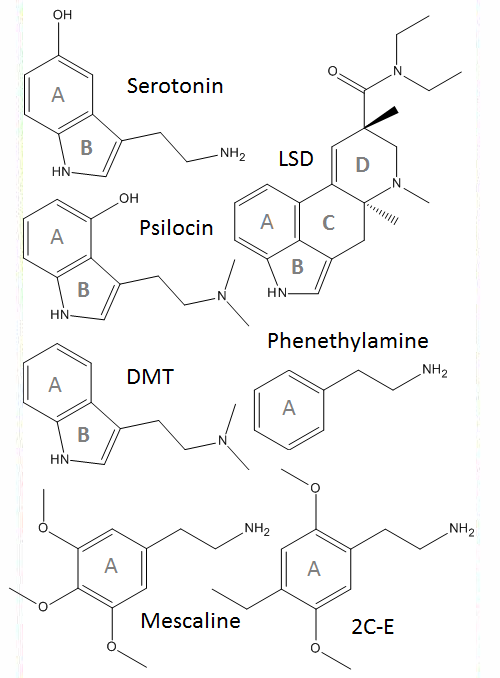
The diagram above shows the structural similarities between the psychedelics. The three classes (phenethylamines, lysergamides and tryptamines) all contain the same chemical rings, which have been labelled. A represents the benzene ring, which all three classes contain. B represents the pyrrole ring, in both tryptamines and lysergamides. A and B together form the indole ring. C (cyclohexane) and D are only contained in the lysergamides, possibly contributing to its potency.
Dissociatives act as non-competitive NMDA receptor antagonists, meaning they inhibit glutamate molecules. Glutamate is the neurotransmitter responsible for telling the body when it’s “awake”, for building up memories and for regulating awareness, mood and movement. NMDA receptors allow for electrical signals to pass between neurones in the brain and spinal column; for the signals to pass, the receptor must be open. NMDA receptor antagonists close the NMDA receptors, by preventing the glutamate from binding to it. This disconnection of neurones leads to loss of feeling, difficulty moving,and eventually the k-hole. It is also this disconnection that causes the anaesthetic properties of dissociatives.
PCP, MXE and ketamine fall into the arylcyclohexylamine class of chemicals, which possess NMDA receptor antagonist properties. DXM/DXO fall into the morphinan class of chemicals. Nitrous oxide, however, is unique, due to being an inorganic molecule. Another inorganic dissociative is xenon, which is also an NMDA receptor antagonist. However, information on recreational use is limited.
Deliriants are antagonists towards the cholinergic receptors, blocking the neurotransmitter acetylcholine. Acetylcholine is the neurotransmitter responsible for regulating the sleep cycle, dreaming alertness, and for building memory. The prolonged suppression of cholinergic activity and REM sleep due to deprivation or amphetamine abuse creates psychotic episodes which may be defined as bursts of dream activity erupting spontaneously into waking states. Deliriants could therefore be considered to trigger a similar state by blocking acetylcholine and suppressing cholinergic system activity. Causing trippers to begin dreaming whilst maintaining full conscious awareness. Deliriants are known for causing people to have no memory of their experience, tying in with their anticholinergic effects. Anticholinergics are split into two class; anti-muscarinic (act on muscarinic acetylcholine receptors) and anti-nicotinic (act on nicotinic acetylcholine receptors). Anti-muscarinic drugs include DPH, scopolamine and atropine. They are all competitive antagonists, meaning they bind to the receptor, but do not activate it.
Atypical drugs don’t fit into the three basic hallucinogen categories, and act in a number of different ways. MDMA is an entactogenic drug that works as a re-uptake inhibitor targeting serotonin receptors. This leads to the prevention of the re-uptake of the serotonin. More serotonin in then in the synapse, so the receptors on the post-synaptic neurone continue to be fired off. Serotonin is known for its control of mood, often being referred to as “the happy chemical”, along with dopamine. Muscimol is a GABA agonist. Salvia is a k-opioid receptor agonist. The k-opioid receptor is responsible for altering the perception of pain, consciousness, gravity, fear, mood and motor control. This explains the sensations of intense gravity, painful tingling and paranoia during Salvia trips. Ibogaine is 5HT-2A agonist, an NMDA antagonist and the k-opioid receptor agonist. The tryptamine core of ibogaine causes the affinity to the 5HT system.
This section has described the chemistry and neuroscience at the basic level of the neurone. However, I intend to write a second part to this article, which describes in detail the effects of hallucinogens, and specifically psychedelics, on specific parts of the brain, and how this translates into the subjective components of the psychedelic experience.
MXE, broken down and described
Threshold : 8 - 20 mg
Light : 20 - 40 mg
Common : 40 - 60 mg
Strong : 50 - 100+ mg
(oral ingestion)
Onset : 20 - 60 minutes
Duration : 2 - 6 hours
Normal After Effects : 2 - 48 hours
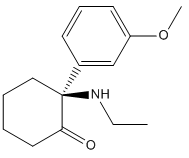
MXE or Methoxetamine is a recently discovered dissociative with little to no history of human usage, first spotted by the authorities for sale on a number of websites in November 2010. It is a chemical of the arylcyclohexylamine class and a derivative of ketamine, thought to behave as an NMDA receptor antagonist and dopamine reuptake inhibitor, though it has not been formally profiled pharmacologically. It is a product of intelligent drug design, its N-ethyl group was chosen to increase potency deliberately, making it 4 times as potent as ketamine. An interesting and detailed interview with the anonymous chemist who invented this substance can be found here.
It is in my opinion, the most genuinely interesting research chemical created so far, taking it’s users to impossibly deep states of detachment and incredibly rich hallucinations. The base components of which I will begin to break down and describe now…
Physical effects:
The methoxetamine body high is not characterized by an increase in sensory input to the body as with most hallucinogens, but is actually something that could only be described as the complete opposite of this feeling. As a user increases their dosage, the only physical sensation that makes itself proportionally apparent is a feeling of a cold, mechanical numbness, which at higher doses is capable of becoming completely anaesthetic like in its effects. This is accompanied by feelings of physical detachment that start out as sensations of being removed from the body, autonomy and a slight lack of motor control. Ending with complete a disconnection from the physical senses and out of body experiences.
Cognitive effects:
As feelings of being disconnected from the body increase, the mind begins to detach itself simultaneously, resulting in bizarre mental states of dissociation. These can be described at lower levels as feelings of detachment from the external environment, making the world seem as if it were being watched through a TV, a dream or just intrinsically unreal in some way. Creating a feeling of being mentally withdrawn from the environment, allowing people to look at their lives from an almost third person perspective and analyse it without bias, surprisingly resulting in an enjoyable state of deep introspection and a profound drunkenness.
As the detachment increases, the ego becomes severely suppressed and inhibited, impairing cognitive functioning and suppressing the short term memory until it begins to struggle or become completely incapable of holding onto a normal thought for any length of time.
Besides generic feelings of extreme mental intoxication normally found at these levels of ego suppression, MXE has the extremely unique effect of making films and TV shows become ridiculously immersible, to the point where you become so carried away that you begin to think it is genuinely happening in front of you. Despite the fact that you cannot even begin to follow the plot, feeling to me like the cognitive functioning of the ego has been stripped away to the point where it can no longer distinguish between what is real, and what is simply playing on a screen in front of it. An effect that also translates over to a few specific videogames.
Now I hate including cultural references in my writings and I apologize in advance, but the greatest specific example of this is high dose MXE trips combined with flying through landscapes on Minecraft creative mode. Literally feeling as if you are flying in the most realistic way and an incredible experience. One that works equally as well if somebody else takes control of the game and plays for you, still feeling as if you are still the only person playing. This seems to work across all people at the appropriate dosage. For a video of the specific game play that I am talking about click here.
Visual effects:
At lower levels of dissociation, the visual effects of MXE are extremely simplistic and shallow. Generally manifesting themselves as blurred and double vision and only becoming deep once a person has been almost or completely disconnected from their body and sensations.
Starting with the dissociative equivalent of visuals, which can be described as morphing geometric patterns which are super imposed onto a black background. Feeling not as if they are on a veil in front of your vision as with LSD or mushrooms but instead completely surrounding and encasing your visual field. They are extremely simplistic and slow moving in comparison to other dissociative visuals such as DXM. Only presenting themselves when the eyes are closed and often appearing to be comprised of many tiny interlocking woven lines. These do not seem to increase in complexity as a person reaches higher levels of dissociation, but are instead taken over by and replaced once complete and total disconnection of the body is reached. Causing trippers to slip into what the online dissociative community commonly refers to as “the M-hole”. These are completely solid and physical structures of a vast scale. A common characteristic among all of the dissociatives but can be described as particularly monolithic and ominous in appearance with this substance, especially when compared to the likes of ketamine and DXM.
These structures take a huge variety of forms but can be described as spires, towers, tear drops, columns, cubes and shapes of any kind that are huge in size and often thousands of miles wide. They alternate between each other by morphing in a comprehensible, consistent way or by panning out of view until another structure takes its place. As a tripper’s dosage increases to states of level 4 dissociation, the amount of detail in which these structures are seen and felt increases proportionally. This continues until the sensation of seeing the entire universe condensed into an infinitely intricate form becomes present. This is accompanied by the sudden realization that you are the structure you are staring down upon.

Above is my amateur attempt at replicating a generic MXE space with a simplistic structure.
As disconnection increases to even further levels of dissociation, hallucinatory states not unlike those found within common psychedelics come into play, these are extremely diverse imagined scenarios in which contact with autonomous entities are completely possible. They look perfectly solid in appearance, with reports of memory replays and becoming god seeming to be common across a large percentage people who choose to explore MXE this deeply.
Perspective distortions:
The perspective distortions on MXE do not seem to feel particularly different from those found on other commonly used dissociatives such as DXM and Ketamine. Most commonly including, alice in wonderland syndrome, the feeling of becoming impossibly giant or tiny in size. Changes in noise volume, sounds seeming either extremely loud or very quiet and muffled. As well as distortions in distance, making specific objects or the entire external environment seem physically closer or further away.
Potential health effects, addiction and tolerance:
The toxicity and long term health effects of recreational MXE use does not seem to have been studied in any scientific context and the exact toxic dosage is unknown. This is because MXE is a research chemical with very little history of human usage. Anecdotal evidence from people who have tried MXE within the psychedelic community confirm that there do not seem to be any negative health effects attributed to simply trying this drug at low to moderate doses or using it sparingly but nothing can be completely guaranteed.
The only known death attributed to simply trying this substance is a swedish man who intravenously injected 100 mg of methoxetamine along with 400mg of MDAI and died due to cardiac problems. The fact that these were both injected and the amount of MDAI was 4 times the recomended dosage when consumed orally does not provide us with any real data. This is especially true when you consider that extremely high dose MXE trips of 200mg + are reported all over the internet without any negative consequences and I have personally consumed doses of 180mg without even experiencing a come down or hang over the next day.
There has been one anecdotal report of a girl who deliberately tried to kill herself by consuming 900 - 1000mg of MXE but survived unharmed and the specific trip report for this can be found here. Once again however this does not provide any real data because she was taken to hospital and made to consume charcoal in an attempt to rid her body of the substance.
MXE does not seem to physically addictive but can become habit-forming as there is no real tolerance attributed to this drug, meaning that it could potentially be used multiple days in a row if somebody chose to do so. There have been multiple reports across the internet of people becoming seriously addicted daily users of this substance so serious precautions and considerations should be taken before trying this substance.
Reports of compulsive redosing during high dose trips resulting in over doses have also been reported. This can be prevented by keeping your MXE far away from you when tripping and addiction can be avoided by manually limiting your usage of the drug. It’s worth noting however that just as with most hallucinogens, most users note that the desire to use them can actually decrease with use.
In terms of its long term health effects when used repeatedly and with excess for extended periods of time, MXE seems to exhibit almost identical bladder and urinary tract problems to those found within ketamine but to a lesser extent. This is because MXE is 4 times as potent as Ketamine so significantly less of drug needs to be consumed. Symptoms of Ketamine cystitis can become extremely serious and can described as,
- urinary frequency - a need to empty your bladder every few minutes.
- urinary urgency - a sudden, compelling need to urinate
- urinary pressure - a constant sensation of fullness in your bladder that is unrelieved by urination
- pelvic and bladder pain - pain can develop suddenly and severely, particularly as the bladder fills with urine.
- hematuria - visible blood in the urine.
- incontinence - leakage of urine
All of these however can easily be avoided by simply not using MXE on a daily or even weekly basis and once again, manually limiting your usage of the substance.
Legal Issues:
- As of October the 18th 2012 MXE has been regarded as a Class B of the “Misuse of Drugs Act (1971)”, despite the fact that the act does not classify drugs based on harm. The report went on to suggest that all analogues of MXE should also become class B drugs and suggested a catch-all clause covering both existing and unresearched arylcyclohexamines.
- MXE has been a controlled substance in Russia since October 2011
- MXE has also been illegal in Switzerland since December 2011.
- MXE became a controlled substance in Japan from July 1, 2012, by amendment to the Pharmaceutical Affairs Law.
Else where in the world however MXE is completely uncontrolled and unscheduled. If you want to try this substance a quick google search for the term “MXE vendor”, “methoxetamine vendor” or other similar phrases is usually sufficient to find a supplier in the top 3 or 4 links. It is also freely available in any desired quantity in the countries of which it has been made illegal, you just have to search a little harder.
Conclusion:
In conclusion, MXE is one hell of a drug, it is an extremely weird trip and not for the faint hearted. Capable of taking people to worlds so unlike anything found within psychedelics yet still freely available across the internet through grey market research chemical vendors.
It is definitely worth noting however that MXE does have a dark side to it, with potentially addictive effects for those who are lacking in self control and can easily be abused.
The physical, visual and cognitive components of a Dissociative trip
Dissociatives are a class of hallucinogen which reduce or block signals to the conscious mind from other parts of the brain. They offer a trip that is characterized by dissociation and bizarre feelings of detachment from reality. With anaesthetic like effects and dream like states.
It’s worth noting that in comparison to psychedelics and deliriants they are a very new class of hallucinogen with the first classical dissociative being synthesized in 1926 (PCP).
This guide is in reference to all of the classical Dissociatives or more specifically Ketamine, MXE, DXM, PCP and 3-MeO-PCP. This list excludes Nitrous Oxide which feels completely a-typical in comparison.
All of the classical Dissociatives are pharmacologically categorized as NMDA receptor antagonists which are a class of anesthetics that work to antagonize, or inhibit the action of, the N-methyl d-aspartate receptors (NMDAR) within the brain. The NMDA receptor is a receptor that allows for the transfer of electrical signals between neurons in the brain and in the spinal column. These receptors are located at the end of dendrites on a neuron cell. The dendrites send messages to other neurons through these, but when a drug that blocks the NMDA activity is taken, they are partially or entirely blocked, decreasing the brains ability to transfer information across itself. This disconnects the neurons and triggers feelings of extreme dissociation or detachment, leading onto hallucinatory states which differ from a psychedelic experience in almost every possible way.
This guide will categorize the universal effects that occur between each of the classical dissociatives and break them down into their simplest components.
Dissociation and detachment:

Feelings of detachment are the most noticeable component of a dissociative trip.
At lower states of dissociation this essentially feels like an obvious but still difficult to pinpoint feeling of detachment from the external environment and body. The greatest analogy to depict this is that if we look at the world through a window during our day to day lives, when a person becomes dissociated they are standing increasingly further back from this window proportionally to the dosage consumed. This triggers a feeling of being mentally withdrawn from the environment, allowing people to look at their lives from an almost third person perspective and analyse it without bias, surprisingly resulting in an enjoyable state of deep introspection and a profound drunkenness. These states are often described by people as:
- Feeling generally separate from the external world.
- Feeling physically and/ or mentally autonomous.
- Feeling as though life is being watched through a screen.
- Feeling as though life is a film or a dream.
- Feeling as though you are physically further away in distance from the external world.
- Feeling as though you are looking through somebody else’s eyes.

States of dissociation and detachment increase proportionally to dosage until they become completely detached from the external environment and eventually their own bodies causing them to slip into the famous dissociative hole.
A process which can be broken down into 4 distinct levels of increasing intensity.
- partial detachment - This can be described as feelings of surrealness and general detachment from the external environment. As described in detail above.
- detachment from environment - As the detachment increases the environment becomes physically further away in distance and increasingly disconnected from a persons sensory perception. Blurred vision sets in while anaesthetic like effects and tactile numbness begin to take place. At this point motor control, coordination and balance become suppressed in a way that is proportional to dosage. In terms of sound, hearing also seems to become muffled and distant.
- detachment from body - Complete disconnection from body. It is here where the tripper finds themselves out of their body having slipped into a what can only be described as a hallucinatory hole or an empty void.
- detachment from self - The fourth level of dissociation and detachment occurs at the pont at which the brains neurons have become so disconnected that a persons sense of mind and self cease to exist, resulting in ego death. This gives the profound experience that there is no longer an “I” experiencing the intensity of the trip any more, there is just the trip as it is and by itself.
In terms of the thought patterns and general mental processes, dissociative ego death is very similar to its psychedelic equivalent in a number of ways. Characterized by an extreme loss or failure of a person’s short and long term memory. This means that a person who is experiencing ego death cannot hold onto the memory of where they are, what they are doing or who they even are, instantly forgetting everything as soon as it happens to them. - detachment from awareness - The highest level of detachment occurs when the neurons within a persons brain have become so disconnected from each other that the tripper literally passes out into total unconsciousness. This consistently leaves extended gaps in a persons memory and large periods of amnesia which are literally impossible to recall once the experience is over.
More Examples: here and here
Double vision:
As a person begins to become disconnected and detached from their external environment. The visual field not only becomes blurred and indistinct but completely doubled over itself. This feels as if you are seeing out of both of your eyes at once with the two images no longer being spliced and merged together into a unified whole. Forcing people to close one of their eyes if they want to perform any task which requires fine vision or reading.

Perspective Distortions:
Another very common mental component of a classic dissociative trip is one of a profound shift in perspective; this generally consists of drastic changes in the size and distance attributed either to a person’s body or their external environment.

Feelings of suddenly having an impossibly giant or tiny body are very common. This feeling is already known by the scientific literature as “Alice in Wonderland Syndrome”. It is known as a temporary condition often associated with migraines, brain tumors, and of course the use of psychoactive drugs. With dissociatives at least it can also be more specifically attributed to the room around you or certain body parts. For example feelings of having a huge head or tiny limbs are quite common. This specific mental component has limitless potential in terms of size and the feeling of being simultaneously huge and tiny or having a body that feels larger than the entire universe is not unheard of.
Perspective distortions can also affect distance, making specific objects or the entire external environment seem physically closer or further away.
Another common manifestation of this effect is changes in noise volume, making sounds seem extremely quiet and muffled or extremely loud and overwhelming.
More examples: here, here and here.
Scenery slicing:
Scenery slicing is a fairly uncommon visual but appears across multiple people and regularly enough to make it worth mentioning. This effect usually happens spontaneously with no obvious trigger and makes the external environment appear as if it has been cut remarkably cleanly into separate slices with a razor blade Which then slide across each other in separate directions causing the visual field to split apart into sections.

Visual geometry:
Visual geometry is the sensation of a person’s field of open and closed eye vision becoming partially or completely encompassed by fast-moving kaleidoscopic and indescribably complex geometric patterns, form constants, shapes, fractals, structures and colour.
Visual geometry never stands still at any point and are often extremely fast changing and self transforming in terms of their shape and style within themselves. This happens whilst they are naturally drifting laterally or radially across the visual field to create overlapping webs of many arising and decaying geometric patterns, all of which are visible within a single perceptual frame.
Whilst psychedelic visual geometry merely displays itself on a veil in front of your visual field with no sense of particular size attributed them. Dissociatives are significantly less complex but make up for this through the sheer immersiveness of their style. These visuals take you directly into the center of them, as if they are surrounding you and also have a sense of physical size and distance attributed to them.
In terms of their stylistic appearance they also tend to be darker and slower in terms of their movement and the way in which they shift in their shape across themselves. These usually only display themselves when the tripper has their eyes closed or are in darkness.

Dissociative visual geometry can only be broken down into 4 possible levels, as opposed to the 7 difering levels of intensity found within psychedelic visual geometry (including 7A and 7B). They can be broken down and described as…
- Visual Noise – This is the most basic level of visual geometry and can be experienced in a completely sober state. It can be described as the visual noise or static combined with random light and dark red regions that can be seen under the eye lids.
- Motion and Colour – This level is also easily obtainable without psychedelics and can be described as the appearance of unstructured regions of fleeting flashes and clouds of colour.
- Partially Defined Geometry - This is the level where things start to get distinctively psychedelic and complex indescribable shapes and patterns begin to show themselves. At this level however the patterns can be described as strictly 2-Dimensional. They are fine, small and zoomed out in size with a dark colour palette that limits itself to a couple of different shades such as black and dark purples.
They are displayed on both the open and closed eye visual field across a flat veil of geometry but significantly more detailed with the eyes closed or in dark environments. - Fully Defined Geometry – This is the level where the detail in which the geometry displays itself becomes profoundly complex but remains strictly 2-Dimensional. At this point the visuals become large in size and extremely intricate in detail with a colour palette that is limitless in its possibilities.
They are displayed on both the open and closed eye visual field across a flat veil of geometry that floats directly in front of the eyes, remaining significantly more detailed with the eyes closed or in dark environments.

Spaces and holes:
The spaces and holes encountered on Dissociatives are something that is experienced once the detachment has reached level 3. When you have finally become completely disconnected from your physical body. Causing you to undergo an out of body experience and be pulled into a place that feels as if it is outside of reality.
A place that is commonly referenced to by the dissociative community as a hole. With drug specific manifestations of this state being known as “the K-hole” for Ketamine and the “M-hole” for MXE. Commonly described as a complete loss of bodily awareness and sensations of floating or falling through a dark and infinite void over great physical distances. Often done on what feels like some sort of invisible rail. A feeling that is interpreted by many people as flying through space or the night sky. With many trippers stating that they feel as though their perceptions are located so deep inside the mind that the real world seems so distant that it might as well not exist.
In terms of its appearance, a typical dissociative hole is usually completely dark with occasional clouds of slow moving amorphous colour clouds in the background. At their lowest level they are completely empty, but as dosage is increased they are accompanied by and filled with a wide variety of elaborate and complex structures which are described in detail below.
More examples: here.
Hallucinatory structures:
Dissociative induced hallucinatory structures are the only feature found within what would otherwise be completely empty spaces and holes. They can generally be described as 3-Dimensional and monolithic shapes or structures of infinite variety and size that float above, below or in front of you as they gradually zoom, rotate or pan into focus and become unveiled before your eyes at a slow pace. These structures can take any static comprehensible shape possible but can commonly be experienced as vast and giant pillars, columns, blocks, teardrops, wheels and pyramids. Often fractal in nature and capable of being manifested in any variety of colours but usually following darker themes and tones. In terms of the materials that they appear to be comprised of and the complexity of detail in which they are perceived in, dissociative structures can be broken into 4 basic levels.
- 2-Dimensional Structures - The most basic level of structural complexity confines it’s geometry to strictly 2-Dimensional shapes. These shapes are usually very flat and dark in their colour and often “felt” instead of seen in a way that cannot be described adequately to the uninitiated. In terms of their size, these structures take up the entirety of a persons visual field but do not appear to have any particular size attributed to them.
- Partially defined 3-Dimensional Structures - Above this the structures become better defined and 3-Dimensional in shape with basic detail in their lighting and shadow. Appearing to be made of semi transparent condensed colour or solidified shimmering visuals that are seen as ill defined, soft and out of focus around their edges. In terms of size, these structures appear to be extremely large, stretching out across hundreds and hundreds of metres.
- Fully defined 3-Dimensional Structures - Once hallucinatory structures reach their third level of complexity they become fully defined in their shape, edges, lighting, shadow and detail. Often appearing to be made of solid and dense realistic materials such as stone and metal. They are capable of being thousands of miles across themselves and extremely complex in form.
- Self transforming mechanistic structural universes - As dosage increases, the detail continues to complexify proportionally until the sensation of seeing the entire universe condensed into an infinitely vast and intricate self transforming machine structure becomes present. Accompanied by the sudden realization that you are the structure that you are staring down upon and that the structure is also you. In terms of its appearance, this state is extremely hard to describe. The structure can take any form but usually appears to be a consistently shaped machine-like structures or clouds that are infinite in size and felt at every point of detail across themselves. This is immediately interpreted through some sort of innate instinct as “the universe” or at least, “everything” by everybody who undergoes the experience.
Structures typically last anywhere from 30 seconds to several minutes before the person slips back into reality or into the presence of another structure. There are three different methods through which these hallucinatory structures are shifted between.
- Structural Transformations - structures can switch between each other by morphing around you in a static, comprehensible way. Something that usually unfolds in front of you in a rather slow, step by step morphing process.
- Structural Panning - structures can switch between each other by remaining completely static in their shape but simply panning out of view until they are no longer within your field of vision. It’s from here that another structure usually comes into view from behind your physical body within a few seconds to a couple of minutes. Allowing the cycle of continuous spontaneous structures to go on undisturbed.
- Travelling over great distances - The third method of transitioning is experienced when the structures appear to be stuck in place whilst you are floating silently between them over what feels like a huge and physical distance. This is often done on an invisible rail through the vast and infinite dissociative hole. A feeling that is interpreted by many people as flying through space or the night sky.
As a tripper’s dosage increases, the level of detail in which these structures are seen and felt increases proportionally. Below is my amateur attempt at replicating what it’s like to float through an extremely simple generic space, with a basic structure.

More examples: here.
Hallucinatory states:
Hallucinations and scenarios are only possible during very high dose trips and an intensely realistic component of the Dissociative experience. They could be anything but generally fall under common archetypes such as contact with autonomous entities, imagined landscapes, alternate dimensions, replayed memories and situations that seem so unlike anything previously experienced that they are in all probability, untranslatable into English. Starting out by following a feeling of detachment from the hallucination itself, for example watching autonomous people and entities going about their daily business oblivious to your existence, playing out as if it were a film. At higher doses of hallucinatory states they become increasingly involved, accessing distant memories from your past is also completely possible. Replayed memories can feel like weeks and weeks of real time hallucinations and are perfect in every detail.
In comparison to psychedelics they are more solid and not made of a closed eye visual based material. The solidity and detachment from these scenarios is what separates them in my opinion from any entity contact or hallucinations experienced on drugs such as Mushrooms or LSD.
In conclusion:
Although this guide is much shorter than my psychedelic guide. This is not because there is less to experience with dissociatives but rather because these compounds have only 5 distinct effects. But none the less, these effects come with an unlimited capacity.