 Disregard everything I say. Every bit of writing here can be considered a work of fiction. Do not ever use anything I've ever said here for anything ever and if you do you are doing so at your own legal risk as I am not responsible for anything that may or may not happen to you. I did after all tell you to disregard everything I say as in reality I actually have no idea what I'm talking about and shall continue to be a retarded teenager with an Internet connection. Please point out as many flaws in my reasoning, claims, factual information and grammar as possible. MYSOURCESARE: Personal Experience, the Internet and nowhere I could just be making things up so don't say I didn't warn you.
An Explanation of the Effect of Hallucinogens upon the Nervous System at the level of the Neurone
This article is intended to be a detailed explanation of how hallucinogens affect the brain, via the inhibition and excitation of neurotransmitters in the nervous system. This article is not written by me, but an extremely close friend of mine who is significantly more knowledgeable when it comes to science, and specifically chemistry. She is also my editor and grammar-checker, as well as scientific advisor and participator in 100% of the field of research that has gone into the previous several specific substance guides which have been posted on this website.
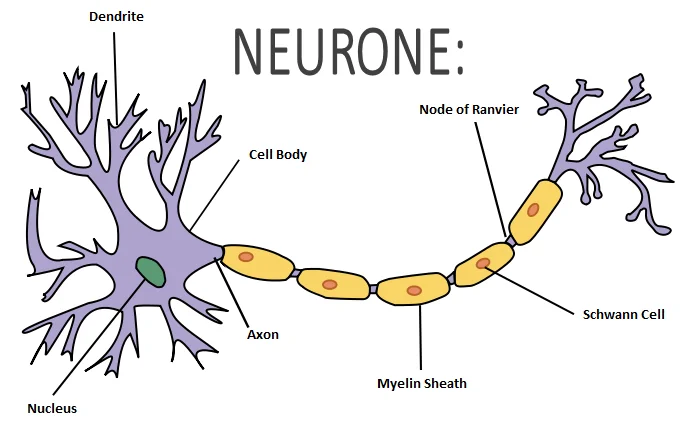 A neurone is a cell that carries electrical impulses. Information is processed and transmitted by the nervous system in the form of electrical and chemical signals. The neurone primarily comprises of a cell body, an axon and dendrites. The axon is a nerve fibre that carries electrical signals away from the cell body, to the end of the neurone. The end of the neurone then connects to the dendrites on the cell body of the next neurone, via a synapse. Drugs cause their effects due to their action on the neurones in the nervous system.
A nerve impulse is a self-propagating wave of electrical disturbance that travels along the surface of the axon membrane. This electrical disturbance comprises of a temporary reversal of the electrical potential difference; not an electrical current. The axon is usually negatively charged compared to the outside of the axon, and this is known as the resting potential, the value of which is usually around -65mV. When a stimulus is received, a reversal in electrical potential difference is caused, and this is known as the action potential (normally around +40mV).
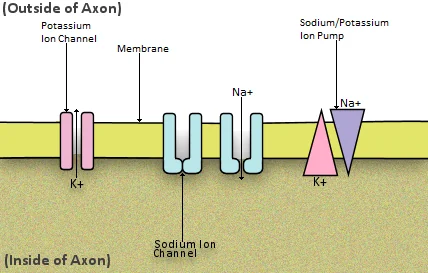
To begin, the inside of the axon is negatively charged, compared with the outside of the axon. The change in potential difference, that is needed to fire off an action potential, is controlled by the movement of sodium and potassium ions in and out of the axon. An ion is a positively or negatively charged molecule. This movement occurs via the action of ion pumps and channels. The ions cannot just diffuse in and out of the axon uncontrollably; this diffusion is prevented by a membrane around the axon. Periodically placed along the membrane are proteins that act as channels for ions to pass through. Sodium gated channels and potassium gated channels open and close to allow the ions to pass through only at specific times. Sodium-potassium pumps transport Na+ and K+ in and out of the axon.
The inside of the axon starts at around -65mV compared to the outside of the axon. An action potential is reached when the axon is at +40mV compared to the outside of the axon. This value of +40mV is reached by the movement of sodium and potassium ions in and out of the axon. Sodium-potassium pumps transport 2K+ into the axon for every 3Na+ transported out of the axon. Both sodium and potassium are in the forms of positive ions here. However, more sodium is removed from the axon compared to the potassium brought. This means the overall electro negativity is decreasing in the axon, and the axon is getting closer to reaching the potential difference of +40mV. Sodium ions then begin to diffuse back into the axon naturally, and potassium ions diffuse back out. At this stage however, potassium gated channels are open, whereas sodium gated channels are closed. This means the K+ can diffuse out faster than the Na+ can diffuse back into the axon. This increases the potential difference further between the inside and the outside of the axon.
Once an action potential has been established, it “moves” along the axon in a neurone. The action potential doesn’t move in a physical sense of the word; the reversal of electrical charge is instead reproduced at different points along the axon, in a “Mexican wave” effect. One point in an axon will become depolarised (depolarisation is a change in a cell’s membrane potential, making it more positive, or less negative), and this depolarisation is a stimulus for the next region of the axon to depolarise. As the next region depolarises, the previous region returns to normal and repolarises.
Eventually, the action potential will reach the end of an axon, known as a synaptic knob. A synapse occurs at a point where the axon of one neurone meets the dendrite of another neurone.
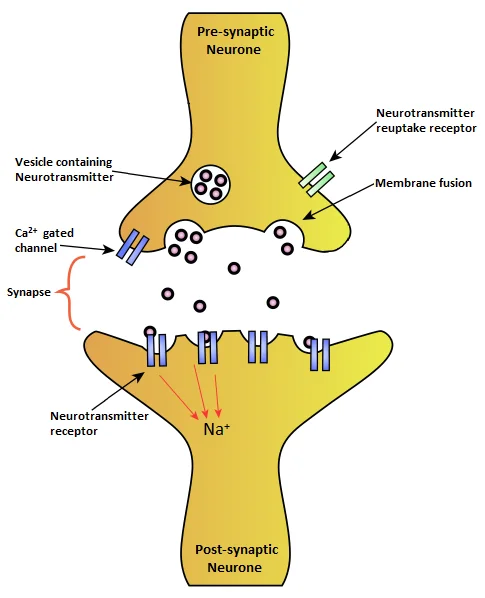
When an action potential reaches the synaptic knob, the calcium ion channels open, and Ca2+ enters the synaptic knob. As the Ca2+ enters, the vesicles containing the neurotransmitters fuse with the membrane of the pre-synaptic neurone, and the neurotransmitters are released into the synapse. The neurotransmitter molecules attach to the receptors on the sodium ion channels, which allow Na+ ions to diffuse into the post-synaptic neurone. This influx of Na+ generates a new action potential in the post-synaptic neurone. An enzyme is then released into the synapse that breaks the neurotransmitters down into small, precursor molecules. These fragments are reabsorbed by receptors on the pre-synaptic neurone, and they are then used to remake the neurotransmitters. The neurotransmitters are then ready to release when a new action potential reaches the pre-synaptic neurone. This reabsorbing prevents the neurotransmitters from continuously binding with the sodium ion channels on the post-synaptic neurone, and firing off repeated new action potentials.
Neurotransmitters can have one of two effects. Excitatory neurotransmitters/receptors make it more likely that a new action potential will fire off. Inhibitory neurotransmitters/receptors make it less likely that a new action potential will fire off. Many drugs work by affecting the way neurotransmitters work. There’s a handy table listing the effects of different neurotransmitters right here.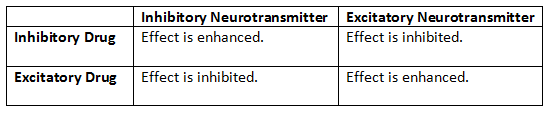 Drugs can stimulate the nervous system by creating more action potentials in the post-synaptic neurone. They can do this by mimicking a neurotransmitter, stimulating the release of more neurotransmitter, inhibiting the re-uptake receptor on the pre-synaptic neurone or by inhibiting the enzyme that breaks down the neurotransmitter. Agonists are chemicals that bind to a receptor and trigger a response, often by mimicking the neurotransmitter.

Drugs are also capable of inhibiting the nervous system by creating fewer action potentials in the post-synaptic neurone. This can be done by inhibiting the release of neurotransmitter, or blocking receptors on the sodium/potassium ion channels. This reduces the body’s response to impulses. Antagonists work by blocking or dampening signals of agonist drugs/neurotransmitters.
The Action of Different Drugs on the Nervous System
Psychedelics mostly act on serotonin receptors, and act as full or partial agonists. LSD, LSA, psilocin, DMT, mescaline and the 2Cx family all work as partial agonists. The table below shows a few of the commonly known psychedelics, and their action on receptors. The 5HT receptor system acts via the neurotransmitter of serotonin, D1 acts via dopamine, and the A-2 system acts via noradrenaline. 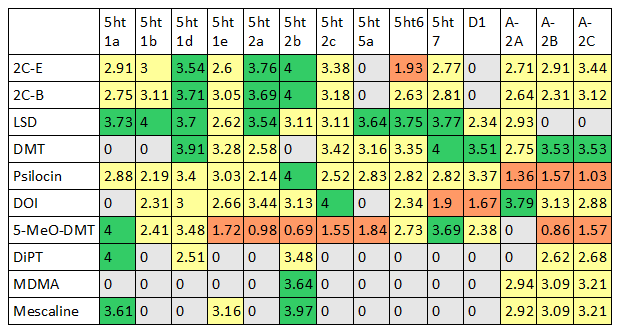 The scale is from 0 to 4, with 4 being the highest affinity. The chart above is colour coded with a traffic light system. Green refers to an affinity of 3.5-4, representing a very high affinity. Yellow is 2-3.5, representing medium affinity. Orange is below 2. Any value that is orange/below 2 should be disregarded, as the affinity isn’t high enough to cause any great effect. Grey is 0, meaning no affinity at all to the receptor.
The current scientific consensus is that the 5HT-2A receptor is the one targeted by drugs responsible for psychedelic experiences. However, drugs like mescaline and MDMA are both capable of inducing psychedelic experiences on par with that of psilocin and LSD, but show no affinity to the 5HT-2A receptor.
LSD, for example, works by fitting into the receptors on the post-synaptic neurone. It has a higher affinity than serotonin itself for the serotonin receptors, specifically 5HT receptors, and therefore prevents serotonin binding to the receptors by competing with it.
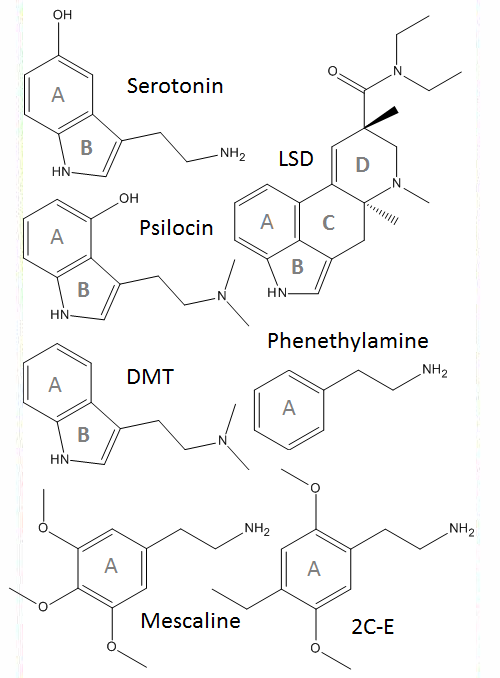
The diagram above shows the structural similarities between the psychedelics. The three classes (phenethylamines, lysergamides and tryptamines) all contain the same chemical rings, which have been labelled. A represents the benzene ring, which all three classes contain. B represents the pyrrole ring, in both tryptamines and lysergamides. A and B together form the indole ring. C (cyclohexane) and D are only contained in the lysergamides, possibly contributing to its potency.
Dissociatives act as non-competitive NMDA receptor antagonists, meaning they inhibit glutamate molecules. Glutamate is the neurotransmitter responsible for telling the body when it’s “awake", for building up memories and for regulating awareness, mood and movement. NMDA receptors allow for electrical signals to pass between neurones in the brain and spinal column; for the signals to pass, the receptor must be open. NMDA receptor antagonists close the NMDA receptors, by preventing the glutamate from binding to it. This disconnection of neurones leads to loss of feeling, difficulty moving,and eventually the k-hole. It is also this disconnection that causes the anaesthetic properties of dissociatives.
PCP, MXE and ketamine fall into the arylcyclohexylamine class of chemicals, which possess NMDA receptor antagonist properties. DXM/DXO fall into the morphinan class of chemicals. Nitrous oxide, however, is unique, due to being an inorganic molecule. Another inorganic dissociative is xenon, which is also an NMDA receptor antagonist. However, information on recreational use is limited.
Deliriants are antagonists towards the cholinergic receptors, blocking the neurotransmitter acetylcholine. Acetylcholine is the neurotransmitter responsible for regulating the sleep cycle, dreaming alertness, and for building memory. The prolonged suppression of cholinergic activity and REM sleep due to deprivation or amphetamine abuse creates psychotic episodes which may be defined as bursts of dream activity erupting spontaneously into waking states. Deliriants could therefore be considered to trigger a similar state by blocking acetylcholine and suppressing cholinergic system activity. Causing trippers to begin dreaming whilst maintaining full conscious awareness. Deliriants are known for causing people to have no memory of their experience, tying in with their anticholinergic effects. Anticholinergics are split into two class; anti-muscarinic (act on muscarinic acetylcholine receptors) and anti-nicotinic (act on nicotinic acetylcholine receptors). Anti-muscarinic drugs include DPH, scopolamine and atropine. They are all competitive antagonists, meaning they bind to the receptor, but do not activate it.
Atypical drugs don’t fit into the three basic hallucinogen categories, and act in a number of different ways. MDMA is an entactogenic drug that works as a re-uptake inhibitor targeting serotonin receptors. This leads to the prevention of the re-uptake of the serotonin. More serotonin in then in the synapse, so the receptors on the post-synaptic neurone continue to be fired off. Serotonin is known for its control of mood, often being referred to as “the happy chemical", along with dopamine. Muscimol is a GABA agonist. Salvia is a k-opioid receptor agonist. The k-opioid receptor is responsible for altering the perception of pain, consciousness, gravity, fear, mood and motor control. This explains the sensations of intense gravity, painful tingling and paranoia during Salvia trips. Ibogaine is 5HT-2A agonist, an NMDA antagonist and the k-opioid receptor agonist. The tryptamine core of ibogaine causes the affinity to the 5HT system.
This section has described the chemistry and neuroscience at the basic level of the neurone. However, I intend to write a second part to this article, which describes in detail the effects of hallucinogens, and specifically psychedelics, on specific parts of the brain, and how this translates into the subjective components of the psychedelic experience.
Psilocin (mushrooms), broken down and described
Onset : 60 - 120 minutes
Duration : 2 - 6 hours
Normal After Effects : up to 8 hours
Threshold : .25 - 1 g
Light : 1 - 2.5 g
Common : 2.5 - 3.5 g
Strong : 3.5 - 5 g
Heavy : 5 g +
(Mushrooms)
Threshold : 10 mg
Light : 20 mg
Common : 30 mg
Strong : 40 mg
Heavy : 50 mg +
(Psilacetin / 4-AcO-DMT)
Psilocin is a naturally occurring tryptamine psychedelic found within approximately 190 separate species of mushroom, and growing on every continent across the planet. Psychedelic mushrooms have been in use since before recorded human history, with their depiction being found on cave art and famously used by the native people of Mesoamerica for religious and shamanic purposes.
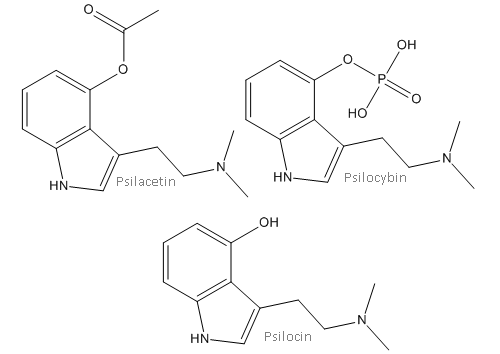
There are two separate chemicals found within mushrooms in roughly equal amounts, both classed as substituted tryptamine alkaloids and serotonergic psychedelic drugs, but it’s important to note that only Psilocin is directly active. The other substance, Psilocybin, is instead a pro-drug of the pharmacologically active substance Psilocin and converted directly into it within the liver. Once the molecule has been converted into Psilocin, it acts as a partial agonist for several serotonergic receptors. Psilocin has a high affinity for the 5-HT2A serotonin receptor in the brain, where it mimics the effects of serotonin (5-hydroxytryptamine, or 5-HT).
In an identical fashion, Psilacetin or 4-AcO-DMT is a pro-drug to Psilocin. This is a drug that is commonly sold as a synthetic grey area tryptamine analogue through online research chemical vendors. It has become increasingly popular over the past several years and is experientially indistinguishable from normal mushrooms. It fits into all of the descriptions of Psilocin effects perfectly, which I will now begin to describe.
Physical effects:
The body high of Psilocin is that of a soft and often overwhelming tingling sensation across the body that is capable of becoming physically euphoric at higher doses. It is incredibly relaxing and results in a mostly lethargic state. This usually causes a tripper to want to sit down on a comfortable spot and enjoy the trip, instead of engaging in physical activities. If physical activities such as dancing are forcibly engaged in however, Psilocin can become almost as energetic as stimulating psychedelics such as LSD and the 2Cx family.
These feelings are also accompanied by a constant urge to yawn, a runny nose and an involuntary shedding of tears that occurs regardless of a person’s current emotional perspective.
Cognitive effects:
The head space of Psilocin has a very obvious stoning effect to it that can be described as vaguely similar to weed. This feels extremely mellow and relaxed but can result in confusion and disorientation when taken in inappropriately complex environments. This is something that can result in easily avoidable irrational, negative and paranoid states for those who undergo the experience without being aware of this in advance.
At high doses, despite an overall relaxation of a person’s thought patterns throughout the duration of the trip, there are constant waves of extremely stimulated and profound thinking. These feel like a flooding of creative and insightful thoughts in quick succession but are spontaneously surpassed by waves of equal intensity and duration which result in the opposite, general thought suppression and mental intoxication.
The overall theme of a person’s thought patterns are directed equally towards states of deep introspection and personal problem solving, as well as states of outrospectiveness. Trippers often find themselves contemplating the society they live in, the nature of existence, their place in the universe and other general philosophical thoughts.
As dosage increases, ego suppression eventually leads onto ego loss or death, resulting in a complete failure of the short term memory. This can lead onto extremely delusional scenarios and false memories, which can be both positive or negative depending on the circumstances. Throughout these states, it is normal to become completely incapable of following conversation. The unstable often find themselves thinking that they are “going insane" or “dying", but stable people discover profound but ineffable secrets with heavy religious and transcendental undertones. These are almost always forgotten afterwards but generally cause trippers to temporarily believe that nothing is ever going to be the same again and that the history of the human race or the entire cosmos will be forever changed from this point forward, with a new, transcendental beginning of some description finally being upon us.
Visual Effects:
The visuals are generally described by most as soft, rounded and somehow organic and natural looking geometry, with slightly more earthy colours of browns, reds and greens. The visuals are not as fast moving or mathematical as LSD and change by means of flowing, swirling and morphing into themselves to create new and constantly changing geometric forms. These visuals are high in structure, spontaneously morphing into structured forms and objects made of a condensed closed eye visual based material.
As the visuals increase proportionally to the dosage, ego death is eventually triggered. This occasionally, but not always, gives way to level 6A psychedelic visuals and a feeling of experiencing the entire universe all at once. More often than not however, Psilocin leads onto level 6B psychedelic visuals; a feeling which can generally be described as becoming completely disconnected from the self and falling into something which is only ever interpreted as the source of all existence. This is a place that feels as if you have entered the very inner workings of the universe, with the underlying source code of existence and the true nature reality presenting itself to you in the most incomprehensible manner.They are very high in imagery, which increase in elaborateness until they have become fully fledged 3D hallucinatory scenarios.
The distortions are significantly more solid on Psilocin in comparison to other psychedelics. They look more believable and are a little more permanent than those found on LSD and the 2Cx series, meaning they are more likely to stay put and not reset if you double take.
The imagery and hallucinations are extremely prevalent in comparison to substances such as LSD and can be described as completely alien in nature, following almost science fiction themes and plots regarding the future of humanity and our place within the universe. I would hypothesize that these themes stem from from the fact that the head space of Psilocin forces people to consider future and potential possibilities which manifests itself directly into the hallucinations.
Auditory effects:
The most common auditory hallucination experienced with Psilocin is hearing your subconscious thoughts and desires being placed onto others. This is often in the form of hearing phrases, statements and messages embedded within music and the things other people say to you; these often feel as if they are completely convincing and real at the time, but become easier to spot with experience.
Health effects, addiction potential and tolerance:
The toxicity of psilocybin, psilacetin and psilocin is extremely low. In rats, the median lethal dose (LD50) of Psilocybin when administered orally is 280 milligrams per kilogram (mg/kg). Psilocybin comprises approximately 1% of the weight of Psilocybe cubensis mushrooms, and so nearly 1.7 kilograms (3.7 lb) of dried mushrooms, or 17 kilograms (37 lb) of fresh mushrooms, would be required for a 60-kilogram (130 lb) person to reach the 280 mg/kg LD50 value of rats. Based on the results of animal studies, the lethal dose of psilocybin has been extrapolated to be 6 grams, 1000 times greater than the effective dose of 6 milligrams.
There are no known long term physical effects from ingestion of mushrooms containing Psilocybin and Psilocin.
Keep in mind that psychedelic mushrooms are non-habit-forming and that the desire to use them can actually decreases with use. They are most often self-regulating. You also build an almost immediate tolerance to them after ingestion, preventing you from experiencing their full effects more often then every 4-7 days, unless you increase your dose significantly.
Legal issues:
- Psilocybin and psilocin are listed as Schedule I drugs under the United Nations 1971 Convention on Psychotropic Substances.
- Psilocybin mushrooms are regulated or prohibited in many countries, often carrying severe legal penalties (for example, the U.S. Psychotropic Substances Act, the UK Misuse of Drugs Act 1971 and Drugs Act 2005, and the Canadian Controlled Drugs and Substances Act).
- On November 29, 2008, The Netherlands announced it would ban the cultivation and use of psilocybin-containing fungi beginning December 1, 2008.
- The UK ban on fresh mushrooms (dried ones were illegal as they were considered a psilocybin-containing preparation) introduced in 2005.
- New Mexico appeals court ruled on June 14, 2005, that growing psilocybin mushrooms for personal consumption could not be considered “manufacturing a controlled substance" under state law. However it still remains illegal under federal law.
- 4-ACO-DMT is unscheduled in the United States. It may be considered an analog of psilocin.
- 4-ACO-DMT could also be considered illegal in the UK under the Misuse of Drugs Act 1971. O-Acetylpsilocin is an ester of psilocin, to which it metabolizes. This means that it potentially carries the same penalty as any Class A drug.
If you want to try Psilocin despite the legal issues you have multiple options. You can purchase them through a street dealer, grow them yourself using this guide here or you can pick them fresh in your local area during the correct season if you know where to look for them.
If you want to try 4-ACO-DMT despite the legal issues, you can find it for sale through the power of google. It sold online to the masses through various research chemical vendors who I cannot legally mention the names of.
Conclusion:
Psilocin is my favourite psychedelic, best used in silent darkness and in high doses to fully release their hallucinatory effects. They are slightly more capable of producing bad trips in people who are inexperienced with psychedelics, as they can be a little more confusing. However, they are extremely rewarding in terms of their head space, allowing for extremely deep philosophical thoughts and realizations that I have not found with any other substance.