 Disregard everything I say. Every bit of writing here can be considered a work of fiction. Do not ever use anything I've ever said here for anything ever and if you do you are doing so at your own legal risk as I am not responsible for anything that may or may not happen to you. I did after all tell you to disregard everything I say as in reality I actually have no idea what I'm talking about and shall continue to be a retarded teenager with an Internet connection. Please point out as many flaws in my reasoning, claims, factual information and grammar as possible. MYSOURCESARE: Personal Experience, the Internet and nowhere I could just be making things up so don't say I didn't warn you.
Ketamine, broken down and described
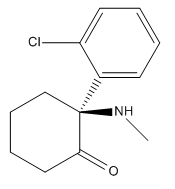
Dosage (insufflated),
Threshold : 10 - 15 mg
Light : 15 - 30 mg
Common : 30 - 75 mg
Strong : 60 - 125 mg
The K Hole : 100 - 250 mg
Duration (insufflated),
Onset : 5 - 15 minutes
Duration : 45 - 60 minutes
Normal After Effects : 1 - 3 hours
Dosage (oral),
Threshold : 40 - 50 mg
Light : 50 - 100 mg
Common : 75 - 300 mg
Strong : 200 - 450 mg
The K Hole : 500 + mg
Onset : 5 - 20 minutes (depending on stomach contents)
Duration : 90 minutes
Normal After Effects : 4 - 8 hours
Ketamine is a hallucinogenic drug used in human and veterinary medicine, primarily for the induction and maintenance of general anesthesia, usually in combination with a sedative. Other uses include sedation and anestheticin intensive care, (particularly in emergency medicine), and treatment of bronchospasm (a sudden constriction of the muscles in the walls of the lungs bronchioles).
Ketamine was originally developed as a medicine in 1965 as a derivative of phencyclidine (PCP), which was synthesized in 1926. It became popular among recreational users in the 1970’s but remains a ‘core’ medicine in the World Health Organization’s “Essential Drugs List”, a list of minimum medical needs for a basic healthcare system.
This substance is a dissocitive which falls into the arylcyclohexylamine class of chemicals, and possesses NMDA receptor antagonist properties. NMDA receptors allow for electrical signals to pass between neurones in the brain and spinal column; for the signals to pass, the receptor must be open. NMDA receptor antagonists close the NMDA receptors by blocking them. This disconnection of neurones leads to loss of feeling, difficulty moving, and eventually the famous “k-hole”.
This drug is the most famous of the classical dissociative hallucinogens and exhibits a wide array of complex subjective effects which are described in detail below…
Physical effects:
Assuming the substance has been insufflated, the very first physical effect hat is noticed is a sharp but relatively painless sensation within the nostril. An unpleasant taste is present for 15 - 20 minutes after insufflation and seems to come and go in an unpredictable manner.
At lower dosages, the physical sensations produced by the trip itself can be broken down into two distinct sensations. The first is a sharp, pleasurable tingling sensation which is location specific to the hands, feet and head. The second is a warm euphoric glow which emanates outwards from the centre of the body’s torso. Alongside of this, a significant decrease in the body’s overall weight is felt. This creates sensations of being extremely light and floaty in a way which is not necessarily stimulating, but still encouraging towards the act of moving around and engaging in physical activities.
As dosage increases, the physical sensations induced by the trip begin to become encompassed by feelings of physical detachment. This begins with feeling as if you are becoming removed from the body with a proportional loss of motor control and tactile sensation that increases along side of it. These sensations of dosage relative physical detachment are often described as feeling as if your body is not your own or feeling as if its movements have become partially to fully autonomous. As this effect increases motor control and bodily awareness are completely lost as total detachment from the physical senses and out of body experiences begin to take toll. This is accompanied by significant changes in the perceived direction and pull of gravity which results in feelings of flying over vast distances in multiple directions and varying speeds.
It’s worth noting that high dose ketamine trips can sometimes result in nausea and vomiting at the peak of trip. For most people, this is surprisingly not as unpleasant as they would initially expect due to the accompanying detachment from the physical senses.
Cognitive effects:
The most noticeable change in mental perception within the ketamine trip can be defined as a mild to complete detachment from the self and conscious awareness, which is the very definition of psychological dissociation. At lower levels this is usually described as feeling somehow separate and withdrawn from the external environment, as if life has somehow become a vague dream or film that plays out in front of you. Alongside of this, feelings of partial to complete autonomy associated with your thought stream and spoken conversation are often noted. As dosage increases, the cognitive detachment and dissociation eventually becomes so all-encompassing that ego death is inevitably reached, this is usually during high level out of body experiences. Along side of this, ketamine exhibits states of therapeutic dissociated introspection and spontaneous environment specific states of unity and interconnectedness.
It has also shown that ketamine, if taken even in small doses, is very effective for patients suffering from chronic depression and bipolar disorder. Specific studies which can be read about here and here have shown that the effect of the drug is immediate or within 2 hours and consistent in relieving patient’s depressive and/or suicidal symptoms, lasting up to 3 days after a single dosage. In comparison, common antidepressents, such as Prozac, are entirely ineffective for 40% of the population and can take weeks to show effects. This gives ketamine the potential to become an indispensable tool in the treatment of depression and bipolar, which is currently being held back by institutionalised drug prohibition. The mechanism behind this has been shown by studies which can be read about here. It stems from the way in which ketamine triggers the release of glutamate, which is a neurotransmitter that immediately stimulates the growth of damaged synapses which have been damaged by stress and depression.
Visual effects:
At lower levels of dissociation, the visual effects of ketamine can be described as the onset of a progressive detachment from the perception of sight and the brain’s ability to process it. This begins with blurred and doubled vision which leads onto the external environment, appearing as if it is being watched through a screen that becomes proportionally more distant dependent on dosage. Accompanying this, visual geometry similar in style to that of a psychedelic trip occurs. This experience is limited to level 1 - 4 experiences however and appears as significantly more colourful and intricate than anything found within MXE, but equal in complexity to that of DXM. Open eye perspective distortions such as alterations in the perception of size and distance attributed to the self and / or the external environment are commonly present.
Other dissociative specific visual distortions and alterations such as scenery slicing and environmental cubism are also present. As overall visual detachment increases in perfect proportion to its physical counterpart, out of body experiences eventually begin to set in. This takes a person’s conscious awareness into a place which can only be described as entering a vast and dark void, space or hole. It is commonly referred to by the drug community as “The k-hole” and contains within it an infinite array of level 1 - 4 hallucinatory structures.
Alongside of this, fully 3-dimensional hallucinatory states such as autonomous entity contact, landscapes and concepts are occasionally present, but significantly less consistent in their manifestation than psychedelics and deliriants.
Auditory effects:
At lower levels of detachment, a greatly enhanced sense of music appreciation becomes present. This can be described as the sensation of being able to comprehend and pay attention to each and every layer of sound to a complex piece of music. As dissociation increases however, sound can eventually become muffled, distant and extremely hard to perceive. Alongside of this, distortions in noise volume perception are often extremely altered at random points creating the sensation that everything is abnormally loud or silent.
Health effects, addiction potential and tolerance:
There are multiple dangers associated with compulsive ketamine abuse. It is because of this that I highly recomend doing as much research as you possibly can before considering trying this drug.
Extreme ketamine use can injure the bladder, causing ulcers (wounds) and fibrosis (stiffening of the bladder walls and shrinkage). This is strictly associated with regular overuse of ketamine and results in urinary frequency, urgency, pressure, pain, incontinence and/or bleeding from the bladder. They can receive a variety of diagnoses including ulcerative bladder, interstitial cystitis or ketamine cystitis.
Ketamine is also psychologically addictive when used on a regular basis. This can be avoided however by manually limiting your usage and not taking it compulsively.
Fatal ketamine overdoses are particularly rare but not completely unheard of. The LD50 for ketamine when injected into mice is 400mg/kg. As humans are generally more sensitive to drugs we devide it by 2, making 200mg/kg the estimated human lethal dose. Assuming the human weighs a conservative 50kg, this would require the lethal dosage to be atleast 10 grams. 40 times the amount of 250mg necessary for a highdose K-hole experience.
In terms of ketamine tolerance, this can take weeks to build up for some but for others it can take a single night of heavy use. Once a physical tolerance to ketamine has set itself in, it can often take a month or more to reset itself.
Legal issues:
- The increase in illicit use prompted ketamine’s placement in Schedule III of the United States Controlled Substance Act in August 1999.
- In the United Kingdom, it became labeled a Class C drug on 1 January 2006.
- In Canada, ketamine is classified as a Schedule I narcotic, as of August 2005.
- In Hong Kong, as of 2000, ketamine is regulated under Schedule 1 of Hong Kong Chapter 134 Dangerous Drugs Ordinance. It can only be used legally by health professionals, for university research purposes, or with a physician’s prescription.
- By 2002, ketamine was classified as schedule III in Taiwan.
Conclusion:
Ketamine and dissociatives in general are a truly fascinating experience which open up a whole new world completely unlike anything found with the world of psychedelics. However, they are not nearly as insightful and something which I only try on a very rare basis due to their addictive potential and adverse health effects.
An Explanation of the Effect of Hallucinogens upon the Nervous System at the level of the Neurone
This article is intended to be a detailed explanation of how hallucinogens affect the brain, via the inhibition and excitation of neurotransmitters in the nervous system. This article is not written by me, but an extremely close friend of mine who is significantly more knowledgeable when it comes to science, and specifically chemistry. She is also my editor and grammar-checker, as well as scientific advisor and participator in 100% of the field of research that has gone into the previous several specific substance guides which have been posted on this website.
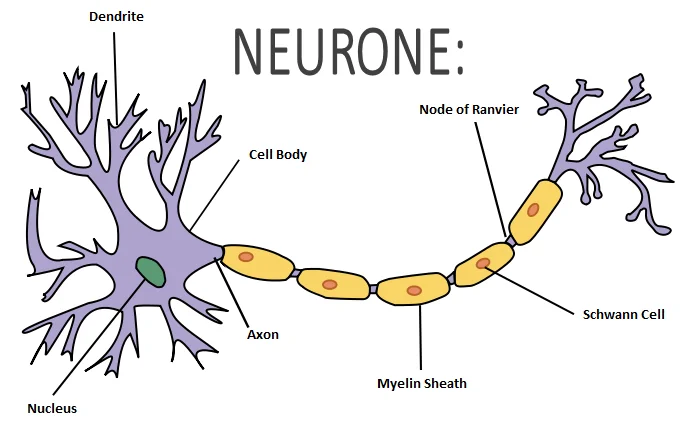 A neurone is a cell that carries electrical impulses. Information is processed and transmitted by the nervous system in the form of electrical and chemical signals. The neurone primarily comprises of a cell body, an axon and dendrites. The axon is a nerve fibre that carries electrical signals away from the cell body, to the end of the neurone. The end of the neurone then connects to the dendrites on the cell body of the next neurone, via a synapse. Drugs cause their effects due to their action on the neurones in the nervous system.
A nerve impulse is a self-propagating wave of electrical disturbance that travels along the surface of the axon membrane. This electrical disturbance comprises of a temporary reversal of the electrical potential difference; not an electrical current. The axon is usually negatively charged compared to the outside of the axon, and this is known as the resting potential, the value of which is usually around -65mV. When a stimulus is received, a reversal in electrical potential difference is caused, and this is known as the action potential (normally around +40mV).
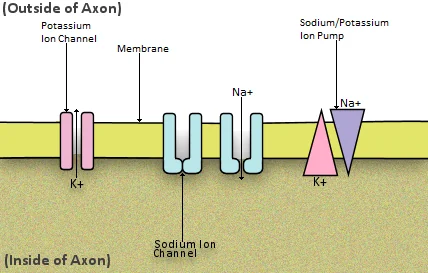
To begin, the inside of the axon is negatively charged, compared with the outside of the axon. The change in potential difference, that is needed to fire off an action potential, is controlled by the movement of sodium and potassium ions in and out of the axon. An ion is a positively or negatively charged molecule. This movement occurs via the action of ion pumps and channels. The ions cannot just diffuse in and out of the axon uncontrollably; this diffusion is prevented by a membrane around the axon. Periodically placed along the membrane are proteins that act as channels for ions to pass through. Sodium gated channels and potassium gated channels open and close to allow the ions to pass through only at specific times. Sodium-potassium pumps transport Na+ and K+ in and out of the axon.
The inside of the axon starts at around -65mV compared to the outside of the axon. An action potential is reached when the axon is at +40mV compared to the outside of the axon. This value of +40mV is reached by the movement of sodium and potassium ions in and out of the axon. Sodium-potassium pumps transport 2K+ into the axon for every 3Na+ transported out of the axon. Both sodium and potassium are in the forms of positive ions here. However, more sodium is removed from the axon compared to the potassium brought. This means the overall electro negativity is decreasing in the axon, and the axon is getting closer to reaching the potential difference of +40mV. Sodium ions then begin to diffuse back into the axon naturally, and potassium ions diffuse back out. At this stage however, potassium gated channels are open, whereas sodium gated channels are closed. This means the K+ can diffuse out faster than the Na+ can diffuse back into the axon. This increases the potential difference further between the inside and the outside of the axon.
Once an action potential has been established, it “moves” along the axon in a neurone. The action potential doesn’t move in a physical sense of the word; the reversal of electrical charge is instead reproduced at different points along the axon, in a “Mexican wave” effect. One point in an axon will become depolarised (depolarisation is a change in a cell’s membrane potential, making it more positive, or less negative), and this depolarisation is a stimulus for the next region of the axon to depolarise. As the next region depolarises, the previous region returns to normal and repolarises.
Eventually, the action potential will reach the end of an axon, known as a synaptic knob. A synapse occurs at a point where the axon of one neurone meets the dendrite of another neurone.
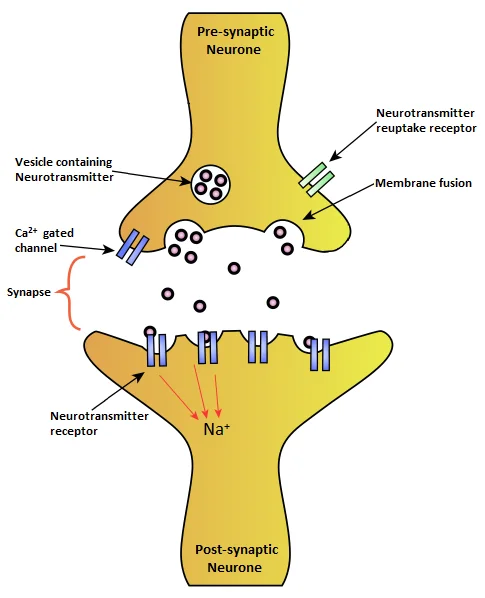
When an action potential reaches the synaptic knob, the calcium ion channels open, and Ca2+ enters the synaptic knob. As the Ca2+ enters, the vesicles containing the neurotransmitters fuse with the membrane of the pre-synaptic neurone, and the neurotransmitters are released into the synapse. The neurotransmitter molecules attach to the receptors on the sodium ion channels, which allow Na+ ions to diffuse into the post-synaptic neurone. This influx of Na+ generates a new action potential in the post-synaptic neurone. An enzyme is then released into the synapse that breaks the neurotransmitters down into small, precursor molecules. These fragments are reabsorbed by receptors on the pre-synaptic neurone, and they are then used to remake the neurotransmitters. The neurotransmitters are then ready to release when a new action potential reaches the pre-synaptic neurone. This reabsorbing prevents the neurotransmitters from continuously binding with the sodium ion channels on the post-synaptic neurone, and firing off repeated new action potentials.
Neurotransmitters can have one of two effects. Excitatory neurotransmitters/receptors make it more likely that a new action potential will fire off. Inhibitory neurotransmitters/receptors make it less likely that a new action potential will fire off. Many drugs work by affecting the way neurotransmitters work. There’s a handy table listing the effects of different neurotransmitters right here.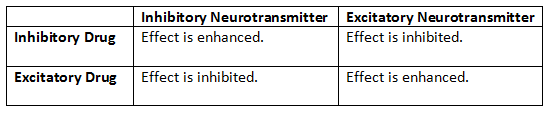 Drugs can stimulate the nervous system by creating more action potentials in the post-synaptic neurone. They can do this by mimicking a neurotransmitter, stimulating the release of more neurotransmitter, inhibiting the re-uptake receptor on the pre-synaptic neurone or by inhibiting the enzyme that breaks down the neurotransmitter. Agonists are chemicals that bind to a receptor and trigger a response, often by mimicking the neurotransmitter.

Drugs are also capable of inhibiting the nervous system by creating fewer action potentials in the post-synaptic neurone. This can be done by inhibiting the release of neurotransmitter, or blocking receptors on the sodium/potassium ion channels. This reduces the body’s response to impulses. Antagonists work by blocking or dampening signals of agonist drugs/neurotransmitters.
The Action of Different Drugs on the Nervous System
Psychedelics mostly act on serotonin receptors, and act as full or partial agonists. LSD, LSA, psilocin, DMT, mescaline and the 2Cx family all work as partial agonists. The table below shows a few of the commonly known psychedelics, and their action on receptors. The 5HT receptor system acts via the neurotransmitter of serotonin, D1 acts via dopamine, and the A-2 system acts via noradrenaline. 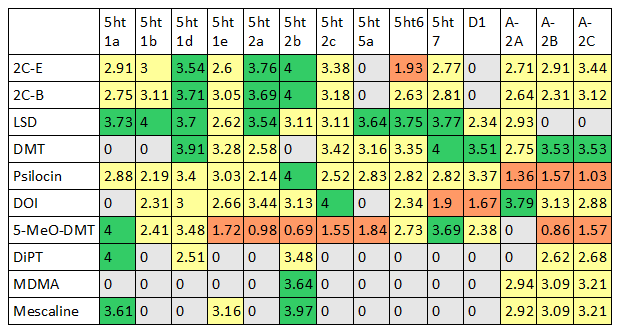 The scale is from 0 to 4, with 4 being the highest affinity. The chart above is colour coded with a traffic light system. Green refers to an affinity of 3.5-4, representing a very high affinity. Yellow is 2-3.5, representing medium affinity. Orange is below 2. Any value that is orange/below 2 should be disregarded, as the affinity isn’t high enough to cause any great effect. Grey is 0, meaning no affinity at all to the receptor.
The current scientific consensus is that the 5HT-2A receptor is the one targeted by drugs responsible for psychedelic experiences. However, drugs like mescaline and MDMA are both capable of inducing psychedelic experiences on par with that of psilocin and LSD, but show no affinity to the 5HT-2A receptor.
LSD, for example, works by fitting into the receptors on the post-synaptic neurone. It has a higher affinity than serotonin itself for the serotonin receptors, specifically 5HT receptors, and therefore prevents serotonin binding to the receptors by competing with it.
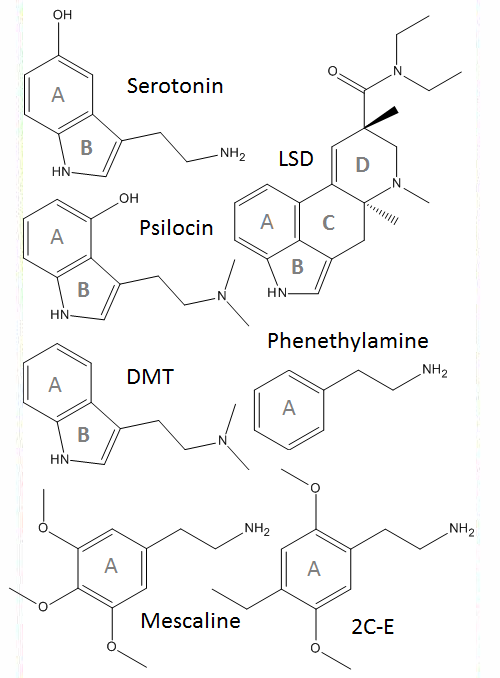
The diagram above shows the structural similarities between the psychedelics. The three classes (phenethylamines, lysergamides and tryptamines) all contain the same chemical rings, which have been labelled. A represents the benzene ring, which all three classes contain. B represents the pyrrole ring, in both tryptamines and lysergamides. A and B together form the indole ring. C (cyclohexane) and D are only contained in the lysergamides, possibly contributing to its potency.
Dissociatives act as non-competitive NMDA receptor antagonists, meaning they inhibit glutamate molecules. Glutamate is the neurotransmitter responsible for telling the body when it’s “awake”, for building up memories and for regulating awareness, mood and movement. NMDA receptors allow for electrical signals to pass between neurones in the brain and spinal column; for the signals to pass, the receptor must be open. NMDA receptor antagonists close the NMDA receptors, by preventing the glutamate from binding to it. This disconnection of neurones leads to loss of feeling, difficulty moving,and eventually the k-hole. It is also this disconnection that causes the anaesthetic properties of dissociatives.
PCP, MXE and ketamine fall into the arylcyclohexylamine class of chemicals, which possess NMDA receptor antagonist properties. DXM/DXO fall into the morphinan class of chemicals. Nitrous oxide, however, is unique, due to being an inorganic molecule. Another inorganic dissociative is xenon, which is also an NMDA receptor antagonist. However, information on recreational use is limited.
Deliriants are antagonists towards the cholinergic receptors, blocking the neurotransmitter acetylcholine. Acetylcholine is the neurotransmitter responsible for regulating the sleep cycle, dreaming alertness, and for building memory. The prolonged suppression of cholinergic activity and REM sleep due to deprivation or amphetamine abuse creates psychotic episodes which may be defined as bursts of dream activity erupting spontaneously into waking states. Deliriants could therefore be considered to trigger a similar state by blocking acetylcholine and suppressing cholinergic system activity. Causing trippers to begin dreaming whilst maintaining full conscious awareness. Deliriants are known for causing people to have no memory of their experience, tying in with their anticholinergic effects. Anticholinergics are split into two class; anti-muscarinic (act on muscarinic acetylcholine receptors) and anti-nicotinic (act on nicotinic acetylcholine receptors). Anti-muscarinic drugs include DPH, scopolamine and atropine. They are all competitive antagonists, meaning they bind to the receptor, but do not activate it.
Atypical drugs don’t fit into the three basic hallucinogen categories, and act in a number of different ways. MDMA is an entactogenic drug that works as a re-uptake inhibitor targeting serotonin receptors. This leads to the prevention of the re-uptake of the serotonin. More serotonin in then in the synapse, so the receptors on the post-synaptic neurone continue to be fired off. Serotonin is known for its control of mood, often being referred to as “the happy chemical”, along with dopamine. Muscimol is a GABA agonist. Salvia is a k-opioid receptor agonist. The k-opioid receptor is responsible for altering the perception of pain, consciousness, gravity, fear, mood and motor control. This explains the sensations of intense gravity, painful tingling and paranoia during Salvia trips. Ibogaine is 5HT-2A agonist, an NMDA antagonist and the k-opioid receptor agonist. The tryptamine core of ibogaine causes the affinity to the 5HT system.
This section has described the chemistry and neuroscience at the basic level of the neurone. However, I intend to write a second part to this article, which describes in detail the effects of hallucinogens, and specifically psychedelics, on specific parts of the brain, and how this translates into the subjective components of the psychedelic experience.
The physical, visual and cognitive components of a Dissociative trip
Dissociatives are a class of hallucinogen which reduce or block signals to the conscious mind from other parts of the brain. They offer a trip that is characterized by dissociation and bizarre feelings of detachment from reality. With anaesthetic like effects and dream like states.
It’s worth noting that in comparison to psychedelics and deliriants they are a very new class of hallucinogen with the first classical dissociative being synthesized in 1926 (PCP).
This guide is in reference to all of the classical Dissociatives or more specifically Ketamine, MXE, DXM, PCP and 3-MeO-PCP. This list excludes Nitrous Oxide which feels completely a-typical in comparison.
All of the classical Dissociatives are pharmacologically categorized as NMDA receptor antagonists which are a class of anesthetics that work to antagonize, or inhibit the action of, the N-methyl d-aspartate receptors (NMDAR) within the brain. The NMDA receptor is a receptor that allows for the transfer of electrical signals between neurons in the brain and in the spinal column. These receptors are located at the end of dendrites on a neuron cell. The dendrites send messages to other neurons through these, but when a drug that blocks the NMDA activity is taken, they are partially or entirely blocked, decreasing the brains ability to transfer information across itself. This disconnects the neurons and triggers feelings of extreme dissociation or detachment, leading onto hallucinatory states which differ from a psychedelic experience in almost every possible way.
This guide will categorize the universal effects that occur between each of the classical dissociatives and break them down into their simplest components.
Dissociation and detachment:

Feelings of detachment are the most noticeable component of a dissociative trip.
At lower states of dissociation this essentially feels like an obvious but still difficult to pinpoint feeling of detachment from the external environment and body. The greatest analogy to depict this is that if we look at the world through a window during our day to day lives, when a person becomes dissociated they are standing increasingly further back from this window proportionally to the dosage consumed. This triggers a feeling of being mentally withdrawn from the environment, allowing people to look at their lives from an almost third person perspective and analyse it without bias, surprisingly resulting in an enjoyable state of deep introspection and a profound drunkenness. These states are often described by people as:
- Feeling generally separate from the external world.
- Feeling physically and/ or mentally autonomous.
- Feeling as though life is being watched through a screen.
- Feeling as though life is a film or a dream.
- Feeling as though you are physically further away in distance from the external world.
- Feeling as though you are looking through somebody else’s eyes.

States of dissociation and detachment increase proportionally to dosage until they become completely detached from the external environment and eventually their own bodies causing them to slip into the famous dissociative hole.
A process which can be broken down into 4 distinct levels of increasing intensity.
- partial detachment - This can be described as feelings of surrealness and general detachment from the external environment. As described in detail above.
- detachment from environment - As the detachment increases the environment becomes physically further away in distance and increasingly disconnected from a persons sensory perception. Blurred vision sets in while anaesthetic like effects and tactile numbness begin to take place. At this point motor control, coordination and balance become suppressed in a way that is proportional to dosage. In terms of sound, hearing also seems to become muffled and distant.
- detachment from body - Complete disconnection from body. It is here where the tripper finds themselves out of their body having slipped into a what can only be described as a hallucinatory hole or an empty void.
- detachment from self - The fourth level of dissociation and detachment occurs at the pont at which the brains neurons have become so disconnected that a persons sense of mind and self cease to exist, resulting in ego death. This gives the profound experience that there is no longer an “I” experiencing the intensity of the trip any more, there is just the trip as it is and by itself.
In terms of the thought patterns and general mental processes, dissociative ego death is very similar to its psychedelic equivalent in a number of ways. Characterized by an extreme loss or failure of a person’s short and long term memory. This means that a person who is experiencing ego death cannot hold onto the memory of where they are, what they are doing or who they even are, instantly forgetting everything as soon as it happens to them. - detachment from awareness - The highest level of detachment occurs when the neurons within a persons brain have become so disconnected from each other that the tripper literally passes out into total unconsciousness. This consistently leaves extended gaps in a persons memory and large periods of amnesia which are literally impossible to recall once the experience is over.
More Examples: here and here
Double vision:
As a person begins to become disconnected and detached from their external environment. The visual field not only becomes blurred and indistinct but completely doubled over itself. This feels as if you are seeing out of both of your eyes at once with the two images no longer being spliced and merged together into a unified whole. Forcing people to close one of their eyes if they want to perform any task which requires fine vision or reading.

Perspective Distortions:
Another very common mental component of a classic dissociative trip is one of a profound shift in perspective; this generally consists of drastic changes in the size and distance attributed either to a person’s body or their external environment.

Feelings of suddenly having an impossibly giant or tiny body are very common. This feeling is already known by the scientific literature as “Alice in Wonderland Syndrome”. It is known as a temporary condition often associated with migraines, brain tumors, and of course the use of psychoactive drugs. With dissociatives at least it can also be more specifically attributed to the room around you or certain body parts. For example feelings of having a huge head or tiny limbs are quite common. This specific mental component has limitless potential in terms of size and the feeling of being simultaneously huge and tiny or having a body that feels larger than the entire universe is not unheard of.
Perspective distortions can also affect distance, making specific objects or the entire external environment seem physically closer or further away.
Another common manifestation of this effect is changes in noise volume, making sounds seem extremely quiet and muffled or extremely loud and overwhelming.
More examples: here, here and here.
Scenery slicing:
Scenery slicing is a fairly uncommon visual but appears across multiple people and regularly enough to make it worth mentioning. This effect usually happens spontaneously with no obvious trigger and makes the external environment appear as if it has been cut remarkably cleanly into separate slices with a razor blade Which then slide across each other in separate directions causing the visual field to split apart into sections.

Visual geometry:
Visual geometry is the sensation of a person’s field of open and closed eye vision becoming partially or completely encompassed by fast-moving kaleidoscopic and indescribably complex geometric patterns, form constants, shapes, fractals, structures and colour.
Visual geometry never stands still at any point and are often extremely fast changing and self transforming in terms of their shape and style within themselves. This happens whilst they are naturally drifting laterally or radially across the visual field to create overlapping webs of many arising and decaying geometric patterns, all of which are visible within a single perceptual frame.
Whilst psychedelic visual geometry merely displays itself on a veil in front of your visual field with no sense of particular size attributed them. Dissociatives are significantly less complex but make up for this through the sheer immersiveness of their style. These visuals take you directly into the center of them, as if they are surrounding you and also have a sense of physical size and distance attributed to them.
In terms of their stylistic appearance they also tend to be darker and slower in terms of their movement and the way in which they shift in their shape across themselves. These usually only display themselves when the tripper has their eyes closed or are in darkness.
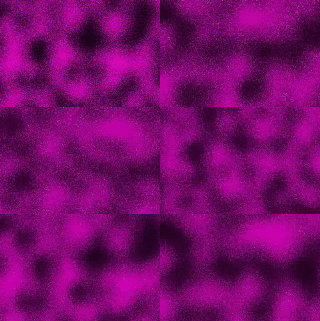
Dissociative visual geometry can only be broken down into 4 possible levels, as opposed to the 7 difering levels of intensity found within psychedelic visual geometry (including 7A and 7B). They can be broken down and described as…
- Visual Noise – This is the most basic level of visual geometry and can be experienced in a completely sober state. It can be described as the visual noise or static combined with random light and dark red regions that can be seen under the eye lids.
- Motion and Colour – This level is also easily obtainable without psychedelics and can be described as the appearance of unstructured regions of fleeting flashes and clouds of colour.
- Partially Defined Geometry - This is the level where things start to get distinctively psychedelic and complex indescribable shapes and patterns begin to show themselves. At this level however the patterns can be described as strictly 2-Dimensional. They are fine, small and zoomed out in size with a dark colour palette that limits itself to a couple of different shades such as black and dark purples.
They are displayed on both the open and closed eye visual field across a flat veil of geometry but significantly more detailed with the eyes closed or in dark environments. - Fully Defined Geometry – This is the level where the detail in which the geometry displays itself becomes profoundly complex but remains strictly 2-Dimensional. At this point the visuals become large in size and extremely intricate in detail with a colour palette that is limitless in its possibilities.
They are displayed on both the open and closed eye visual field across a flat veil of geometry that floats directly in front of the eyes, remaining significantly more detailed with the eyes closed or in dark environments.

Spaces and holes:
The spaces and holes encountered on Dissociatives are something that is experienced once the detachment has reached level 3. When you have finally become completely disconnected from your physical body. Causing you to undergo an out of body experience and be pulled into a place that feels as if it is outside of reality.
A place that is commonly referenced to by the dissociative community as a hole. With drug specific manifestations of this state being known as “the K-hole” for Ketamine and the “M-hole” for MXE. Commonly described as a complete loss of bodily awareness and sensations of floating or falling through a dark and infinite void over great physical distances. Often done on what feels like some sort of invisible rail. A feeling that is interpreted by many people as flying through space or the night sky. With many trippers stating that they feel as though their perceptions are located so deep inside the mind that the real world seems so distant that it might as well not exist.
In terms of its appearance, a typical dissociative hole is usually completely dark with occasional clouds of slow moving amorphous colour clouds in the background. At their lowest level they are completely empty, but as dosage is increased they are accompanied by and filled with a wide variety of elaborate and complex structures which are described in detail below.
More examples: here.
Hallucinatory structures:
Dissociative induced hallucinatory structures are the only feature found within what would otherwise be completely empty spaces and holes. They can generally be described as 3-Dimensional and monolithic shapes or structures of infinite variety and size that float above, below or in front of you as they gradually zoom, rotate or pan into focus and become unveiled before your eyes at a slow pace. These structures can take any static comprehensible shape possible but can commonly be experienced as vast and giant pillars, columns, blocks, teardrops, wheels and pyramids. Often fractal in nature and capable of being manifested in any variety of colours but usually following darker themes and tones. In terms of the materials that they appear to be comprised of and the complexity of detail in which they are perceived in, dissociative structures can be broken into 4 basic levels.
- 2-Dimensional Structures - The most basic level of structural complexity confines it’s geometry to strictly 2-Dimensional shapes. These shapes are usually very flat and dark in their colour and often “felt” instead of seen in a way that cannot be described adequately to the uninitiated. In terms of their size, these structures take up the entirety of a persons visual field but do not appear to have any particular size attributed to them.
- Partially defined 3-Dimensional Structures - Above this the structures become better defined and 3-Dimensional in shape with basic detail in their lighting and shadow. Appearing to be made of semi transparent condensed colour or solidified shimmering visuals that are seen as ill defined, soft and out of focus around their edges. In terms of size, these structures appear to be extremely large, stretching out across hundreds and hundreds of metres.
- Fully defined 3-Dimensional Structures - Once hallucinatory structures reach their third level of complexity they become fully defined in their shape, edges, lighting, shadow and detail. Often appearing to be made of solid and dense realistic materials such as stone and metal. They are capable of being thousands of miles across themselves and extremely complex in form.
- Self transforming mechanistic structural universes - As dosage increases, the detail continues to complexify proportionally until the sensation of seeing the entire universe condensed into an infinitely vast and intricate self transforming machine structure becomes present. Accompanied by the sudden realization that you are the structure that you are staring down upon and that the structure is also you. In terms of its appearance, this state is extremely hard to describe. The structure can take any form but usually appears to be a consistently shaped machine-like structures or clouds that are infinite in size and felt at every point of detail across themselves. This is immediately interpreted through some sort of innate instinct as “the universe” or at least, “everything” by everybody who undergoes the experience.
Structures typically last anywhere from 30 seconds to several minutes before the person slips back into reality or into the presence of another structure. There are three different methods through which these hallucinatory structures are shifted between.
- Structural Transformations - structures can switch between each other by morphing around you in a static, comprehensible way. Something that usually unfolds in front of you in a rather slow, step by step morphing process.
- Structural Panning - structures can switch between each other by remaining completely static in their shape but simply panning out of view until they are no longer within your field of vision. It’s from here that another structure usually comes into view from behind your physical body within a few seconds to a couple of minutes. Allowing the cycle of continuous spontaneous structures to go on undisturbed.
- Travelling over great distances - The third method of transitioning is experienced when the structures appear to be stuck in place whilst you are floating silently between them over what feels like a huge and physical distance. This is often done on an invisible rail through the vast and infinite dissociative hole. A feeling that is interpreted by many people as flying through space or the night sky.
As a tripper’s dosage increases, the level of detail in which these structures are seen and felt increases proportionally. Below is my amateur attempt at replicating what it’s like to float through an extremely simple generic space, with a basic structure.

More examples: here.
Hallucinatory states:
Hallucinations and scenarios are only possible during very high dose trips and an intensely realistic component of the Dissociative experience. They could be anything but generally fall under common archetypes such as contact with autonomous entities, imagined landscapes, alternate dimensions, replayed memories and situations that seem so unlike anything previously experienced that they are in all probability, untranslatable into English. Starting out by following a feeling of detachment from the hallucination itself, for example watching autonomous people and entities going about their daily business oblivious to your existence, playing out as if it were a film. At higher doses of hallucinatory states they become increasingly involved, accessing distant memories from your past is also completely possible. Replayed memories can feel like weeks and weeks of real time hallucinations and are perfect in every detail.
In comparison to psychedelics they are more solid and not made of a closed eye visual based material. The solidity and detachment from these scenarios is what separates them in my opinion from any entity contact or hallucinations experienced on drugs such as Mushrooms or LSD.
In conclusion:
Although this guide is much shorter than my psychedelic guide. This is not because there is less to experience with dissociatives but rather because these compounds have only 5 distinct effects. But none the less, these effects come with an unlimited capacity.