 Disregard everything I say.
Every bit of writing here can be considered a work of fiction.
Do not ever use anything I've ever said here for anything ever and if you do you are doing so at your own legal risk as I am not responsible for anything that may or may not happen to you. I did after all tell you to disregard everything I say as in reality I actually have no idea what I'm talking about and shall continue to be a retarded teenager with an Internet connection.
Please point out as many flaws in my reasoning, claims, factual information and grammar as possible.
MYSOURCESARE:
Personal Experience, the Internet and nowhere I could just be making things up.
The DXM and DPH combination, broken down and described
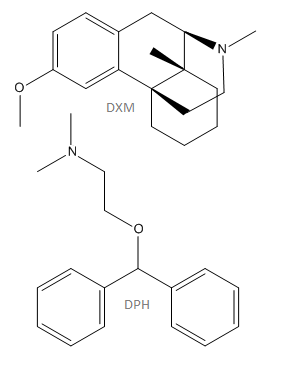
Onset : 30 - 120 minutes
Duration : 4 - 8 hours
Dosage,
Low : 250mg / 250mg
Medium : 300mg / 300mg
Strong : 350mg / 350mg
Heavy : 400mg / 400mg
This article is going to serve as a complete breakdown and categorization for the consistent subjective effects that are induced across all people who undergo the DXM and DPH combination experience. This is something that I am writing because, although there are an infinite amount of possible drug combinations, almost all of them simply induce the effects of the two separate drugs on top of each other in a very predictable manner. However, these two substances do just the opposite of that, producing a very unique synergy when taken together, potentiating the positive aspects of the other substance whilst simultaneously suppressing its negative side effects; all with distinct visual and hallucinatory effects that are found on neither of these substances when taken on their own.
If you are not familiar with the effects or chemistry of either of these substances, you can learn in detail about DXM by clicking here, along with a similar analysis and breakdown of the DPH trip right here.
Body high:
The body high of this combination is that of a mild glow that encompasses the body, with a tingling sensation at the ends of the fingers and toes. It is a relaxing and a completely lethargic state felt alongside the sensation that gravity has increased itself in intensity many times over, resulting in an unnaturally heavy body and consistently causing trippers to want to lay down on a comfortable spot and avoid engaging in any physical activities.
Since this is accompanied by feelings of dehydration and dry mouth, it is important for trippers to try and remember to consistently take small sips of water throughout the duration of the experience.
As a user increases their dosage, physical detachment and dissociation begins to take its toll and the body high is slowly taken over by a decrease in tactile input, along with a feeling of numbness and disconnection, which is eventually capable of becoming completely anaesthetic-like in its effects. This can be described as starting out with sensations of being somehow physically removed from the body, physical autonomy and a proportional lack of motor control. In terms of mobility this combination results in more than a simple lack of motor control and spatial awareness, creating a hilariously strange and robotic style of movement in its users every single time they try to walk or perform basic movements. This is a style of movement known by the dissociative community as the “Robo Walk”.
The greatest thing about the physical effects of taking DXM and DPH in a combination is the way in which they both lessen the negative side effects of the other substance. For example, thanks to DPH’s nausea suppressing abilities, this combination is significantly less likely to make you feel like you desperately need to vomit than simply taking DXM by itself. In return, DXM’s dissociating and anesthetic like qualities have an extremely positive effect on the unbearably strong physical dysphoria which DPH is infamous for. This completely eliminates the muscle cramps, nausea, dizziness, drowsiness, restless leg syndrome, extreme dehydration and occasionally irregular heart beat experienced when DPH is tried simply by itself. This allows the unique delirium, hallucinations and visual effects of the DPH experience to become much more accessible to your average person.
Head space:
The thought patterns of a typical DPH + DXM trip are characterized by that of a general sense of detachment and dissociation, accompanied by delirium and a partial to complete loss of ability to reason or think rationally.
As a user increases their dosage, mental detachment begins to take its toll and any thoughts present within the brain are slowly taken over by bizarre mental states of dissociation. These can be described at lower levels as feelings of detachment from the external environment, making the world seem as if it were being watched through a TV, a dream or just intrinsically unreal in some way. This creates feelings of being mentally withdrawn from the environment, allowing people to look at their lives from an almost third person perspective.
Alongside this, an inability to process basic information becomes present, with trippers finding themselves in states of confusion, disorientation and mild paranoia. They are often unable to process basic things such as language or events that are happening around them, resulting in the unique effect of trippers speaking in nonsensical and meaningless statements with unusually sinister undertones or complete gibberish with no decipherable words of any sort.
As the detachment increases proportional to the dosage consumed, the mind becomes sedated and the ego becomes severely suppressed and inhibited, eventually resulting in ego death. This impairs cognitive functioning and suppresses the short term memory until it begins to struggle or become completely incapable of holding onto a normal thought for any length of time. This is an effect that is worsened by this combination. Large amounts of amnesia and memory loss are experienced, with trips often becoming forgotten completely or only remembered in short snippets, even immediately after they’re over. This happens in much the same way that our dreams are almost always forgotten and rarely remembered in their entirety.
In terms of the mentally dysphoric effects that are usually experienced when DPH is taken by itself, the universal experience of extreme paranoia, panic, depression, agitation, nervousness and feelings of impending doom seem to be completely suppressed when combined with DXM. This results in a trip that is almost completely devoid of overwhelmingly bad vibes whilst still maintaining a somehow sinister or other worldly and nightmarish theme to it.
Visual effects:
The visuals and distortions experienced during a DPH and DXM combination trip are surprisingly psychedelic in places, despite the fact that this trip is technically classed as a dissociating and delirious state, not a psychedelic one.
In terms of the specific style of visuals, they can be described as indescribably complex and intricate webs of ever shifting geometric forms which are very slow in their movements when compared to visuals experienced with traditional psychedelics such as LSD or Mushrooms. It has a colour scheme which is dark in its palette and somehow ominous or sinister in its appearance and style. They manifest themselves in a traditional psychedelic manner when the eyes are closed but appear as static, unmoving shapes and geometry which the external environment morphs into when the eyes are open and looking at any single point, always resetting once the person double takes. This is an unusual visual effect because both dissociative and psychedelic visuals do not do this, instead preferring to manifest themselves as a fast moving and flat translucent veil across the visual field which cannot be interacted with.
The distortions and alterations of open eye perception experienced on this combination are once again, surprisingly psychedelic in comparison to either of these substances when taken by themselves. The external environment begins to generally morph, melt, bend, flow and shift in an extremely fluid fashion. This has a distinctive indescribable style to it, with a large amount of blurriness, as well as significantly less detail and clarity when compared to the distortions found within LSD and Mushrooms.
Another distinct visual effect which I have not found on any substance besides this very specific combination is a distortion which exclusively effects textures. This causes textures to become 3-Dimensional, rising up out of the surface which they reside upon in a strangely intricate and static fashion that looks similar in appearance to condensed, mostly opaque and coloured smoke.
None of the above effects however, although many in number and intense experience wise are the focus of this trip when this combination is taken at anything above low doses. At moderate to high doses the trip becomes completely dominated by extremely detailed and vivid delirious hallucinatory states. These are unique in that they offer solid hallucinations which display themselves seamlessly into waking consciousness and the external environment like fully formed dreams or delusions. In contrast, classical psychedelics and dissociatives have progressive levels of multiple all-encompassing sensory effects, before reaching the level of concrete hallucination. It’s only with delirium that you can experience solid hallucinations of people, objects, forms, creatures, etc within and interacting with your external environment. As these increase in vividness and detail in a way that is proportional to dosage, they start with extremely detailed transformations of existing objects but eventually become all encompassing alternate realities and imagined landscapes of infinite possibility.
When experienced, these hallucinations are always believed to be real in much the same way that we happily accept the logic defying and nonsensical plots to our dreams. This is an unavoidable factor of delirium that can for obvious reason, go wrong if somebody perceives a negative or scary hallucination, which causes them to injure themselves or the people around them. This means that serious precautions have to be taken before anybody even considers undergoing a trip such as this.
Conclusion:
Although this is not an experience that I wish to repeat on any sort of regular basis, the DXM and DPH combination is an extremely fascinating one, making delirium accessible to me in a way that DPH on its own never could. This is something that is owed purely to its horribly dysphoric physical and mental effects. This combination should never be taken by beginners and is not for the faint hearted, due to its very sinister undertones in its hallucinations and general vibe of the trip. If you want to try this drug however, both substances are freely available and unscheduled throughout every country in the world and easily accessible through the power of google search. Keep in mind however that neither of these drugs are 100% physically safe, especially when taken repeatedly on a regular basis. You’ll need to do some independent research on both of these substances before you even consider trying an experience such as this.
DXM, broken down and described
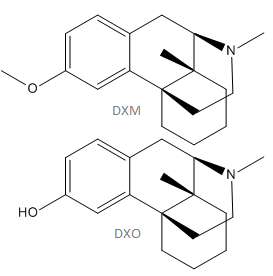 Light : 100 - 200 mg
Common : 200 - 400 mg
Strong : 300 - 600 mg
Heavy : 600 - 900 mg
Risk of Death : 900 - 20,000 mg
Duration : 4 - 8 hours
DXM or Dextromethorphan is an antitussive (cough suppressant) drug. It is one of the active ingredients in many over-the-counter cold and cough medicines, including Robitussin, Delsym, Benylin and others, including many generic labels. It is a dissociative hallucinogen of the Morphinan chemical class with multiple mechanisms of action. These include actions of a nonselective serotonin reuptake inhibitor, inhibiting the reabsorption of the neurotransmitter serotonin even after it has performed its function of transmitting a neural impulse, essentially allowing it to accumulate and be reused, causing physically euphoric effects. It is also a sigma-1 receptor agonist, allowing for its antitussive effects, and the action of its major metabolite dextrorphan as an NMDA receptor antagonist, essentially blocking the connections between neurons and creating for its dissociative effects. Instead of acting as a direct antagonist of the NMDA receptor itself, Dextromethorphan is rapidly absorbed from the gastrointestinal tract and converted into the active metabolite dextrorphan in the liver; a metabolite that is nearly 10 times more potent and the true mediator of this substance’s dissociative effects.
It was first patented and approved by the U.S. Food and Drug Administration (FDA) in 1954 and subsequently sold as an over-the-counter cough suppressant in 1958, with the first record of its recreational use dating back to 1962.
Although it is often considered to be a “kiddie drug” by many people within the online drug community, to me it is without doubt, visually on par with all of the other commonly used dissociatives such as Ketamine, MXE and PCP, and an extremely powerful substance. It takes its users to impossibly deep states of detachment and rich hallucinations, the base components of which I will begin to break down and describe now…
Body high:
The body high of DXM is that of a euphoric glow that encompasses the body and is accompanied by a tingling sensation at the ends of the fingers and toes. At higher doses the overall sensation increases proportionally and is capable of becoming physically euphoric. It is incredibly relaxing and results in a mostly lethargic state, consistently causing trippers to want to lay down on a comfortable spot and enjoy the trip, instead of engaging in physical activities.
As a user increases their dosage, physical detachment begins to take its toll and the body high is slowly taken over by a warm, mechanical numbness, which at higher doses is capable of becoming completely anesthetic-like in its effects. This can be described as starting out with sensations of being removed from the body, physical autonomy and a proportional lack of motor control. One of the famous characteristics of a low dose DXM trip is the way in which it causes people to move in way that the DXM community has named the “robo-walk”. This is more than a simple lack of motor control and spatial awareness but a hilariously strange and robotic style of movement that I have yet to find on any other substance.
As physical detachment continues to increase, it eventually ends with a complete disconnection from the physical senses and out of body experiences, leaving people in a conscious catatonic state.
Head space:
The thought patterns of a typical DXM trip are characterized by that of a child-like sense of glee, a vastly enhanced sense of music appreciation and a bizarrely profound drunkenness.
As a user increases their dosage, mental detachment begins to take its toll and any thoughts present within the brain are slowly taken over by bizarre mental states of dissociation. These can be described at lower levels as feelings of detachment from the external environment, making the world seem as if it were being watched through a TV, a dream or just intrinsically unreal in some way.
This creates a feeling of being mentally withdrawn from the environment, allowing people to look at their lives from an almost third person perspective and analyze it without bias, surprisingly resulting in an enjoyable state of deep introspection.
As the detachment increases, the ego becomes severely suppressed and inhibited, something that eventually results in ego death. This impairs cognitive functioning and suppressing the short term memory until it begins to struggle or become completely incapable of holding onto a normal thought for any length of time.
Perspective distortions:
The perspective distortions on DXM do not seem to feel particularly different from those found on other commonly used dissociatives such as MXE and Ketamine. These most commonly include Alice in Wonderland syndrome, the feeling of becoming impossibly giant or tiny in size. Changes in noise volume, sounds seeming either extremely loud or very quiet and muffled are often experienced, as well as distortions in distance, making specific objects or the entire external environment seem physically closer or further away.
Visual effects:
At lower levels of dissociation, the visual effects of DXM are extremely simplistic and shallow, generally manifesting themselves as blurred and double vision and only becoming deep once a person has been partially or completely disconnected from their body and sensations. This results in out of body experiences in which trippers fly through a distinct and unique hallucinatory world.
This starts at lower levels with the dissociative equivalent of visuals, which for DXM, can be described as morphing geometric patterns which are super imposed onto a dark background. This doesn’t feel as though they are on a flat two dimensional veil in front of your vision as with LSD or mushrooms but instead completely surrounding and encasing your visual field. In comparison to other dissociatives such as MXE, they are extremely colourful, complex and fast moving. They only present themselves when the eyes are closed and generally seem to consist of soft round edges with a pastel colour palette and flat simplistic imagery that is usually comprised of basic shapes such as bubbles, squares and triangles.
In comparison to the classical psychedelics they are not nearly as intricate but still extremely impressive. They do not seem to increase in complexity as a person reaches higher levels of dissociation, but are instead taken over by and replaced once complete and total disconnection of the body is reached, causing trippers to slip into what is refereed to as a dissociative hole. This can be described as the sensation of silently floating through a dark and infinite void. This void is often interpreted as traveling through space or the night sky. This is usually accompanied by monolithic, solid and physical structures of a vast scale that pan, zoom or rotate into and out of view as you float above, below or inside of them. This is a common characteristic among all of the dissociatives but can be described as particularly colorful in appearance with this substance, especially when compared to the likes of other dissociatives such as MXE.
These structures take a huge variety of forms but can be described as spires, towers, tear drops, columns, cubes and shapes of any kind that are huge in size and often thousands of miles wide. They alternate between each other by morphing in a comprehensible, consistent way or by panning out of view until another structure takes its place. As a tripper’s dosage increases, the level of detail in which these structures are seen and felt increases proportionally. This continues until the sensation of seeing the entire universe is condensed into an infinitely intricate form becomes present. This is accompanied by the sudden realization that you are the structure you are staring down upon, a feeling that is so overwhelming and vast it consistently triggers complete ego death.
At this level of dissociation, hallucinatory states not unlike those found within common psychedelics come into play, these are extremely diverse imagined scenarios in which contact with autonomous entities are completely possible. They look perfectly solid in appearance and are not constructed from an incomprehensible visual based material, as with psychedelic substances such as DMT and mushrooms. Reports of memory replays are extremely common and these often overlay themselves onto the external environment in the form of people you have recently seen becoming present in your field of vision.
After glow:
The afterglow is a feeling that is long lasting and as equally enjoyable as the trip itself to many people. It can be be described in terms of its physical sensation as one of euphoria, rejuvenation, relaxation and a light bounciness. In terms of its mental thought processes however, it can be described as a complete loss of anxiety, contentedness and an extremely high appreciation for music.
Grapefruit Potentiation:
It’s worth noting that grapefruit juice is extremely efficient for potentiating and enhancing the DXM trip if approximately 1 glass of white grapefruit juice or more is drunk every hour throughout the day before the trip. The effects will be considerably stronger and more intense. For people who are drinking store brought syrup, this is extremely useful as it means drinking less foul syrup.
The Grapefruit juice acts on DXM by inhibiting the activity of cytochrome P450 enzymes of the 3A and 1A groups. DXM is converted to DXO by this same enzyme, only with different groups. Therefore, with enough grapefruit juice, your overall trip should be more intense, as the DXM is converted into DXO at a faster rate.
Conclusion:
In conclusion, DXM is an extremely powerful drug, capable of taking people to incredibly rich induced mystical and transcendental states. This is despite the fact that it is nothing more than the active chemical in generic over the counter cough syrup and legal in every country across the world. If you want to try DXM, your easiest bet is visiting your local pharmacy, supermarket or buying it in pure form online. Pure powder can be found with a quick google search for the term “DXM powder buy”, “pure dextromephorphan buy” or other similar phrases, usually being sufficient to find a supplier in the top 3 or 4 links. In the UK specifically, Benilyn non-drowsy cough syrup is sold behind the counter in Boots, Morrisons, Sainsburys, Tesco’s and probably ASDA.
It is definitely worth noting however that DXM does have a dark side to it, with potentially addictive effects for those who are lacking in self control and adverse physical effects with repeated long term usage. This is something that can easily be avoided by manually limiting your use of the substance. It’s because of this that I would recommend doing as much research as you possibly can before even considering the consumption of this drug.
The visual and mental components of a Dissociative trip
Dissociatives are a class of hallucinogen which reduce or block signals to the conscious mind from other parts of the brain. In comparison to psychedelics and deliriants they are a very new class of hallucinogen with the first classical dissociative being synthesized in 1926 (PCP). They offer a trip that is characterized by dissociation and bizarre feelings of detachment from reality. With anaesthetic like effects and dream like states.
This guide is in reference to all of the classical Dissociatives or more specifically Ketamine, MXE, DXM, PCP and 3-MeO-PCP. This list excludes Nitrous Oxide which feels completely a-typical in comparison. I will write a guide specifically for nitrous oxide at a later date.
It’s worth noting that Dissociatives can be addictive and bad for your health with regular long term usage so you’ll need to do some independent research before trying these. Although these hallucinations are completely different to anything found with psychedelics, they should not be underestimated and allow you to go equally as deep in a completely different . How ever they are not nearly as powerful when it comes to introspection and resolving personal problems.
All of the classical Dissociatives are pharmacologically categorized as NMDA receptor antagonists which are a class of anesthetics that work to antagonize, or inhibit the action of, the N-methyl d-aspartate receptor (NMDAR). The NMDA receptor is a receptor that allows for the transfer of electrical signals between neurons in the brain and in the spinal column. These receptors are located at the end of dendrites on a neuron cell. The dendrites send messages to other neurons through these, but when a drug that blocks the NMDA activity is taken, they are partially or entirely blocked, decreasing the brains ability to transfer information across itself. Disconnecting the neurons and causing feelings of extreme dissociation or detachment, leading onto hallucinatory states. Causing states of moderate to extreme dissociation in the user as the subconscious brain begins to fill in these sensory gaps with entirely imagined hallucinations and dreamlike states. It’s through this guide that I will categorize the universal effects that occur between each of the classical dissociatives.
Dissociation and detachment:
 Feelings of detachment are the most noticeable component of a dissociative trip. Which is entirely triggered by the blocking of NMDA receptors.
At lower states of dissociation this essentially feels like an obvious but still difficult to pinpoint feeling of detachment from the external environment and body. The greatest analogy to depict this is that if we look at the world through a window during our day to day lives, when a person becomes dissociated they are standing increasingly further back from this window proportionally to the dosage consumed. Creating a feeling of being mentally withdrawn from the environment, allowing people to look at their lives from an almost third person perspective and analyse it without bias, surprisingly resulting in an enjoyable state of deep introspection and a profound drunkenness. These states are often described by people as:
- Feeling generally separate from the external world.
- Feeling physically and mentally autonomous.
- Feeling as though life is being watched through a screen.
- Feeling as though life is a film or a dream.
- Feeling as though you are physically further from the external world.
- Feeling as though you are looking through somebody else’s eyes.

States of dissociation and detachment increase proportionally to dosage until they become completely detached from the external environment and eventually their own bodies causing them to slip into the famous dissociative hole.
A process which can be broken down into 4 distinct levels of increasing intensity.
- partial detachment.
Feelings of surrealness and general detachment from the external environment. As described in detail above. - detachment from environment.
As the detachment increases the environment becomes physically further away in distance and increasingly disconnected from a persons sensory perception. Blurred vision sets in while anaesthetic like effects and tactile numbness begin to take place. At this point motor control and balance become moderately to completely suppressed in a way that is proportional to dosage. In terms of sound, hearing also seems to become muffled and distant. - detachment from body.
Complete disconnection from body. It is here where the tripper finds themselves out of their body having slipped into a what can only be described as a hallucinatory hole or an empty void. - detachment from mind and sense of self.
The final level of dissociation and detachment is complete disconnection from a persons mind and sense of self resulting in ego death. Giving the profound experience that there is no longer an “I” experiencing the intensity of the trip any more, there is just the trip as it is and by itself.
In terms of the thought patterns and general mental processes, dissociative ego death is very similar to its psychedelic equivalent in a number of ways. Characterized by an extreme loss or failure of a person’s short term memory. This means that a person who is experiencing ego death cannot hold onto the memory of where they are and what they are doing for more than a second or two, instantly forgetting everything as soon as it happens to them. Long term memory however seems to remain mostly in tact, with people usually capable of remembering things like who they are and what they are unless they are experiencing ego death at a particularly high level.
More Examples: here and here
Double vision:
As a person begins to become disconnected and detached from their external environment. The visual field not only becomes blurred and indistinct but completely doubled onto itself as well. This feels as if you are seeing out of both of your eyes at once with the two images no longer being spliced and merged together into a unified whole. Forcing people to close one of their eyes if they want to perform any task which requires fine vision or reading.

Perspective Distortions:
Another very common mental component of a classic dissociative trip is one of a profound shift in perspective; this generally consists of drastic changes in the size and distance attributed either to a person’s body or their external environment.
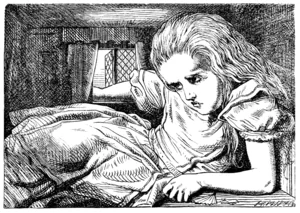
Feelings of suddenly having an impossibly giant or tiny body are very common and can be quite an incredible experience. This feeling is already known by the scientific literature as “Alice in Wonderland Syndrome”. It is known as a temporary condition often associated with migraines, brain tumors, and of course the use of psychoactive drugs. With dissociatives at least it can also be more specifically attributed to the room around you or certain body parts. For example feelings of having a huge head or tiny limbs are quite common. This specific mental component has limitless potential in terms of size and the feeling of being simultaneously huge and tiny or having a body that feels larger than the entire universe is not unheard of.
Perspective distortions can also affect distance, making specific objects or the entire external environment seem physically closer or further away.
Another common manifestation of this effect is changes in noise volume, making sounds seem extremely quiet or extremely loud.
More examples: here, here and here.
Scenery slicing:
Scenery slicing is a fairly uncommon visual but appears across multiple people and regularly enough to make it worth mentioning. This effect usually happens spontaneously with no obvious trigger and makes the external environment appear as if it has been cut remarkably cleanly into separate slices with a razor blade Which then slide across each other in separate directions causing the visual field to split apart into sections.

Closed Eye Visuals:
Visuals are an effect triggered by Dissociatives that can be described as the sensation of a person’s field of closed eye vision being partially or completely encompassed by shifting geometric patterns, shapes, structures and colour. Whilst LSD and Mushrooms merely display visuals on a veil in front of your visual field with no sense of particular size attributed them. Dissociatives take you directly into the center of them, as if they are surrounding you. They also have a sense of physical size attributed to them.
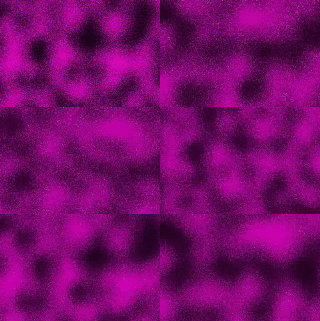 Dissociative visuals are more simplistic and less intricate than psychedelic visuals. They tend to be darker and slower in terms of how fast they change, only displaying themselves when the tripper has their eyes closed. Simply put, the visuals are more solid and realistic than psychedelic visuals with an actual sense of physical size and 3-Dimensional depth but never quite as detailed or complex.

Spaces and holes:
The spaces and holes encountered on Dissociatives are something that is experienced once the detachment has reached level 3. When you have finally become completely disconnected from your physical body. Causing you to undergo an out of body experience and be pulled into a place that feels as if it is outside of reality.
A place that is commonly referenced to by the dissociative community as a hole. With drug specific manifestations of this state being known as “the K-hole” for Ketamine and the “M-hole” for MXE. Commonly described as a complete loss of bodily awareness and sensations of floating or falling through a dark and infinite void over great physical distances. Often done on what feels like some sort of invisible rail. A feeling that is interpreted by many people as flying through space or the night sky. With many trippers stating that they feel as though their perceptions are located so deep inside the mind that the real world seems so distant that it might as well not exist.
In terms of its appearance, a typical dissociative hole is usually completely dark with occasional clouds of slow moving amorphous colour clouds in the background. At their lowest level they are completely empty, but as dosage is increased they are accompanied by and filled with a wide variety of elaborate and complex structures which are described in detail below.
More examples: here.
Hallucinatory structures:
Dissociative induced hallucinatory structures are the only feature found within what would otherwise be completely empty spaces and holes. They can generally be described as 3-Dimensional and monolithic shapes or structures of infinite variety and size that float above, below or in front of you as they gradually zoom, rotate or pan into focus and become unveiled before your eyes at a slow pace. These structures can take any static comprehensible shape possible but can commonly be experienced as vast and giant pillars, columns, blocks, teardrops, wheels and pyramids. Often fractal in nature and capable of being manifested in any variety of colours but usually following darker themes and tones. In terms of the materials that they appear to be comprised of and the complexity of detail in which they are perceived in, dissociative structures can be broken into 4 basic levels.
- 2-Dimensional Structures - The most basic level of structural complexity confines it’s geometry to strictly 2-Dimensional shapes. These shapes are usually very flat and dark in their colour and often “felt” instead of seen in a way that cannot be described adequately to the uninitiated. In terms of their size, these structures take up the entirety of a persons visual field but do not appear to have any particular size attributed to them.
- Partially defined 3-Dimensional Structures - Above this the structures become better defined and 3-Dimensional in shape with basic detail in their lighting and shadow. Appearing to be made of semi transparent condensed colour or solidified shimmering visuals that are seen as ill defined, soft and out of focus around their edges. In terms of size, these structures appear to be extremely large, stretching out across hundreds and hundreds of metres.
- Fully defined 3-Dimensional Structures - Once hallucinatory structures reach their third level of complexity they become fully defined in their shape, edges, lighting, shadow and detail. Often appearing to be made of solid and dense realistic materials such as stone and metal. They are capable of being thousands of miles across themselves and extremely complex in form.
- Self transforming mechanistic structural universes - As dosage increases, the detail continues to complexify proportionally until the sensation of seeing the entire universe condensed into an infinitely vast and intricate self transforming machine structure becomes present. Accompanied by the sudden realization that you are the structure that you are staring down upon and that the structure is also you. In terms of its appearance, this state is extremely hard to describe. The structure can take any form but usually appears to be a consistently shaped machine-like structures or clouds that are infinite in size and felt at every point of detail across themselves. This is immediately interpreted through some sort of innate instinct as “the universe” or at least, “everything” by everybody who undergoes the experience.
Structures typically last anywhere from 30 seconds to several minutes before the person slips back into reality or into the presence of another structure. There are three different methods through which these hallucinatory structures are shifted between.
- Structural Transformations - structures can switch between each other by morphing around you in a static, comprehensible way. Something that usually unfolds in front of you in a rather slow, step by step morphing process.
- Structural Panning - structures can switch between each other by remaining completely static in their shape but simply panning out of view until they are no longer within your field of vision. It’s from here that another structure usually comes into view from behind your physical body within a few seconds to a couple of minutes. Allowing the cycle of continuous spontaneous structures to go on undisturbed.
- Travelling over great distances - The third method of transitioning is experienced when the structures appear to be stuck in place whilst you are floating silently between them over what feels like a huge and physical distance. This is often done on an invisible rail through the vast and infinite dissociative hole. A feeling that is interpreted by many people as flying through space or the night sky.
As a tripper’s dosage increases, the level of detail in which these structures are seen and felt increases proportionally. Below is my amateur attempt at replicating what it’s like to float through an extremely simple generic and space, with a basic structure.

More examples: here.
Hallucinatory states:
Hallucinations and scenarios are only possible during very high dose trips and an intensely realistic component of the Dissociative experience. They could be anything but generally fall under common archetypes such as contact with autonomous entities, imagined landscapes, alternate dimensions, replayed memories and situations that seem so unlike anything previously experienced that they are in all probability, untranslatable into English. Starting out by following a feeling of detachment from the hallucination itself, for example watching autonomous people and entities going about their daily business oblivious to your existence, playing out as if it were a film. At higher doses of hallucinatory states they become increasingly involved, accessing distant memories from your past is also completely possible. Replayed memories can feel like weeks and weeks of real time hallucinations and are perfect in every detail.
In comparison to psychedelics they are more solid and not made of a closed eye visual based material. The solidity and detachment from these scenarios is what separates them in my opinion from any entity contact or hallucinations experienced on drugs such as Mushrooms or LSD.
In conclusion:
Although this guide is much shorter than my psychedelic guide. This is not because there is less to experience with dissociatives but rather because these compounds have only 5 distinct effects. But none the less, these effects come with an unlimited capacity.