
"Transcending this mortal plane through the power of hallucinogen induced nerd rage; Tripping balls in the name of science for the good of the cosmos."
MY SOURCES ARE:
Personal experience and the internet alongside of my own speculation, analyses and conclusions. For all you know I could be lying, so please do some independent research and do not say that I didn't warn you.
PLEASE DISREGARD:
Absolutely everything I say; all pieces of writing and information found within this blog should be considered lies and a work of fiction. Do not ever use anything I've ever said here for anything, ever.
I have, after all, made it very clear that my writings are to be disregarded, as in reality I may well have no idea what I am talking about and do not have any formal qualifications on the subject.
Please point out as many flaws in my reasoning, claims, factual information and grammar as possible.
I love all of you. Thank you for reading.



MXP, broken down and described
Dosage
Threshold : 0 - 50 mg
Light : 50 - 100 mg
Common : 100 - 150 mg
Strong : 150 - 200 mg
Heavy : 200 mg+
Duration
Total duration : 6 - 8 hrs
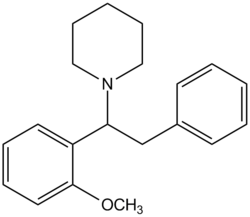
Methoxphenidine (MXP) or 1-[1-(2-methoxyphenyl)-2-phenylethyl]piperidine is a hallucinogenic dissociative compound of the piperdine chemical class. It has similar effects to that of the arylcyclohexylamine and morphinan classes of dissociatives.
It induces a state referred to as “dissociative anesthesia” and is used as a recreational drug. Very little is known about this substance but it has recently become freely available through online research chemical vendors where it is being sold as a designer drug and marketed as a replacement for MXE despite many users reporting it as qualitatively different in its effects and closer to that of DXM. It has yet to be studied within humans in any formal context.
In terms of its chemistry, MXP is classed as a piperdine drug. The piperdine molecule in MXP is attached to a benzene group via two carbon atoms on one side and a methoxybenzene molecule attached to one carbon on the other side. It is usually produced in its freebase form, which is insoluble in water. When consumed orally, the molecule is converted to the hydrochloride salt in the stomach. The HCl salt is reported to raise blood pressure, and peak effects are felt around 2 hours in, whereas the citrate salt has been observed to peak at around 30 minutes with less blood pressure concern. This is the same principal as DXM which is more potent in its citrate salt.
As for its pharmacology, MXP has antagonistic action on NMDA receptors, which leads to anaesthetic and dissociative effects. Although it has not been formally studied, the feelings of physical and emotional euphoria which many users report suggests that it may also have action as a dopamine reuptake inhibitor.
The MXP experience contains a complex and wide array of effects which based on the predefined potential subjective effects index found here, I will now begin to breakdown and describe.
Physical effects:
The subjective physical effects of MXP are most similar to that of DXM than any other commonly used dissociative. They can be broken down into seven components all of which progressively intensify proportional to dosage. These are described below and generally include:
- Disconnection from tactile input - this results in typical states of progressive physical disconnection but is far more consciously controllable than that of other dissociatives. This allows one to choose how much of their body they are currently aware of and connected to simply by directing their focus towards it even throughout higher states of disconnection and out of body experiences.
- Spontaneous tactile sensations - the MXP body high is a soft, pleasurable vibrating sensation. It can be felt all over the body and progressively intensifies throughout the onset before dissipating once the peak has been reached.
- Suppression of touch - this partially to entirely suppresses one’s own sense of touch, creating feelings of numbness within the extremities. It is responsible for the anaesthetic properties of this substance.
- Physical autonomy
- Loss of motor control - a loss of gross and fine motor control alongside of balance and coordination is prevalent within MXP and becomes especially strong at higher dosages. This means that one should be sitting down before the onset unless they are experienced in case of falling over and injuring oneself.
- Euphoria - this results in feelings of physical euphoria which range between mild pleasure to powerful all encompassing bliss.
- Decreased bodily weight - this creates the sensation that the body is floating and has become entirely weightless. This effect is strangely stimulating and encourages physical activities at low - moderate dosages by making the body feel light and effortless to move.
- Dizziness
Cognitive effects:
The head space of MXP is often described as particularly clear headed even at heavy dosages. It is far more controllable, less disorientating and confusing at dosages of equal subjective intensity to that of MXE, DXM and Ketamine. The cognitive effects of MXP can be broken down into 6 separate subcomponents which are listed and described below:
- Disconnection from consciousness
- Acceleration of thought
- Ego suppression, loss and death
- Time distortion - feelings of time dilation and more time having passed than it actually has are common at moderate to strong dosages.
- Euphoria
- Conceptual thinking
Visual effects:
The visual effects of MXP are unique in comparison to other dissociatives as they do not include open eye visual suppression, geometry or distortions but still remain very powerful at appropriate dosages. The present effects progressively intensify according to dosage and commonly include:
- Disconnection from visual input - this eventually results in the MXP’s equivalent of the famous “K-hole” or more specifically, holes, spaces and voids alongside of level 1 - 4 structures. In comparison to other substances, this effect is unique however as it is far more consciously controllable than that of other dissociatives. It allows one to choose how disconnected they currently are by simply directing their focus towards the external environment even throughout higher states of disconnection and out of body experiences.
- Internal hallucinations - these hallucinatory states can be described as dream like in nature while often containing imagery, landscapes, plots, settings, autonomous entity contact and scenarios. They are more common within dark environments and can be described as internal in their manifestation, lucid in believability, mostly unimmersive in style and extremely controllable in their content in a way which allows one to choose what they wish to see.
Auditory effects:
The auditory effects of MXP are common in their occurrence but unlike other more commonly used dissociatives, they are unlikely to suppress or distort auditory input and exhibit a small range of effects which exclusively includes:
- Enhancements
Afterglow:
The afterglow is a feeling that occurs within the 24 hours after the trip itself. It is long lasting and as equally enjoyable as the trip itself to many people. It can be be described in terms of its physical sensation as one of euphoria, rejuvenation, relaxation and a light bounciness. In terms of its mental thought processes however, it can be described as a complete loss of anxiety, feelings of contentedness and an extremely high appreciation for music which dissipates within a day or so after the experience.
Health effects, addiction potential and tolerance:
The toxicity and long term health effects of recreational MXP use does not seem to have been studied in any scientific context and the exact toxic dosage is unknown. This is because MXP is a research chemical with very little history of human usage. Anecdotal evidence from people who have tried MXP within the community suggests that there are no negative health effects attributed to simply trying this drug at low to moderate doses or using it very sparingly (but nothing can be completely guaranteed).
There is a very strong tolerance build up with MXP which results in the need to consume increasingly large doses in order to achieve the same level of effects. This should reset to baseline after 1 - 2 weeks. There may well be some addictive potential but this is still unknown.
Tolerance may be mitigated via preparing the citrate salt by mixing the chemical with citric acid or lemon juice, which will aid in absorption and increase effects.
Legal Issues:
MXP is currently a legal grey area world wide and freely available through the use of online research chemical vendors. This does not mean that you are guaranteed to be immune from legal prosecution should you be found in possession of this substance as it is likely to vary from country to country.
Conclusion:
This new dissociative is an extremely novel, capable and interesting compound. The potential negative effects are currently unknown so tread carefully and start with light dosages if you are so inclined.
This subjective effect breakdown was made in collaboration with PsychonautWiki user, PJosepherum.
Click here for a more comprehensive breakdown.