
"Transcending this mortal plane through the power of hallucinogen induced nerd rage; tripping balls in the name of science, for the good of the cosmos."
MY SOURCES ARE:
Personal experience, the internet, my own analyses and conclusions; the literature is constantly evolving and I could be talking nonsense, so please don't say I didn't warn you.
PLEASE DISREGARD:
Absolutely everything I say; all pieces of writing and information found within this blog should be considered a work of fiction. Do not ever use anything I've ever said here for anything, ever.
I cannot be held accountable for failure to heed my warnings. This blog contains both speculative and scientific information, so I will not accept liability for legal, medical, or indeed any other consequences which may occur as a result of improper utilisation of any published data .
I have, after all, made it very clear that my writings are to be disregarded, as in reality I have only no idea what I am talking about and no formal qualifications on the subject.
Please point out as many flaws in my reasoning, claims, factual information and grammar as possible, as to improve the standard of documentation. I am, after all, simply a kid with an Internet connection.
DPH, broken down and described
Dosage:
Threshold : 10 - 150 mg
Light : 150 - 300 mg
Common : 250 - 500 mg
Strong : 450 - 700 mg
Heavy : 650 - 1000 mg
Duration:
Onset : 60 - 120 mins
Duration : 6 - 8 hours
After effects : up to 12 hrs
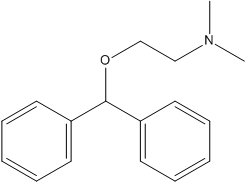
DPH (Diphenhydramine) is a legal and freely available over the counter first-generation antihistamine possessing anticholinergic and sedative properties. It was one of the first known antihistamines, invented in 1943 by Dr. George Rieveschl and usually sold under the brand name of “benadryl”. This substance is available in many forms of generic or store brand medication which are mainly used to treat allergies or as a general sleep aid. When taken in “recreational” doses however, DPH becomes a notorious and extremely powerful deliriant.
Diphenhydramine is classed as an anticholinergic which is functionally similar to tropane alkaloids found within Datura stramonium and other plants in the nightshade family. This substance works via its antagonistic action on acetylcholine receptors. It’s this inhibition of acetylcholine which leads to delirium, sedation and intensely realistic hallucinations along side of some extremely uncomfortable and dysphoric physical side effects.
DPH and other deliriant hallucinogens are generally considered as both physically and psychologically unsafe by the online psychonautic community. This is further backed up by the consistent way in which almost everybody who tries this substance immediately regrets the experience.
Although we strongly discourage ever trying such a drug, the experience itself can be fascinating in itself and worthy of scientific documentation none the less.
In terms of it’s subjective effects, the DPH has a dosage scale unlike anything found within psychedelics or dissociatives. It is not like other drugs in sense of dosage, as a light dose does not equal a light trip. Doses under 300mg induce more of a restless feeling, body high, and muscle relaxation. Doses typically 600mg+ are what make the user enter delirium and begin to see fully formed hallucinations.
Anything in between these two extremes is often a disappointing and uncomfortable experience, characterized with twitching and only very minor hallucinations, mostly in the peripheral vision.
The DPH experience contains a complex and wide array of effects which based on the predefined potential subjective effects index found here, I will now begin to breakdown and describe…
Physical effects:
The physical effects of DPH are usually described as extremely uncomfortable. They can be broken down into nine components all of which progressively intensify proportional to dosage. These are described below and generally include:
- Increased bodily weight - The first noticeable sensation is that of having an extremely heavy body, as if the gravity has been multiplied by a thousand. This makes it extremely difficult and uncomfortable to move.
- Spontaneous tactile sensations - Users commonly report all-encompassing, sharp and extremely painful jolts of electricity that spontaneously manifest themselves in a similar rhythm to hiccups.
- Muscle cramps
- Nausea
- Dizziness
- Restless leg syndrome
- Abnormal heart beat
- Frequent urination
- Difficulty urinating - This can be described as a feeling of concrete blocking your urethra and painfully conflicts with a frequent need to urinate.
The physical effects of DPH and other deliriants are thought to occur when the concentration of acetylcholine in the vagus nerve decreases due to acetylcholine inhibition, leading to the commonly experienced physical dysphoria.
The levels of dysphoria experienced, however, vary between people with a very small percentage of users reporting that they do not seem to experience them at all.
Cognitive effects:
The head space of DPH is described by many as generally negative and dysphoric throughout the trip, generally consisting of extreme paranoia and feelings of impending doom. It is largely confusing and disorienting often leading to a complete inability to communicate or understand normal language. It contains unique cognitive effects found almost exclusively in the deliriant class.
The most prominent of these effects include:
- Depression
- Anxiety
- Thought deceleration
- Suppression of emotion
- Suppression of information processing
- Amnesia
- Suppression of language
- Time distortion
- Paranoia
Visual effects:
Suppression
DPH does not enhance visual stimuli in the way that psychedelics do, instead it tends to decrease visual aptitude both increasing hallucination and degrading vision.
- Decreased visual acuity
- Suppression of pattern recognition
- Blurred vision
Distortions
As for visual distortions and alterations, effects experienced are detailed below:
- Visual drifting (Melting, Breathing, Morphing and Flowing) - In comparison to other hallucinogens, this effect can be described as intricate in complexity, jittery, slow and rigid in motion, static in their permanence, realistic in believability, and interactive in plasticity.
- Visual haze
- After images
Hallucinatory states
DPH and other deliriants are unique in that they offer solid hallucinations which display themselves seamlessly into waking consciousness, similar to fully formed dreams or delusions. In contrast, classical psychedelics and dissociatives have progressive levels of multiple all encompassing sensory effects, before reaching the level of concrete hallucination.
These can literally encompass anything but common manifestations include,
- Black phosphenes
- Spiders and various insects
- Shadow people
- "Hatman"
- Animals and pets
- Human beings, usually behaving completely normally
- Phantom cigarettes, spliffs and bowls
- Phantom water and drinks
- Floating inanimate objects that appear out of nowhere, only to disappear after your hand goes directly through the object while trying to grab hold of it.
- Every day conversations with friends, family members and fictional people that aren’t really there.
The hallucinatory states in DPH and other deliriants are more delirious and uncontrollable than that of any other commonly used hallucinogen. These states alternate between waking external hallucination and internal hallucinatory states.
The effects of such hallucinatory states include two separate components:
- External hallucinations
- Internal hallucinations
Auditory effects:
The auditory effects of DPH are common in their occurrence and exhibit a range of effects which commonly includes:
- Suppression
- Hallucinations
Physical health effects, potential addiction and tolerance:
If taken on any kind of a regular basis, DPH can have some serious but unstudied adverse effects on ones kidneys and result in bladder issues similar to that of ketamine cystitis.
It is assumed non-addictive by most due to the nature of the experience but many people do find themselves coming back to it on a regular basis. This can often lead to addiction and extreme caution should be taken.
Diphenhydramine can become fatal if amounts close to or exceeding 2 grams are consumed and can result in death when combined with most stimulants and MAOI inhibitors. It is worth noting however that a dosage of 1 gram is considered extreme in its strength and could potentially result in a fatal overdose if a person happened to be particularly sensitive to this substance.
In terms of its tolerance, this forms very quickly with DPH trips, meaning that a trip can only occur at full effects every 2-4 weeks.
Available forms:
DPH is available in several different forms over the counter and online.
- Capsules - available over the counter and online. Well-known brands include Benadryl, Benylin, Nytol and Sominex. Many of these products contain other medicines, including dextromethorphan, guaifenesin, and ephedrine. Care should be taken when using these products to ensure that there is no overdose on other medicines in the DPH-containing product.
- Liquid - available over the counter and online. DPH in liquid form can be taken orally or injected. Well-known brands include Benadryl, Benylin, Nytol and Sominex. Many of these products contain other medicines, including dextromethorphan, guaifenesin, and ephedrine. Care should be taken when using these products to ensure that there is no overdose on other medicines in the DPH-containing product.
- Powder - available online. DPH in powdered form can be taken orally, via injection or insufflation.
Legal issues:
DPH is available either over the counter or by prescription in most countries. Some countries however require the purchaser to be over 16, 18 or 21.
- Zambia: Possession and sale is illegal.
Reader submitted trip reports:
Conclusion:
The subjective effects breakdown contained within this article was written by the PsychonautWiki admin known as Cocoanatta.
Nobody is going to stop you from trying this but if you’re completely set on it, at least wait until you have had a large amount of experience being out of your mind on psychedelic and dissociative substances first.
The fact that this substance is completely legal and available to the masses, despite being far more dangerous than comparatively benign psychedelics such as LSD shows that our governments are not concerned with the dangers of drug induced hallucination in itself. They are instead concerned with the secondary effects, namely the drug induced changes of perspective which psychedelics offer but deliriants do not.
Click here for a more comprehensive breakdown.
Datura, broken down and described
Onset : 60 - 120 minutes
Duration : 8 - 18 hours
Normal After Effects : up to 3 days
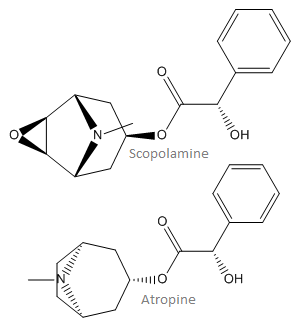
Datura is a genus of legal flowering plants that contains two psychoactive chemicals in roughly equal amounts. These are known as Scopolamine and Atropine, two molecules that are both in the tropane alkaloid class, with anticholinergic effects. The plants precise and natural distribution seems to be throughout most of the temperate and tropical regions of the globe, owing to its extensive cultivation and naturalization. There are a total of nine different species in the Datura genus, but the two most well-known species are Datura inoxia and Datura strammonium. Both of which have been used in a shamanic context for religious purposes on most continents since before recorded history began, with records of its use being found throughout the ancient americas, europe and india.
In terms of it’s subjective effects the Datura trip is extremely similar to that of DPH with a significantly longer duration but less dysphoria. The mental transition from reality to delirium is an extremely smooth one, a stuporous, hazy, mildly dissociating, light and floaty high is felt, and everything seems almost normal apart from waves of mild to intense paranoia. Feelings of being unable to communicate or understand normal language also become apparent with higher doses.
Although Datura is not nearly as dysphoric as DPH it is still capable of feeling overwhelmingly unpleasant. With extreme dry mouth, hot / cold flushes and the inability to urinate despite desperately needing to all commonly reported throughout the trip. Blurred vision occasionally occurs, blinding the tripper and rarely but occasionally lasting for days to weeks after wards.
After a while, delirium takes over, causing you get used to the feeling and not notice it any more, or perhaps it genuinely fades. Leaving the trippers to experience concrete and 100% convincing visual and auditory hallucinations that can vary from mundane, to fascinating to horrifying.
You can use Datura in many ways, one of the most common ways is to smoke the leaves and flowers, which offers a very mild trip with a duration similar to that of weed. You can also make a tea out of the leaves, flowers, and seeds, or you can eat the seeds with or without cooking them. Eating raw seeds is not recommended because of the high toxicity of them. The most potent parts in decreasing order are respectively the seed pods, leafs and flowers. Seeds are eaten while leaves are usually brewed as tea, though they are also chewed for their effects.
It is extremely important to note however that the potency of plants varies wildly and there is no way for the common man to accurately measure the dosage. At high enough doses Datura becomes an incredibly toxic poison that can easily result in death, making Datura the most dangerous hallucinogen out there with accidental overdoses resulting in hospitalization not unheard of. The safest way to ensure this does not happen is to grind the dried plant matter into an extremely fine and even powder so that the active chemicals within them are distributed evenly across itself. From here you can slowly work your way up in extremely small increments until the correct dosage for that particular plant is found.
If you want to try Datura despite all of its risks, you can grow it yourself using seeds purchased online or find a wild plant in your local area.
There is little to no insight to be gained from these substances and they can be extremely dangerous both physically and mentally if dosage is not payed close attention to. I would not recommend either of these drugs to any human being alive but view them more as drugs of interest than anything. Something that a person tries even if only once, just to see what they are like. Nobody is going to stop you from trying these substances, even our nations governments have deemed these substances as legally acceptable, whilst still prohibiting the use and sale of physically benign and mentally beneficial hallucinogens such as LSD or mushrooms. Keep in mind however, that you and you alone are responsible for your actions and that almost everybody who tries these drugs regrets it immediately.
The subjective components of a Delirious trip
Deliriants are a class of hallucinogen that are unique in that even with lower doses, they offer solid hallucinations which display themselves seamlessly into waking consciousness, similar to fully formed dreams or delusions. In contrast, classical psychedelics and dissociatives have progressive levels of multiple all encompassing sensory effects, before reaching the level of concrete hallucination.
The term deliriant was introduced by David F. Duncan and Robert S. Gold to distinguish these drugs from psychedelics and dissociatives, such as LSD and ketamine respectively, due to their primary effect of causing delirium, as opposed to the more lucid states produced by other types of hallucinogen. The term is generally used to refer to anticholinergic drugs.
Despite the fully legal status of several common deliriant plants, substances which fall under this class are largely unpopular as recreational drugs due to the severe and unpleasant nature of the hallucinations produced. In addition to their potentially dangerous mental effects (accidents during deliriant experiences are common). Certain deliriants are poisonous and can cause death due to tachycardia-induced heart failure and hyperthermia even in small doses.
Deliriants work via their antagonistic action on acetylcholine receptors. Inhibition of acetylcholine leads to decreased levels of acetylcholine, causing delirium, sedation and intensely realistic hallucinations. In contrast, cannabis and caffeine have a reverse effect by inhibiting acetylcholine esterate, which breaks down acetylcholine. This leads to increased levels of acetylcholine and improved cognition, stimulation, thus cannabis has an inhibitory effect on deliriants.
The employment of deliriants for shamanic purposes through the famed Datura plant have been in use since before recorded history. Chinese, Aztec, Indian, Native American, Caribbean Island, Chumash, Gypsy, Mexican, South American and Zuni records and legends all mention the use of datura leaves for sacred rituals and visionary purposes.
This guide is in reference to the small number of existing classical deliriants including but not limited to,
Datura, DPH, DMH, atropine, hyoscyamine, scopolamine
This guide will categorize the universal effects that occur between each of the classical dissociatives and break them down into their base components.
Decreased visual acuity:
Decreased visual acuity can be described as the experience of one’s sense of vision becoming partially to completely blurred and indistinct. Depending on the intensity, this can often result in a loss of the ability to function and perform basic tasks which necessitate the use of sight.
Double vision:
Double vision can be the described as the experience of doubled vision identical to that which occurs when one crosses their eyes. Depending on the intensity, this can often result in a loss of the ability to function and perform basic tasks which necessitate the use of sight but can be solved by simply closing one eye. This suggests that the double vision is occurring because the brain is simply overlaying the images received from both eyes on top each other without rendering the information into a singular 3-Dimensional image as it normally does in day to day life.
Suppression of pattern recognition:
Suppression of pattern recognition can be defined as the experience of a partial to all-encompassing inability to process currently perceivable visual information regardless of the clarity, detail and acuteness of its visual acuity. For example, although one may be able to see what is in front of them perfectly clearly they will not be able to register or label what is in front of them rendering even the most common of everyday objects become partially completely unrecognisable.
Vibrating vision:
Vibrating vision (also known as nystagmus) can be defined as rapid and constant involuntary eye movements in which the eyes shift from left to right in such quick succession that one’s vision begins to vibrate and blur. This can severely impair vision and result in a loss of the ability to function and perform basic tasks which necessitate the use of sight.
Visual drifting:
Visual drifting is by far the most common open-eye distortion. It can be described as the experience of objects and scenery appearing to become progressively warped and morphed across the visual field. These alterations gradually increase as a person stares, but are completely non-permanent, meaning that they reset to normal levels once a person double takes on the distortion.
This effect is capable of manifesting itself across 4 different levels of visual intensity which can be described as:
- Peripheral - The most basic form of distortion can be described as a ‘wiggling’ of straight lines within the external environment, which occurs exclusively within the peripheral vision and cannot be looked at directly.
- Direct - At this level, the distortions do not necessarily increase in visual intensity but can now be directly looked at within a person’s central line of sight. This partially alters the appearance and form of shapes, objects and sceneries within the external environment, causing them to subtly drift, bend and morph.
- Distinct - This is the level at which distortions become visually powerful enough to drastically alter and transform the shape of specific objects within the external environment, often to the point where they can become unrecognisable in comparison to their original form.
- All-encompassing - At the highest level of visual drifting, the intensity becomes powerful enough to distort not just specific objects beyond recognition, but every single point of a person’s vision and the entirety of the external environment in its whole.
The particular style of this visual effect depends on the specific continuously changing direction, speed and rhythm of the distortion, resulting in a small variety of different manifestations.
Morphing - This effect is completely disorganized and spontaneous in both its rhythm and its direction. It can be described as objects or scenery appearing to gradually change in their size, shape, configuration and general appearance in a limitless number of ways.
Breathing - This effect makes objects or scenery appear to be steadily contracting inwards and expanding outwards in a consistent rhythm, as if the object or scenery was breathing in and out in a similar fashion to the lungs of a living organism.
Melting - It is not unusual for objects and sceneries to be completely or partially melting. They begin at lower doses as a gradual liquidization of objects which causes them to begin to droop, wobble, and slowly lose their structural integrity. This gradually increases until they become impossible to ignore with the lines, textures, and colour between solid objects appearing to melt into one another in an extremely liquid fashion.
Flowing - Flowing, shifting, rippling, or moving surfaces are a strong visual effect that seems to occur almost exclusively on textures (particularly if they are highly detailed, complex, or rough textures). A classic example of this would be wood grain or carpets flowing like a river in a seamless, looped animation. A consistent way to reproduce this visual is to stare at wood grain and lose focus.
Visual haze:
Visual haze can be described as an effect which distorts the surrounding environment to make it appear as if the air is shrouded in an imaginary cloud of smoke, fog or haze. This effect varies in its intensity, ranging from subtle and barely visible to all-encompassing to the point of significantly impairing one’s vision.
External hallucinations:
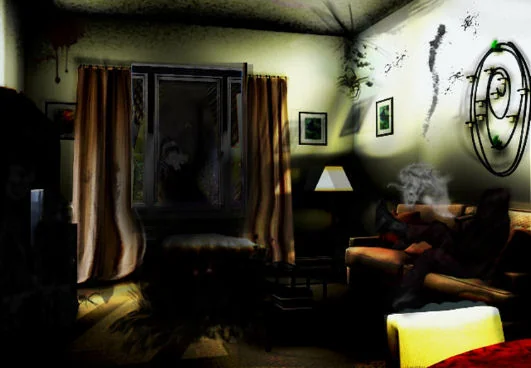
External hallucinations experienced during a delirious trip occur as solid hallucinations which display themselves seamlessly into the external environment as if they were actually happening. this component is extremely prominent and dominates the trip. They are delirious in believability and therefore have a sense of psychological plot acceptance attributed to them which does not occur with psychedelics and dissociatives. This means that no matter how absurd or unlikely the content of the hallucination may be, it will be believed as a real event which is genuinely occurring in exactly the same way which we accept the absurd plots of our dreams. This can be dangerous and could potentially result in people hurting themselves or others.
Delirious hallucinatory states can be broken down into 3 basic levels:
- Erratic hallucinations - The second lowest level of hallucination generally consists of visual snow and static, movement in the peripheral vision, and/or ill defined, fleeting hallucinations which disappear once a person double takes. These often consist of black splotches and pronounced floaters.
- Partially defined hallucinations - At this level the hallucinations are visible within one’s direct line of sight despite the fact that they are not fully defined in their appearance. This means that although visible, they do not look completely detailed and are often blurry or semi-translucent.
- Defined hallucinations - As the vividness and intensity increases, the trip eventually becomes comprised of completely realistic and static hallucinations. These are generally considered by those who have experienced them to be completely convincing in their appearance.
Although the hallucinations can be anything there are still common archetypes which generally occur under the influence of high dose delirious experiences. These hallucinations are generally (but not by any means limited to):
- Family, friends, strangers, and fictional characters usually behaving completely normally
- Inanimate objects, sometimes in believable locations but often floating in the air
- Animals and pets
- Spiders and various insects
- Shadow people
- Smoking phantom cigarettes, spliffs and bowls
- Drinking imaginary cups of water
- Literally anything your imagination can come up with
The more unfamiliar you are with your environment during states of delirium, the more you will hallucinate. Cluttered areas tend to produce hallucinations best. As far as lighting goes, either a dark or dim room is optimum. Darkness produces much more hallucinations and will result in more of a sinister feel, but the light present in a dim room will make you see less (though more detailed) hallucinations.
Internal hallucinations:
Internal hallucinations begin at moderate doses as imagery on the back of one’s eyelids. These can be described as spontaneous moving or still scenes, objects, people, animals, concepts, places or anything you could possibly imagine. They are delirious in believability and displayed in varying levels of detail ranging from cartoon-like in nature to completely realistic although rarely holding form for more than a few seconds before fading or shifting into another image. These sets of imagery commonly include:
everyday objects, living things, plants, animals, insects, architecture, structures, shapes, atoms, molecules, complex mathematical formulae/concepts, linguistic concepts, mechanisms, technology, machine creatures, self-replicating machines, people, faces, eyes, body parts, organs, food, cultural references, fictional characters, logos, religious symbolism, creatures, monsters, demons, mythology, furniture, the room around you and more.
Short breakthroughs into delirium start to happen with increasing frequency and length as dosage is increased. It begins with random flashes of everyday events, such as getting dressed to go to work only to suddenly realize half way through that none of it ever happened and you’re actually sitting at your desk. This eventually increases to permanent, ever shifting alternate realities and a complete disconnection from the real world. The things which occur within this perceived alternate reality can be anything, but generally fall under common archetypes such as contact with autonomous entities, imagined landscapes, nonsensical situations and memory replays.
Overall, the degrees of intensity can be broken down into five simple levels:
- Enhancement of mental visualization - The lowest level of hallucination can be described as a powerful enhancement of a person’s ability to mentally visualize concepts. This internal visualization feels like one extremely vivid daydream after another and follows a person’s thought stream in a way that can be seen at a moderate level of detail within the mind’s eye.
- Partially defined hallucinations - This level of hallucination generally consists of faded imagery on the back of one’s eyelids.
- Fully defined hallucinations - As the vividness and intensity increases, the imagery eventually becomes fully defined in its appearance and displays itself within the tripper’s direct line of sight.
- Partially defined breakthroughs - These begin with random flashes of spontaneous scenarios. These are capable of becoming fully grounded and long-lasting, but are not completely defined in their appearance. They often display themselves as partially to completely blurred and transparent, with the tripper’s physical body still feeling at least partially connected to the real world.
- Fully defined breakthroughs - Once the hallucinations become sufficiently elaborate, they eventually become all-encompassing, permanent, and ever-shifting alternate realities that are completely realistic, extremely detailed, and highly vivid in appearance. These hallucinations occur with the sensation of complete disconnection from the physical body.
Higher states of internal hallucinations can be broken down into three distinct subcomponents described below.
Autonomous Entities
Contact with autonomous entities is very common. These entities generally appear to be the inhabitants of a perceived independent reality. They are expectant of your appearance and often interact with you in various ways. The behaviour of a typical deliriant entity is one of an indifferent and uncaring personality which will engage the tripper in conversation. Entities can literally take any form but common subconscious Jungian archetypes are definitely present and include:
bodiless super intelligent humanoids, aliens, elves, giant spheres, insectoids, cat beings, beings of light, plants, robotic machines, gods, goddesses, demons, human beings and more.
Regardless of presentation, there are distinctly different types of entities which one may encounter, each of which representing a particular subsection of one’s own consciousness through both their visible form and their personality. These can be broken down into 3 separate categories and include:
- Representations of the self - The simplest form of entity can be described as simply a mirror of one’s own personality. It can take any visible form but clearly adopts an obviously identical vocabulary and set of mannerisms to one’s own personality when conversed with.
- Representations of the subconscious - This category of entity can take any visible form but adopts the personality of what seems to be a conscious controller behind the continuous generation of the details behind one’s own mind-scape and internally stored model of reality. When conversed with, it usually adopts an attitude which wants to teach or guide the tripper and assumes that it knows what is best for them.
- Representations of specific concepts - This category of entity is by far the most varied type in terms of its visual form and immediately perceivable personality. It can be identified as a simulated representation of any internally stored concept and adopts an appropriate personality to fit this to an amazing degree of accurate detail. For example, this specific concept could include people you have met throughout your life, fictional characters, and/or symbolic representations of abstract concepts such as emotions or key parts of one’s own personality.
When communicated with through spoken word, the level of coherency in which these entities can reply with is highly variable but can be broken down into 4 distinct levels of communication.
- Silence - This level can be defined as a complete unresponsiveness from the side of the entity and an incapability of speech despite their obvious presence within the hallucination.
- Partially defined incoherent speech - This level can be defined as audible linguistic conversational responses and noises which sound like words but do not contain any real content or meaning beyond a vague sense of emotional intent.
- Fully defined incoherent speech - This level can be defined as audible linguistic conversational responses and noises which contain fully defined and understandable words but often lack grammatical structure or general coherency.
- Fully defined coherent speech - This level can be defined as audible linguistic conversational responses and noises which contain fully defined and understandable words as well as fully defined grammatical structure and general coherency which conveys its point on a level which is on par with the tripper’s own intellect.
Landscapes, sceneries and settings
At level 4 - 5, hallucinations consistently manifest themselves through the essential component of extremely detailed imagined landscapes, locations and sceneries of an infinite variety. These exist for the purpose of acting as the setting in which the plot of the hallucination occurs. The geography of these settings is capable of rendering itself as static and coherent in organization but will usually result in a non-linear, nonsensical and continuously ever-changing layout which does not obey the rules of everyday physics. In terms of the chosen locations, appearance and style of these settings, they seem to be selected at random and are often entirely new and previously unseen locations. They do however play a heavy emphasis on replicating and combining real life locations stored within the dreamer’s memories, especially those which are prominent within one’s life and daily routine. Aside from this they commonly include:
planetary systems, galaxies, quasars, jungles, rain forests, deserts, ice-scapes, cities, natural environments, caves, space habitats, vast structures, civilizations, technological utopias, ruins, machinescapes, rooms and other indoor environments, neurons, DNA, atoms, molecules, mitochondria and more.
At other points they act as something which is flown over but are also often experienced through the act of autonomous entities, directly manipulating what you can see and view and intentionally propelling trippers in different directions at disorienting speeds. These entities force one to view or pass directly through macroscopic and microscopic scale settings, including both previously experienced landscapes and previously unexperienced landscapes.
Scenarios and plots
Each of the above components are randomly shuffled and spliced into any number of an infinite variety of potential plots and scenarios. These may be positive or negative to experience and are difficult to define in a comprehensive manner in much the same way that we cannot predict the plot of abstract literature and films. They can however be broken down into extremely basic occurrences which generally entail visiting some sort of setting or a number of them which contain within them interactive, multiple, or lone characters. Alongside of these, completely unpredictable plot devices and events force the tripper to become involved within the specific scenario of the particular trip.
These scenarios and plots can be linear and logical with events that occur in a rational sequence which lead onto each other through cause and effect. They are equally likely however to present themselves as completely nonsensical and incoherent. This means that the plot will occur with spontaneous events which are capable of ending, starting and changing between each other repeatedly in quick succession and as they please. The plots themselves can either be entirely new experiences that are unlike anything experienced within the real world, old experiences such as accurate memory replays or a combination of the two.
In terms of the amount of time in which they are experienced, hallucinatory plots and scenarios usually feel as if they are being experienced in real-time. This means that when 20 seconds have been felt to have passed within the hallucination, the exact same amount of time will have passed in the real world. At other points, however, distortions of time can make themselves present, resulting in plots and scenarios that can feel as if they literally last days, weeks, months, years, or even infinitely long periods of time.
Anxiety:
Anxiety can be described as negative feelings of psychological tension and general unease. These feelings can range from subtle and ignorable to intense and overwhelming enough to trigger panic attacks and feelings of impending doom.
Anxiety within deliriants is not caused by environmental factors but is an inescapable effect of the drug itself or due to the experience of negative hallucinations.
Depression:
Depression is a state of low mood and aversion to activity that can affect a person’s thoughts, behaviour, feelings and sense of well-being. Depressed people feel sad, anxious, empty, hopeless, worried, helpless, worthless, guilty, irritable, hurt, or restless. People who are experiencing feelings of depression consistently lose interest in activities that once were pleasurable, experience loss of appetite or overeating, have problems concentrating, remembering details, or making decisions, and may contemplate, attempt, or commit suicide.
Depression is not caused by negative realizations regarding the details of ones own life but an inescapable effect of the drug itself.
Thought deceleration:
Thought deceleration can be described as the mental process of thought being slowed down significantly. When experiencing this effect, it literally feels as if the time it takes to think a thought and the amount of time which occurs between each thought has been slowed down to the point of greatly impairing cognitive processing. Not only is the speed of thought decreased, but the sharpness of a person’s mental clarity seems to decrease alongside it, resulting in a complete absence of new or insightful ideas.
Suppression of vocabulary:
Suppression of vocabulary is an effect which can be explained as the experience of being partially to completely unable to formulate coherent sentences and process general conversation. This effect varies in its intensity, at lower levels it is manifested as a slight or general difficulty in speaking and understanding the speech of others which can be counteracted by simply putting more thought and effort into the act of conversation. At higher levels however it is manifested as a complete and all encompassing inability to process language, this results in being unable to understand what others are saying and an inability to talk with any level of coherency beyond gibberish and glossolalia.
Thought loops:
Thought loops can be described as the experience of becoming trapped within a chain of thoughts, actions and emotions which repeat themselves over and over again in a cyclic loop. They are most likely to occur during states of ego loss and the failure of one’s short term memory. This suggests that thought loops are the result of cognitive processes becoming unable to sustain themselves for appropriate lengths of time due to a lapse in short term memory, resulting in the thought process attempting to restart from the beginning only to fall short once again in a perpetual cycle.
This component can be extremely disorientating and often triggers states of progressive anxiety within the person experiencing them if they are unfamiliar with the experience. The most effective way to end a cycle of thought loops is to simply sit down and try to let go.
Delusions:
Delusions are the experience of spontaneous beliefs held with strong conviction. In the context of hallucinogenic drugs they are temporary perspectives which one may slip into during high dosage experiences. They are most likely to occur during states of ego loss or ego death and not by any means permanent as with schizophrenic delusions but do share many common themes and elements within them. These delusions can be broken out of when appropriate evidence is provided to the contrary or the person has sobered up enough to logically analyse the situation.
Types
Delusions are categorized into four different groups:
- Bizarre delusion: This is a delusion that is very strange and completely implausible. An example of a bizarre delusion would be that aliens have removed the reporting person’s brain.
- Non-bizarre delusion: This is a delusion that, though false, is at least possible such as the affected person mistakenly believing that he is under constant police surveillance.
- Mood-congruent delusion: This is any delusion with content consistent with either a depressive or anxious state. For example, a depressed person may believe that news anchors on television highly disapprove of him or a person in a manic state might believe she is a powerful deity.
- Mood-neutral delusion: This is a delusion that does not relate to the sufferer’s emotional state. For example, a belief that an extra limb is growing out of the back of one’s head is neutral to either depression or mania.
Themes
In addition to these categories, delusions often manifest according to a consistent theme. Although delusions can have any theme, certain themes are more common. Some of the more common delusion themes are:
- Delusion of control: This is a false belief that another person, group of people, or external force controls one’s general thoughts, feelings, impulses, or behavior.
- Delusion of death: This is a false belief that one is about to die, is currently dying, does not exist or has already died.
- Delusion of guilt or sin (or delusion of self-accusation): This is an ungrounded feeling of remorse or guilt of delusional intensity in which one believes that they have committed some sort of unethical act.
- Delusion of mind being read: This is the false belief that other people can know one’s thoughts.
- Delusion of thought insertion: This is the belief that another thinks through the mind of the person. This results in the person becoming unable to distinguish between their own thoughts and those inserted into their minds.
- Delusion of reference: The person falsely believes that insignificant remarks, events, or objects in one’s environment have personal meaning or significance. For example, one may feel that people on television or radio are talking about or talking directly to them.
- Grandiose religious delusion: This is the belief that the affected person is a god or chosen to act as a god. An individual can become convinced he has special powers, talents, or abilities. Sometimes, the individual may actually believe they are a famous person or character such as Jesus Christ. Alternatively this can occur as a philosophical insight through high level states of unity and interconnectedness in which it is not necessarily a delusion but a debatable metaphysical perspective.
Ego suppression, loss and death:
Ego suppression, loss and death is an all-encompassing component. The ego is defined as a human being’s concept or sense of identity, self or “I” as a separate agent from the external environment. It is essentially a person’s consciousness or capacity to be self-aware, as enabled by their ability to recall and maintain a general understanding of their internally stored concept of what is considered to be one’s own self.
With any hallucinogen, one’s ability to retain, recall, feel and understand concepts such as a personal sense of self and other fundamental notions pertaining to the basics of human existence are partially to completely diminished depending on dosage. This is the result of a progressively all-encompassing state of memory suppression. It is a process which is capable of being broken down into 3 basic levels:
- Ego suppression - This is a partial failure of a person’s short term memory. It can be described as a general increase in distractibility, loss of focus and a general sense of difficulty when it comes to processing anything outside of the present moment.
- Ego loss - This is the complete failure of a person’s short term memory. It can be described as a person becoming being completely incapable of remembering any specific details regarding the present situation for more than a second or two. This often results in disorientation, thought loops, loss of control and confusion for the inexperienced. Long term memory however remains almost entirely intact as people are still perfectly capable of recollecting their name, date of birth, childhood school, etc.
- Ego death - This is a complete failure of a person’s long term memory. Ego death can be described as a total loss of control in which the person becomes completely incapable of remembering even the most basic fundamental human concept stored within the long term memory. This includes your name, who you are, your home town, the fact that you are on drugs, what drugs even are, what human beings are, what life is, what existence is or what anything is. Ego death gives the profound experience that there is no longer an “I” experiencing the intensity of the trip anymore, there is just the trip as it is and by itself.
Dysphoria:
One of the first things a person generally notices whilst gradually coming up on a deliriant is how absolutely terrible and miserable they feel.
There is not a single classical deliriant that does not have multiple negative side effects that will leave its users feeling sometimes unbearably uncomfortable. Dysphoric effects do however seem to die down at very high doses, but only because the hallucinations become so overpowering that you forget how ill you are truly feeling.
These feelings are commonly experienced as,
- Extreme Sensitivity to sunlight.
- Loss of coordination.
- Loss of fine and gross motor control
- Dry mouth (sometimes to the point where it becomes impossible to swallow).
- Abnormal heart beat.
- Temporary erectile dysfunction.
- Shrinkage of genitalia (this occurs naturally when the body is under extreme stress)
- Dizziness.
- Drowsiness.
- Muscle cramps.
- Nausea, violent vomiting (at higher doses).
- Very Frequent urination.
- Extreme difficulty urinating.
- Loss of gross and fine motor skills.
- Strange “shock” sensations like high voltage electricity
It’s these sensations that render deliriants completely useless as recreational substances, making them an experience that very few wish to repeat.
Conclusion:
There isn’t any insight to be gained from this category of trip. It’s sad that there is no such thing as an enjoyable deliriant, since they are just as limitless as any psychedelic at high doses but in an inherently unpleasant way.
The fact that every last one of the classical deliriants is completely legal and available to the masses, despite being far more dangerous than comparatively benign psychedelics shows that the government are not concerned with the dangers of drug induced hallucination in itself. They are concerned with the secondary effects, namely the drug induced changes of perspective which psychedelics offer but deliriants do not.
Nobody is going to stop you from trying this but if you’re completely set on it, at least wait until you have had a large amount of experience being out of your mind on psychedelic and dissociative substances first.