
"Transcending this mortal plane through the power of hallucinogen induced nerd rage; Tripping balls in the name of science for the good of the cosmos."
MY SOURCES ARE:
Personal experience and the internet alongside of my own speculation, analyses and conclusions. For all you know I could be lying, so please do some independent research and do not say that I didn't warn you.
PLEASE DISREGARD:
Absolutely everything I say; all pieces of writing and information found within this blog should be considered lies and a work of fiction. Do not ever use anything I've ever said here for anything, ever.
I have, after all, made it very clear that my writings are to be disregarded, as in reality I may well have no idea what I am talking about and do not have any formal qualifications on the subject.
Please point out as many flaws in my reasoning, claims, factual information and grammar as possible.
I love all of you. Thank you for reading.



2C-T-7, broken down and described
Dosage (oral)
Threshold : 3 - 5 mg
Light : 10 - 20 mg
Common : 15 - 30 mg
Strong : 10 - 50 mg
Heavy : 25 - 60mg
Total duration : 5 - 10 hrs
Onset : 60 - 90 mins
Come up : 15 - 30 minutes
Peak : 3 - 7 hours
Come down : 1 - 2 hours
After effects : 2 - 4 hours
Threshold : 1 - 3 mg
Light : 2 - 10 mg
Common : 5 - 15 mg
Strong : 5 - 20 mg
Heavy : 7 - 25 + mg
Duration (insufflated)
Total duration : 3 - 7 hours
Onset : 5 - 15 mins
Come up : 20 - 60 mins
Peak : 2 - 4 hours
Come down : 1 - 2 hours
After effects : 1 - 2 + hours
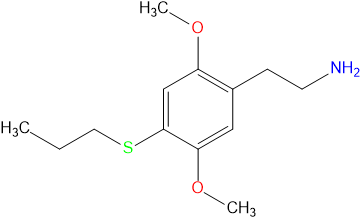
In terms of its chemistry, 2C-T-7 is a substituted phenethylamine with methoxy groups attached to carbons R2 and R5as well as a sulfide chain attached to carbon R4.
In terms of its pharmacology, 2C-T-7 has efficacy at the 5-HT2A receptor as a partial agonist. This is a mechanism of action shared by all of the hallucinogenic tryptamines and phenethylamines. Along side of this, as the 2,5-desmethoxy derivative of 2C-T-7 has been shown to be a moderate monoamine oxidase A inhibitor, this substance may likewise have MAOI effects.
2C-T-7 is a highly dose sensitive psychedelic known for its strong visuals and intense body load. Many reports also indicate that the effects of this chemical may be overly intense for those who are not already experienced with psychedelics. The experience contains a complex and wide array of effects which based on the predefined potential subjective effects index found here, I will now begin to breakdown and describe.
Physical effects:
The physical effects of 2C-T-7 can be broken down into six components all of which progressively intensify proportional to dosage. These are described below and generally include:
- Spontaneous tactile sensations - The body high of 2C-T-7 is intense but, in comparison to 2C-E or 2C-B, it can be considered mild though is still capable of becoming very powerful and highly physically euphoric. It is similar yet distinct from the body high experienced on 2C-E, 2C-B, and LSD. The sensation itself can be described as intense and will manifest itself in the form of a continuously shifting tingling sensation that travels up and down the body in spontaneous waves.
- Stimulation - In terms of its effects on the physical energy levels of the tripper 2C-T-7 is usually considered to be very energetic and stimulating in a fashion that is quite comparable to that of other phenethylamines such as 2C-B, 2C-E and 2C-P.
- Increased bodily control - Although this component is capable of manifesting itself in a distinct and noticeable fashion for most users it does not generally seem to be as apparent or intense as the same component found within LSD and 2C-B.
- Enhancement of touch
- Nausea - Mild to extreme nausea is commonly reported when consumed in moderate to high dosages and either passes once the tripper has vomited or gradually fades by itself as the peak sets in.
- Loss of temperature regulation
Cognitive effects:
The head space of 2C-T-7 is described by many as one which is both insightful and relatively normal in its thought processes even at moderate to high dosages.
The total sum of these cognitive components regardless of the setting generally includes:
- Enhancement of current mind state
- Acceleration of thought
- Feelings of fascination, importance and awe
- Time distortion
- Introspection
- Outrospection
- Removal of cultural filter
- Conceptual thinking
- Ego suppression, loss and death
- Thought loops
- Feelings of interdependent opposites
- Delusions
- States of unity and interconnectedness
Visual effects:
Enhancements
2C-T-7 presents a full and complete array of possible visual enhancements which generally includes:
- Increased visual acuity
- Enhancement of colour
- Enhanced pattern recognition
Distortions
2C-T-7 presents a full and complete array of possible visual distortions which generally includes:
- Drifting (Melting, Flowing, Breathing and morphing) - In comparison to other psychedelics, this effect can be described as highly detailed, slow and smooth in motion, static in their appearance and extremely realistic in style but with a subtle digital/cartoonish form.
- Tracers
- After images
- Texture repetition
- Colour shifting
- Scenery slicing
Geometry
The visual geometry that is present throughout this trip can be described as more similar in appearance to that of 4-AcO-DMT or Ayahuasca than that of LSD, 2C-B or 2C-I. They can be comprehensively described as structured in their organization, organic in geometric style, intricate in complexity, large in size, fast and smooth in motion, colourful in scheme, glossy in colour, sharp in their edges and equally rounded and angular in their corners. They give off a contradictory natural and synthetic feel with slightly more mystical and shamanic undertones to them in comparison to other phenethylamines. At higher dosages they are equally likely to result in states of Level 7A visual geometry and Level 7B. There seems to be visual geometry that is extremely similar to 2C-E and 2C-P and can be described as equal in intensity or complexity and equal in proportion to the accompanying cognitive and physical effects.
Hallucinatory states
2C-T-7 produces a full range of high level hallucinatory states in a fashion that is more consistent and reproducible than that of many other commonly used psychedelics. This holds particularly true in comparison to other substances within the phenethylamine family. These effects include:
- External hallucinations
- Internal hallucinations - In comparison to other psychedelics such as LSD, 2C-T-7 is very high in hallucinations embedded within visual geometry. This particular effect commonly contains hallucinations with scenarios, settings, concepts and autonomous entity contact. They are more common within dark environments and can be described as internal in their manifestation, lucid in believability, interactive in style and almost exclusively of religious, spiritual, mystical or a transcendental nature in their overall theme.
Auditory effects
The auditory effects of 2C-T-7 are more common in their occurrence than many more commonly used psychedelics and exhibit a full range of effects which commonly includes:
- Enhancements
- Distortions
- Hallucinations
Health effects, addiction potential and tolerance:
The toxicity and long term health effects of recreational 2C-T-7 use does not seem to have been studied in any scientific context and the exact toxic dosage is unknown. This is because 2C-T-7 is a research chemical with very little history of human usage. Anecdotal evidence from people who have tried 2C-T-7 within the psychedelic community suggests that there are no negative health effects attributed to simply trying this drug at low to moderate doses or using it very sparingly (but nothing can be completely guaranteed).
2C-T-7 does not seem to be physically addictive and many users experience a self regulating quality. There seems to be a tolerance build up when used consecutively multiple days in a row which requires one to double their dosage each time to achieve the same effects.
There is no current data for the LD50 of 2C-T-7, but it is thought to be high. Erowid does however have some annecdotal information on fatal dosages occurring at 35mg+ of insufflated dosages.
If 2C-T-7 does have MAOI effects, this could indicate that 2C-T-7 is more likely to induce serotonin syndrome, especially at high dosages, than other serotonergic hallucinogens. This may make it dangerous to combine with certain substances such as MDMA, AMT, Ayahuasca or any substance which releases neurotransmitters such as serotonin or those with similar pharmocological effects.
Legal issues:
- 2C-T-7 is scheduled in Germany.
- In Australia, 2C-T-2 and 2C-T-7 are covered by the country’s analogue drug laws.
- 2C-T-7 is unscheduled in Canada.
- The Netherlands was the first country in the world to ban 2C-T-7, after being sold in smartshops for a short period. After 2C-T-2 was first banned, 2C-T-7 quickly appeared on the market, but was soon banned as well. 2C-T-7 is a list I drug of the Opium Law.
- Schedule I in Sweden. 2C-T-7 was first classified as “health hazard” under the act Lagen om förbud mot vissa hälsofarliga varor (translated Act on the Prohibition of Certain Goods Dangerous to Health) as of April 1, 1999 under SFS 1999:58 that made it illegal to sell or possess.
- In 1999, Alexander Shulgin was sent a copy of a letter from the British Home Office to several of its administrative associates that in effect placed all compounds listed in PiHKAL into Class A.
- On September 20, 2002, 2C-T-7 was classified as a Schedule I substance in the United States by an emergency ruling by the DEA. On March 18, 2004, the DEA published a Final Rule in the Federal Register permanently placing 2C-T-7 in Schedule I.
Conclusion:
2C-T-7 shows incredible depth on both an insightful and a recreational level with a full spectrum of deep psychedelic effects. It is completely worthy of its position within the magical half dozen and an extremely versatile compound. I would recommend this experience to anybody willing to try it in a safe and sensible manner.
This substance breakdown was written in collaboration with PsychonautWiki admin PJosepherum. For a more detailed breakdown please click the here.