
"Transcending this mortal plane through the power of hallucinogen induced nerd rage; Tripping balls in the name of science, for the good of the cosmos."
MY SOURCES ARE:
Personal experience and the internet alongside of my own speculation, analyses and conclusions. For all you know I could be lying, so please do some independent research and do not say that I didn't warn you.
PLEASE DISREGARD:
Absolutely everything I say; all pieces of writing and information found within this blog should be considered lies and a work of fiction. Do not ever use anything I've ever said here for anything, ever.
I have, after all, made it very clear that my writings are to be disregarded, as in reality I may well have no idea what I am talking about and do not have any formal qualifications on the subject.
Please point out as many flaws in my reasoning, claims, factual information and grammar as possible.
I love all of you. Thank you for reading.



5-MeO-DMT, broken down and described
Dosage (smoked)
Threshold : 1 - 2 mg
Light : 2 - 5 mg
Common : 5 - 10 mg
Strong : 10 - 20 mg
Heavy : 20mg +
Duration (smoked)
Total duration : 30 minutes
Onset : 0 - 1 mins
Peak : 1 - 15 minutes
Come down : 3 - 5 mins
After effects : 15 - 60 mins
Dosage (insufflated)
Threshold : 3 - 5 mg
Light : 5 - 10 mg
Common : 8 - 15 mg
Strong : 10 - 25 mg
Heavy : 25mg+
Duration (insufflated)
Total duration : 2 - 3 hours
Onset : 1 - 10 mins
Peak : 30 - 60 mins
Come down : 30 - 60 mins
After effects : 1 - 3 hrs
5-MeO-DMT (5-methoxy-N,N-dimethyltryptamine) is a powerful psychedelic tryptamine. It is found in a wide variety of plant species, and a single psychoactive toad species. Like its close relatives DMT and bufotenin (5-HO-DMT), it has been used as an entheogen by South American shamans for thousands of years. In modern times, however, it is primarily acquired in its pure form through the use of online research chemical vendors.
When used as a drug in its purified form, 5-MeO-DMT is vaporized, insufflated, or injected and is active at a dose of as little as 2 mg. 5-MeO-DMT is active orally when taken with an MAOI, but according to numerous reports this combination is extremely unpleasant and has a strong body load.
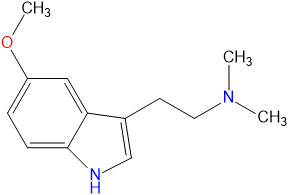
In terms of its chemistry, 5-MeO-DMT is made up of a tryptamine backbone, with a methoxy group substituted onto carbon R5 and two methyl groups substituted onto the nitrogen RN1 and RN2. 5-MeO-DMT is a methoxy derivative of DMT. It is also the O-methyl analogue of bufotenin (5-HO-DMT) and occurs in many organisms alongside of this compound.
In terms of its pharmacology, 5-Meo-DMT’s psychedelic effects are believed to come from its efficacy at the 5-HT2A receptor as a partial agonist. Specifically, this molecule shows high affinity for the 5-HT2 and 5-HT1A subtypes. Additional mechanisms of action such as reuptake inhibition of neurotransmitters such as serotonin, noradrenaline and dopamine are involved also.This can result in 5-MeO-DMT becoming dangerously toxic when combined with MAOIs, RIMAs, SSRIs stimulants or any substance which acts as a releasing agent or reuptake inhibitor of neurotransmitters.
5-MeO-DMT is O-demethylated by polymorphic cytochrome P450 2D6 (CYP2D6) to an active metabolite, bufotenin.
However, the role of these interactions and how they result in the psychedelic experience continues to remain elusive.
The effects listed below are based upon the subjective effects index and personal experiences of PsychonautWiki contributors. The listed effects will rarely if ever occur all at once but heavier dosages will increase the chances and are more likely to induce a full range of effects.
Physical Effects:
The physical effects of 5-MeO-DMT can be broken down into ten components all of which progressively intensify proportional to dosage. In comparison to its often relatively mild accompanying cognitive and visual effects, 5-MeO-DMT seems to have by far the most proportionally intense and overwhelming physical sensations found within the known psychedelic experience. These individual components are complex, overwhelming and equally capable of being interpreted as either extremely pleasurable or uncomfortable.
- Enhancement of tactile sensations - This particular component is perhaps the most overwhelming sensation within the entirety of the 5-MeO-DMT experience. It increases the intensity of tactile sensations to such an overwhelming extent that it induces a sustained and repeatable full body orgasm within every nerve ending across the entire body. The experience of this results in the perception of having a difficulty sustaining the act of breathing. It is worth noting, however, that this is not a genuine or dangerous experience of respiratory depression and is perfectly safe.
- Physical euphoria
- Nausea
- Increased bodily control
- Loss of motor control
- Bodily pressures
- Skin flushing
- Changes in gravity
- Loss of temperature regulation
- Increased bodily weight
Cognitive Effects:
The most prominent of 5-MeO-DMT’s cognitive effects generally include:
- Current mind state enhancement
- Mindfulness
- Conceptual thinking
- Thought connectivity
- Anxiety
- Time distortion
- Direct communication with the subconscious
- States of unity and interconnectedness
- Ego suppression, loss and death
- Delusions
- Amnesia
Visual effects:
The visual effects of 5-MeO-DMT can be broken down into five components all of which progressively intensify proportional to dosage. In comparison to its consistently overwhelming and intense accompanying cognitive and physical effects, 5-MeO-DMT seems to have some of the most proportionally underwhelming visual effects found within the known psychedelic experience.
- Visual acuity enhancement and Visual acuity suppression - 5-MeO-DMT is equally capable of both decreasing and increasing visual acuity. The outcome of which effect will manifest seems to be chosen almost entirely at random and is largely setting dependent.
- Colour enhancement
- Colour shifting
- Drifting (Morphing, Breathing, Melting, Flowing) - In comparison to other psychedelics, this effect can be described as identical to DMT in its style, highly detailed, slow and smooth in motion and static in appearance.
- Geometry - The visual geometry that is present throughout this trip does not usually occur and never extends beyond level 7 at its highest state. It is very similar to DMT although significantly smaller in size and more likely to manifest in darkness or without distractions. In terms of appearance, it can be comprehensively described through its variations as intricate in complexity, abstract in form, equally organic and digital in feel, structured in organization, brightly lit, multicoloured in scheme, glossy in shading, equal in sharp and soft edges, small in size, fast in speed, smooth in motion, equal in rounded and angular corners, immersive in depth and consistent in its intensity.
Auditory effects:
The auditory effects of 5-MeO-DMT are common in their occurrence and exhibit a full range of effects which generally include:
Natural sources:
Colorado River toad: The Colorado River toad (Incilius alvarius), also known as the Sonoran Desert toad, is a psychoactive toad found in northern Mexico and the southwestern United States. Its skin and venom contain 5-MeO-DMT and bufotenin.
The toad’s primary defense system are glands that produce a poison that may be potent enough to kill a grown dog. These parotoid glands also produce the 5-MeO-DMT and bufotenin for which the toad is known. Fresh venom can easily be collected from these glands without harm to the toad. To do this, obtain a flat glass plate or any other smooth, nonporous surface of at least 12-inches square and hold the toad in front of the plate (which is fixed in a vertical position). When the desert toad is stroked near the parotid glands in the neck region, there is a squirting out of this venom. When it is allowed to dry on a hard surface it takes on the texture of rubber cement. It contains up to 15% 5-MeO-DMT, as well as N-methyl-5-methoxytryptamine, 5-MeO-NMT and Bufotenine, which have their own entries. In this manner, the venom can be collected on the glass plate, free of dirt and liquid released when the toad is handled.
Physical Health Effects, Potential Addiction and Tolerance:
The toxicity and long term health effects of recreational 5-MeO-DMT use do not seem to have been studied in any scientific context and the exact toxic dosage is unknown. Anecdotal evidence from people within the psychedelic community who have tried 5-MeO-DMT suggests that although physically intense, this substance is well tolerated and physically benign just like other tryptamines. There are no known negative health effects attributed to trying this substance at low or heavy dosages and it has a long history of usage dating back thousands of years.
Deaths from 5-MeO-DMT are rare but, as a powerful monoamine reuptake inhibitor, injury can occur when excessive doses are taken or when taken with drugs such as MAOIs, RIMAs, stimulants and any substance which act as a releasing agent or reuptake inhibitor of neurotransmitters such as serotonin and dopamine. This has resulted in well documented deaths that are easily avoidable and could have been otherwise prevented.
There is a strong tolerance gained after a single dosage of this compound. This diminishes effects greatly if one tries to redose but returns to base line levels within 24 hours.
Legal issues:
- Denmark: As of December 1, 2004, 5-MeO-DMT was legally restricted to “medical or scientific purposes”.
- Gemany: As of December 1, 2004, 5-MeO-DMT was legally restricted to “medical or scientific purposes”.
- Greece: 5-MeO-DMT became a controlled substance in Greece on February 18, 2003 [EU Legal Database].
- New Zealand: 5-MeO-DMT is Schedule I (Class A) in New Zealand.
- Sweden: Sveriges riksdags health ministry Statens folkhälsoinstitut classified 5-MeO-DMT as “health hazard” under the act Lagen om förbud mot vissa hälsofarliga varor (translated “Act on the Prohibition of Certain Goods Dangerous to Health”) as of Oct 1, 2004, in their regulation SFS 2004:696 listed as 5-metoxi-N,N-dimetyltryptamin (5-MeO-DMT), making it illegal to sell or possess.
- Switzerland: 5-MeO-DMT is Schedule I in Switzerland.
- Romania: 5-MeO-DMT is illegal in Romania since February 2010.
- USA: 5-MeO-DMT was added to Schedule I, effective January 19, 2011. This means it is illegal to manufacture, buy, possess, or distribute (sell, trade or give) without a DEA license.
Conclusion:
In conclusion, 5-MeO-DMT is an A-Typical psychedelic which although interesting, remains very consistent and repetitive in comparison to other tryptamines such as DMT itself. It is worth trying for the sheer physical intensity and euphoria of it but I would not recommend this substance to anybody who is looking to experience genuine psychedelia.
This substance breakdown was written through collaboration between PsychonautWiki contributors Pjosepherum, Josikins and Oscarette. The full article is available here.