 Disregard everything I say.
Every bit of writing here can be considered a work of fiction.
Do not ever use anything I've ever said here for anything ever and if you do you are doing so at your own legal risk as I am not responsible for anything that may or may not happen to you. I did after all tell you to disregard everything I say as in reality I actually have no idea what I'm talking about and shall continue to be a retarded teenager with an Internet connection.
MYSOURCESARE:
Personal Experience, the Internet and nowhere I could just be making things up.
Sensory Filter Theory - speculation on how the Psychedelic experience is generated
This article is technically a repost of a repost but it is a necessary one. This is because my understanding of this topic has recently increased so greatly since I have started deliberately reading up on psychology and neuroscience in general, that it has needed a complete overhaul. As a result of this, the original article will be broken down into two separate articles. For both, I will try my hardest to supply as much solid evidence for as I possibly can, but if you know more about these things than me and want to contribute ideas of your own or debate mine please do so. Any help with this would be great as my knowledge of neuroscience barely extends beyond what Wikipedia has managed to teach me over the past few weeks, making it something that is trivial in comparison to genuine scientists.
For a long time I and others have suspected that during sober living, a large part of what our brain does is filter out the mass of sensory data and self thought into a highly streamlined package. This package is what the subconscious brain has deemed important and relevant to pass along for our conscious faculties. The underlying mechanism behind this must have evolved, because if it did not we would be immediately and constantly overwhelmed by the sheer amount of raw sensory input and our inability to process it all, causing us to be completely incapable of functioning. It’s because of this that we have evolved a brain which is able to filter out irrelevant information, using what I have named the Sensory Filter.
It seems to me that all visual and mental components of the psychedelic experience are generated by this one very specific mental component of the psychedelic experience, the partial or complete removal of the sensory filter.
The effects of this are commonly felt in quite a direct way, even at low level psychedelic experiences, in a way that anybody who has ever tripped should be quite familiar with. These low level effects are the result of the partial removal of somebody’s sensory filter, which seem to be universally felt as:
- Being able to comprehend your entire visual field, including your peripheral vision. For example; the sensation of staring at a tree and comprehending the exact position of all of its branches in your visual field all at once, instead of just the simple few that are in focus.
- Being able to comprehend every layer of complex sounds, and the precise position and direction from which they are coming from in your surroundings. This results in greatly increased music appreciation.
- Being able to feel every nerve ending all over your entire body, whilst simultaneously having increased muscle control and bodily awareness.
The above effects are generated are all generated by a lack of filtering when it comes to external sensory information but this sensory filter does not just block out irrelevant external sensory input from being experienced. It also filters out irrelevant brain activity from the conscious faculties and it’s through this that the higher levels of psychedelic visuals are generated.
This irrelevant brain activity includes many things such as the organization and firing of every neuron, every memory, every stored concept and every last structure of the mind, until something such as a mind altering drug forces it to stop. In simple terms, this means that once the sensory filter is shut down, we suddenly become exposed to the very fabric of our mind. This is due to the brain being chemically changed in a way that causes it to begin to reveal itself to itself.
To describe in depth how this lowering of our sensory filter results in the psychedelic experience, I will first break the visual effects of tripping into three separate categories, and explain in simple terms how I think they work (using my personal experience and research as a basis). After this I will explain the neuroscience behind it all, whilst trying my best to cite studies and articles as evidence. Before I begin, please remember however to keep in mind throughout this article that I am a teenager who has taken a whole bunch of drugs and not a neuroscientist of any sort. This means that although I have tried my best to keep this as scientifically accurate as possible I cannot promise anything and if anybody out there wants to team up and help me write a better thesis I would be all for it.
The first of these three separate visual effects that I am going to explain are Open/Closed eye visuals, which can be described as the sensation of a persons visual field being partially or completely encompassed by intensely fast-moving, kaleidoscopic and indescribably complex geometric patterns, shapes, fractals, structures and colour. These visuals somehow have a deep sense of profoundness and importance attributed to them and feel like perfect visual representations of your current mind state, and the vibes of your current surroundings.
It’s because of this, among other things, that I have been led to believe that Visuals are the experience of your lowered sensory filter allowing you to be exposed to the current neurological structure, organization and activity of the brain. This starts at lower levels of tripping, as geometric patterns that increase in intensity, until they eventually encompass and overwhelm your entire visual field. As the amount of neurological structure that is experienced increases proportionally with dosage, the sensory filter is eventually decreased to 0%, leading to a person being exposed to the organization of their entire mind all at once. This feels like you have suddenly become everything in the universe as the boundaries in your mind are completely broken down, and is described as profound and infinite in size. As this is happening, the vast data stream of neurological structure and geometric shapes that are experienced begin to cause the ego to go through complete sensory overload.
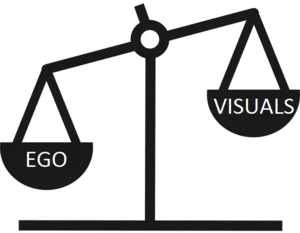 Since this sensory overload increases proportionally with dosage it can be thought of as a set of scales. As Visuals go up, the ego goes down, and vice versa. Because of this, once the sensory filter hits 0% and a person starts to feel one with the universe, the ego becomes completely eradicated. This results in a state in which you are conscious, but your short term memory has been destroyed, creating a state that can be very confusing and often negative to the unprepared and the unstable.
This idea is mostly based on in-depth sceptical discussions with friends and the fac that all of my personal experiences pointing towards the idea that Closed Eye Visuals feel as if they are perfect representations of the mind because they are the literal spilling over of our neuroligcal structure into the visual cortex due to a dampened sensory filter. This does also however have a scientific basis that I will go into later.
The second visual effect that I am going to explain is Distortions. This category of visual effects is a very common one and does not behave anything like Closed Eye Visuals. Instead of geometric shapes, these visuals are most commonly manifested as objects and scenery in your visual field acting as if they are melting, bending, changing colour and various other distorting effects. These increase in intensity when stared at, but immediately reset once you double take.
In my opinion, these are generated by your sensory filter, allowing the conscious facilities to be visually exposed to your immediate short term memory. This creates a recursive loop that continuously builds up. As you experience this, you literally see your short term memory and then immediately your memory of your short term memory and so on continuously. This builds up a visual feedback loop of increasing inaccuracy, which must be based on some sort of recursive visual looping system within the brain. This looping system sends sensory input from the optic nerve into the processing faculties of our subconscious brain and straight back into the optic nerve as a loop. This happens because our dampened sensory filter allows us to be exposed to our sensory processing faculties and working memory causing it to continuously go around and around, allowing the distortions to build up and up, until the loop is broken by new visual input (when a person looks away or double takes).
It’s because of this that distortions increase when stared at, but reset when looked away from. Out of focus eyes allow the loop to continue undisturbed, but new input immediately breaks it. This is just like a visual form of the increasingly loud feedback noise that you get looping through speaker systems when a microphone is placed near them.
I think the fractal effects found within visuals are closely related to this recursive visual looping. Fractals are generated by recursive formulas, such as x=x^2. Therefore, it would make sense that the fractals you see within the visuals are simply the looping effect being played out onto visuals, instead of your external environment. These fractals are created because your brain’s recursive looping is reinterpreting the same stimuli multiple times, causing the geometry to flower out into these fractals that all psychonauts are familiar with.
Finally, the third visual effect that I am going to explain is the experience of Imagery and Hallucinations. These states begin as imagery within the visuals, which can be described as pictures of scenes, objects, people, place or anything you could possibly imagine. On many psychedelics, such as; LSA, Ayahuasca and Syrian Rue, these are manifested as exact visual versions of whatever you are currently thinking about that all come about when you slip into a mildly trance-like state. As these states of imagery become increasingly elaborate (proportional to dosage), they eventually become fully fledged 3D hallucinations. These could be described as induced mystical states, contact with autonomous entities, imagined landscapes and situations that seem so unlike anything previously experienced that they are in all probability untranslatable into English. It’s not uncommon for people to report that these sorts of hallucinations feel infinitely more realistic than anything a person has previously experienced in real life.
For multiple reasons, it seems to me that these hallucinations are caused when high states of sensory filter suppression triggers dreaming in fully conscious trippers. My reasoning for this is three fold; the first is pretty simply that psychedelic hallucinations look and feel exactly like extremely vivid dreams. This is even to the point where it is not uncommon for people to recognize places from dreams they have had during intense Ayahuasca trips. Along the same lines, the feelings of amnesia commonly felt after strong DMT trips are identical to that extremely familiar feeling of not being able to remember a vivid dream immediately after you have woken up.
My second line of evidence to support this is that the imagery seen within closed eye visuals (that eventually leads onto hallucinations) feel exactly like Hypnagogia. Hypnagogia is the state between being awake and falling asleep where many people experience mild hallucinations, imagery and a fluid association of ideas. In fact, hypnagogia is considered to be characterized and based on a mental function, known as “auto-symbolism”, which are a person’s thoughts and ideas being made to manifest in their minds eye. This happens continuously when experienced, and can be either a vague and hazy manifestation, or completely clear and distinct ones depending on the persons dosage. Either way, this is exactly what states of hypnagogia are commonly described to be like. These two in my opinion feel identical, therefore making Imagery simply a psychedelic induced state of hypnagogia. These later lead onto full-on dreams, once they eventually become powerful enough as you finally fall asleep. This makes perfect sense, as Imagery leads onto Hallucinations in exactly the same way as Hypnagogia leads onto dreams.
All of this is happening along side the effect of a conscious person’s exposure to the neurological structure of their mind, and therefore visuals is what must cause the hallucinations and autonomous entities to commonly be made of what appears to be an impossible closed eye visual based material.
In my opinion, this has a genuine neurological basis, as the leading theory in the generation of dreams ties perfectly into the sensory filter. The leading theory can be found described in detail, here and here, but put simply, it is believed that once a person falls asleep, the level of activation in the conscious part of the brain descends to a very low level, as the inputs from the sensory are basically disconnected. This triggers what scientists have called the “continual-activation” mechanism, to generate a data stream from the memory stores to flow through the conscious part of the brain. It’s suggested that this pulse-like brain activation is the inducer of each dream. It’s proposed that, with the involvement of the brain associative thinking system, dreaming is, thereafter, self-maintained with the dreamer’s own thinking until the next pulse of memory insertion. This explains why dreams have both characteristics of continuity (within a dream) and sudden changes (between two dreams).
The supposed “continual activation” mechanism is, in my opinion, a loss of sensory filter. This is caused by the complete loss of ego that occurs to the brain as it falls asleep. This loss of ego happens because the activity in the Medial Prefrontal Cortex is lowered to a near halt during sleep. The function of the Medial Prefrontal Cortex when awake has been implicated to be planning complex cognitive behaviour, personality expression, decision-making and moderating social behaviour. The basic activity of this brain region is considered to be orchestration of thoughts and actions in accordance with internal goals. All of these are the essential components of the ego and it is this cortex that is said to in charge of our Exectutive functions.
Executive functions are a psychological umbrella term for some of the essential components of the ego. These components are:
- planning
- working memory
- attention
- problem solving
- verbal reasoning
- inhibition
- mental flexibility
- multi-tasking
- initiation and monitoring of actions
The medial prefrontal cortex is presumed by scientists to manage these executive functions via a high level gating system or filtering mechanism, that enhances goal-directed activations and inhibits irrelevant activations. This filtering mechanism enables executive control at various levels of processing, including selecting, maintaining, updating, rerouting activations and emotional regulation.
Simply put this is the physical location of the sensory filter and it is completely tied in with our ego in a single cortex at the very front of our brains. It’s this unity of these two systems that causes ego and psychedelic experience to act as a set of scales as when the ego is suppressed, so is the sensory filter and vice versa. This means that as activity in the Medial Prefrontal Cortex goes down so must the level of the psychedelic experience go proportionally up to compensate.
It’s the similarities between this dampening of activity in the medial prefrontal cortex found during both sleep and the psychedelic experience that is what leads me to believe that both dreaming and hallucinations are caused by a suppressed sensory filter. This allows our conscious mind to become exposed to a completely random mixture of concepts and events stored within the long term memory of the brain. This means that states of dreaming, states of meditation and states of psychedelic hallucination are the essentially the same thing, caused by different methods of simultaneously suppressing both a person’s ego and their sensory filter.
This has led me to a conclusion that is now greatly supported in a recent study by British scientists. This was a study that tested patients under the influence of psilocybin during a brain scan, and managed to determine that psychedelics do not increase brain activity, but actually reduce it. They were shown to do this by binding to the serotonin receptors within the Medial Prefrontal Cortex and the Posterior Cingulate Cortex, and greatly reducing their activity. The Posterior Cingulate Cortex is also related to ego and has been shown to serve the function of dealing with internally directed thought, for example, memory recollection with an active role in the control of cognition. This is done through signalling an environmental change and the immediate need to alter behaviour.
Psilocybin cuts activity in both of these nodes, destroys their filtering abilities along with their connection to other brain areas, allowing the senses to run free. It’s this dampening of the ego and our sensory filter that psychedelics have now been shown to cause, which allows information to flow freely across the brain and the senses to run wild.
Psychedelics have now been proven to cause a decrease in brain activity in hub areas that deal with the self and moving information. This results in a) the subconscious mind taking over and b) the sensory filter being lowered.
However, there are still two more component beyond the visual components of a psychedelic experience that still needs to be categorized. These need to be tied in to the sensory filter, so that we can have the full picture when it comes to understanding how they work.
These is much rarer than anything found during the visual side of tripping, but still common enough to be worthy of mention. This is what is known as an Audio Hallucination. Audio Hallucinations are uncommon but happen occasionally and are more likely to occur on substances such as Ayahuasca, DMT, Syrian Rue and any 2C* compound. I have broken these noises down into two distinct categories that both tie into the sensory filter.
The first of these two I have named as “Audio Effects”, and they come in many forms. They are commonly described as hearing noises such as; reverb, tones, and general sound effects, that seem to follow thought patterns and processes.
Examples of this include hearing the very mechanics of your brain on Ayahuasca or DMT, in a way that can either sound like a soft purring or multiple tones and phasers in a completely rhythm-less tune. On DMT this can sound like a rocket launch as you begin to take off or as rhythm-less and unaggressive soft-toned dubstep, but are essentially limitless in their possibilities.
After personal experience, I have come to the conclusion that Audio Effects are essentially the heard equivalent of visuals and work by means of a lowered sensory filter, allowing neurological structure to pour over into a person’s audio cortex as opposed to their visual cortex.
The Second of these two components is a genuine Audio Hallucination. These can be described as hearing voices, music or any sound that is genuinely not there. The most common version of this seems to be hearing music that has been played throughout the day, within the sounds of your surroundings, even after it has stopped. For example listening to ambient music all day and then stopping can often cause a person to hear said ambient music in the sounds of the wind, the cars and any noise that may be around them.
This is, in my opinion, because Audio Hallucinations are not the heard equivalent of Visuals, but are in fact the heard equivalent of Imagery and Hallucinations. This must mean that they are the result of a person’s lowered sensory filter, granting them access to heard concepts within their long term memory, as opposed to ones that are seen. This puts forward another supporting line of evidence towards the idea of long term memory access causing imagery and hallucinations.
The more I have thought about the sensory filter, the more I have come to the conclusion that it is without a doubt the most important component of a psychedelic experience. It seems to me that it is the “base component” that leads to all others. This idea, or ideas similar to it, seem to have been on the tips of everybody’s tongue since the 1954, when Aldous Huxley first wrote about a similar idea in his book the doors of perception which he called the “Mind at Large”.
Many people (including myself) have come to similar conclusions across reddit and various forums over the internet, before the recent Psilocybin study, that provided some concrete evidence to base our musings on.
Although it’s important to note that even though none of these people ever defined their ideas beyond a few sentences and some vague metaphors, this still shows that one of the most important tools that we have when it comes to making sense of and mapping out the psychedelic experience is first hand experience and rational thought.
This may be mostly based on personal experience but I’d like to think that based on my extremely basic understanding of how the human brain works this does seem to be how the visual components of a psychedelic experience are generated and I challenge you to debate me at any point.
To express my ideas on how this works simply I have created the chart below. The concepts on it show what I’m trying to express and each part depends on the component to its left and leads on to the components to its immediate right. You’re going to have to click to enlarge I’m afraid.

Note: there is most likely going to be a second section to this article. I will get working on it immediately.
-
adriftinhilbertspace liked this
-
lightweaves reblogged this from disregardeverythingisay
-
iridescentfae reblogged this from disregardeverythingisay
-
lightweaves liked this
-
survivalofthaillest liked this
-
hidingfromthenormals liked this
-
ricky-jupiter liked this
-
thisisgoodcoffee liked this
-
themodulationofattention reblogged this from disregardeverythingisay and added:
interesting stuff here.
-
lubotdivad liked this
-
famemouse reblogged this from disregardeverythingisay
-
different-trains liked this
-
deleonchristian liked this
-
lsdkat liked this
-
cognitive-treehouse liked this
-
portaltoastateofinnerpeace liked this
-
pizzamtn liked this
-
dustyyyy liked this
-
spiraldowntherabbithole reblogged this from disregardeverythingisay
-
onthecarpet reblogged this from disregardeverythingisay
-
zhaozhou reblogged this from disregardeverythingisay
-
pulsarae liked this
-
jaydevss liked this
-
zayaszombie reblogged this from disregardeverythingisay
-
famemouse liked this
-
grapepaint liked this
-
earandril liked this
-
trendyblackens liked this
-
cloudedperception liked this
-
n9nlinear liked this
-
unicornmcgee liked this
-
bodhiduck liked this
-
stevenmiller reblogged this from disregardeverythingisay
-
committedpsychonaut liked this
-
disregardeverythingisay posted this